How to Compare Online Testosterone Care Before You Pay
Compare the clinical plan and the full recurring bill, not just the advertised price of testosterone.
A sound online service should assess whether testosterone fits your concern, explain any off-label use and what applies where you live, and make the product, monitoring plan, and recurring costs clear before you pay. For example, one service listed compounded cream at $100 for 90 days, while another listed a $155 monthly membership plus estimated $60 monthly medication and a $65 initial test. These are dated provider prices, not equivalent quotes or national averages. 1 2
Start with the reason for treatment
For women, the best-supported use of systemic testosterone is hypoactive sexual desire disorder (HSDD), considered through a biopsychosocial assessment. A clinician should explore possible contributing factors, including health conditions, medications, relationship concerns, and mental health, rather than treating a low lab result or a general concern such as fatigue as proof that testosterone is needed. A blood testosterone level does not diagnose HSDD. 5 6
The evidence is strongest for postmenopausal women with HSDD. A 2026 systematic review reported fewer trials and less certain evidence for premenopausal women, so ask how the clinician’s reasoning accounts for your life stage. 3
Regulatory status and available formulations differ across jurisdictions. ISSWSH guidance discusses off-label use and says compounded products cannot be recommended because efficacy and safety data are lacking. Ask what applies where you live and which type of product the service proposes and why; “custom” or “bioidentical” does not by itself mean better suited or better tested. 6
Compare the bill in like-for-like pieces
An advertised medication price may leave out the clinical care needed to decide whether treatment is appropriate and to follow it safely. Before paying, ask for the cost of the initial evaluation, lab work, follow-up visits and tests, medication, shipping, and any membership or renewal fee. Ask how often each charge recurs, whether insurance may cover any part, and what you would owe if the clinician decides not to prescribe.
Two dated examples show why the total matters. Midi’s page, observed September 25, 2026, listed compounded testosterone cream starting at $100 for a 90-day supply. It described a clinician visit, baseline lab work, and follow-up blood draws, and advised checking lab coverage with the insurer. That starting medication price is not an all-in treatment cost; the page also listed availability only in specified states. 1
Hone’s page, updated September 9 and observed September 25, 2026, listed an estimated $60 per month for compounded cream, separate from a $155 monthly Premium membership, plus a $65 initial at-lab test. At those listed prices, the first month adds up to $280 before any other charges, and later months to $215, assuming the listed membership and medication continue. Follow-up consultations, quarterly testing, and shipping were described as included in membership, though the exact tests may vary and the medication estimate depends on dose and modality. These are examples of one provider’s listed terms, not a personal quote or a comparison of clinically equivalent treatment. 2
When comparing services, put each one on the same time frame, such as the first month and a typical later month. Keep medication, membership, visits, and labs visible as separate line items. A lower medication price may not mean lower total cost if visits and testing are billed separately; a higher subscription may include some of those services. The listed terms can change, so confirm the current written quote before checkout. 1 2
Check who assesses and follows you
Ask who will evaluate you, what professional license they hold, and whether they are authorized to practice where you live. The service’s ability to accept you online or ship a product should not be treated as proof that you are clinically eligible. Availability can vary: for example, Midi’s observed page listed a specific set of states, not nationwide service. Confirm your own state and ask how care continues if you move or the service cannot prescribe there. 1
A thoughtful assessment should be more than a questionnaire followed by a hormone panel. Testosterone testing can provide a baseline for monitoring, but a level alone cannot establish the diagnosis. Clinical guidance calls for a biopsychosocial assessment and shared discussion of off-label use, potential benefits, risks, and alternatives. 6
Before treatment starts, ask what baseline testing the clinician plans and what results could change the decision. Ask when levels and symptoms will be reviewed, who will review them, and how you can reach that person. Guidance recommends monitoring testosterone to keep levels in the premenopausal physiological range and checking for signs of excess androgen effects. One position statement recommends an initial monitoring check within 3-6 weeks; follow-up should be an explicit part of your care plan, not an optional add-on you discover after paying. 4 6
Know what the product and plan actually promise
Get the product name, formulation, route, and prescribed amount in writing, along with the pharmacy that dispenses it. Ask whether it is a compounded preparation or a product approved for another use, and how the clinician will monitor treatment. Avoid treating a high testosterone level as a treatment target: guidance describes using levels to monitor safety, not to diagnose low desire or justify escalating treatment. 6
Ask what improvement the clinician expects, how you and the clinician will judge whether it is meaningful, and what happens if it is not. Benefits should not be promised for broad claims such as energy, mood, or weight based on a prescription alone. The clinical guideline centers treatment on HSDD and notes that long-term safety has not been established. 6
A quick comparison before checkout
You should be able to answer these questions from the service’s written information:
- Assessment: Will a clinician discuss your symptoms, health, medications, and other possible contributors before recommending treatment?
- Credentials and location: Who is prescribing, what is their license, and can they provide care where you live?
- Product: Is it compounded or a product approved for another use? What exact formulation and pharmacy are involved?
- Monitoring: What baseline and follow-up tests, symptom reviews, and clinician visits are included, and when do they happen?
- Full cost: What will the initial evaluation, labs, membership, medication, shipping, and ongoing follow-up cost over time?
- Privacy and continuity: How does the service handle your health information, and who can help if you have a concern or want to stop?
If the service cannot explain the clinical rationale, product, follow-up, or total recurring charges before taking payment, you do not yet have enough information to compare its offer fairly.
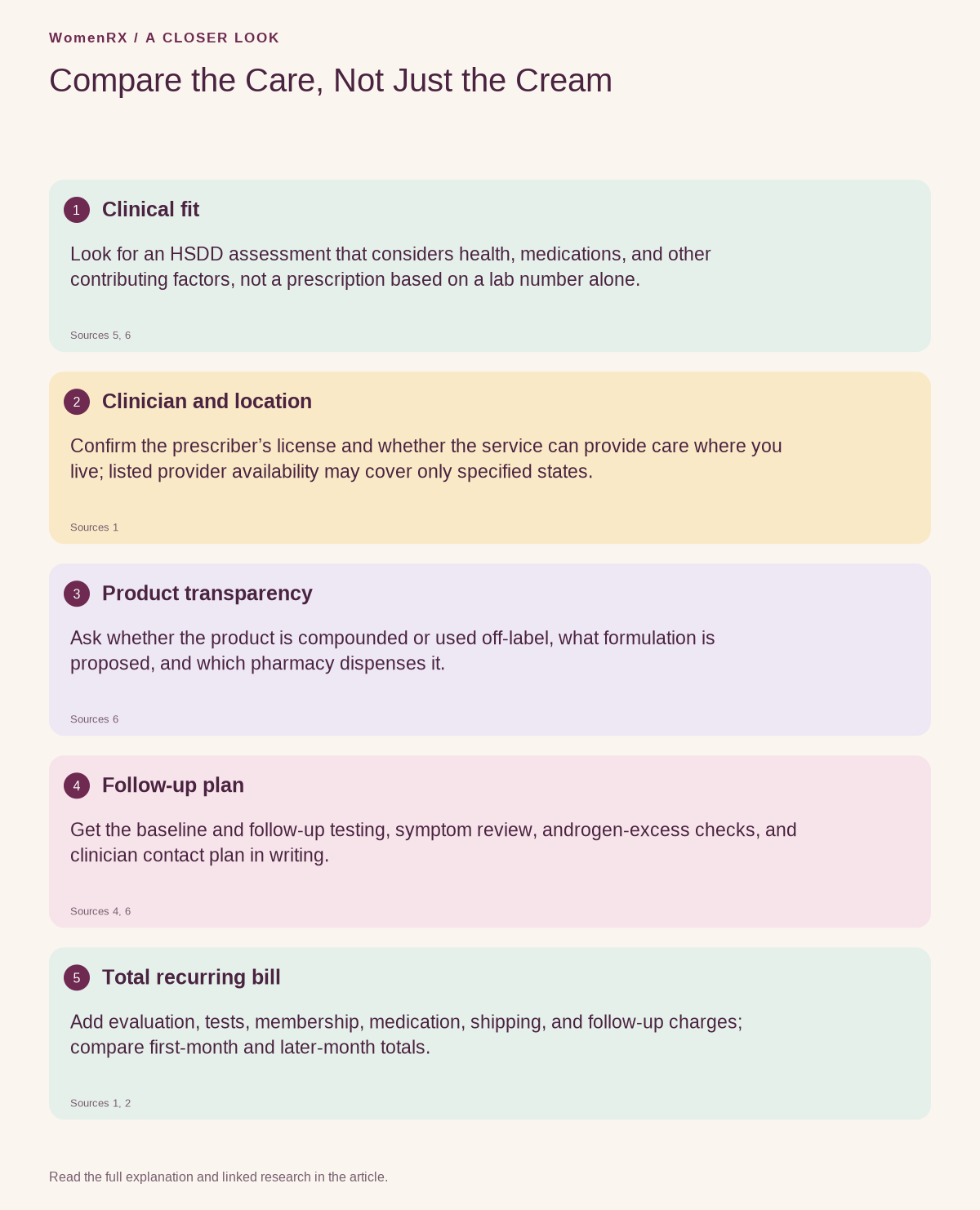
Compare the Care, Not Just the Cream
Clinical fit: Look for an HSDD assessment that considers health, medications, and other contributing factors, not a prescription based on a lab number alone.56
Clinician and location: Confirm the prescriber’s license and whether the service can provide care where you live; listed provider availability may cover only specified states.1
Product transparency: Ask whether the product is compounded or used off-label, what formulation is proposed, and which pharmacy dispenses it.6
Follow-up plan: Get the baseline and follow-up testing, symptom review, androgen-excess checks, and clinician contact plan in writing.46
Total recurring bill: Add evaluation, tests, membership, medication, shipping, and follow-up charges; compare first-month and later-month totals.12
Read the figure as text
Separate the clinical assessment and follow-up from product charges so a low advertised medication price does not hide the total cost or missing care.- Clinical fit: Look for an HSDD assessment that considers health, medications, and other contributing factors, not a prescription based on a lab number alone.56
- Clinician and location: Confirm the prescriber’s license and whether the service can provide care where you live; listed provider availability may cover only specified states.1
- Product transparency: Ask whether the product is compounded or used off-label, what formulation is proposed, and which pharmacy dispenses it.6
- Follow-up plan: Get the baseline and follow-up testing, symptom review, androgen-excess checks, and clinician contact plan in writing.46
- Total recurring bill: Add evaluation, tests, membership, medication, shipping, and follow-up charges; compare first-month and later-month totals.12
More questions, answered
Can a testosterone blood test tell me whether I need treatment?
No. The guideline says a total testosterone level should not be used to diagnose HSDD. A baseline level can help with monitoring if treatment is considered, while the decision itself depends on a clinical assessment of symptoms and contributing factors. 6
Does online care mean a service can prescribe in every state?
No. Provider availability can be limited by location. For example, Midi’s page observed September 25, 2026 listed service in specified states rather than nationwide. Confirm availability for your state directly; a provider’s listed service area is not proof that you personally qualify for treatment. 1
Sources you can check
- Midi: women's testosterone cream starting price and supplyAccessed 2026-09-25Return to first citation
- Hone: women's Premium membership and testosterone cream priceAccessed 2026-09-25Return to first citation
- Testosterone therapy for female sexual dysfunction: a systematic review of the literature demonstrating outcomes in premenopausal and postmenopausal women.Furlan VA, Hammad MAM, Quesada S, Nguyen S, Yih J. · The journal of sexual medicine · 2026Return to first citation
- Androgen therapy in midlife and older women: a position statement of the Latin American Association of Gynecological Endocrinology (ALEG).Pilnik S, Belardo A, Marchesan LB, Camero-Lascano A, Acuña-San Martín M, Elizalde-Cremonte A, Ojeda E, Manzur A, Chedraui P. · Climacteric : the journal of the International Menopause Society · 2025Return to first citation
- International Society for the Study of Women's Sexual Health Clinical Practice Guideline for the Use of Systemic Testosterone for Hypoactive Sexual Desire Disorder in Women.Parish SJ, Simon JA, Davis SR, Giraldi A, Goldstein I, Goldstein SW, Kim NN, Kingsberg SA, Morgentaler A, Nappi RE, Park K, Stuenkel CA, Traish AM, Vignozzi L. · The journal of sexual medicine · 2021Return to first citation
- International Society for the Study of Women's Sexual Health Clinical Practice Guideline for the Use of Systemic Testosterone for Hypoactive Sexual Desire Disorder in Women.Parish SJ, Simon JA, Davis SR, Giraldi A, Goldstein I, Goldstein SW, Kim NN, Kingsberg SA, Morgentaler A, Nappi RE, Park K, Stuenkel CA, Traish AM, Vignozzi L. · Climacteric : the journal of the International Menopause Society · 2021Return to first citation