Good Food Sources of Zinc, and How to Choose
Seafood, meat, beans, seeds, whole grains, dairy, and fortified cereals can all contribute zinc, but the amount your body absorbs varies with the meal.
Oysters, beef, crab, fortified cereal, oats, pumpkin seeds, lentils, dairy, and other foods can all add zinc. Animal foods generally provide zinc that is more available for absorption; phytate in beans, nuts, seeds, and whole grains can bind some zinc. For most meals, variety matters more than finding one “best” food, with needs changing during pregnancy and breastfeeding. 1
Start with the amount you need
For most adult women, the recommended dietary allowance (RDA) is 8 mg of zinc a day. It’s 11 mg during pregnancy and 12 mg while breastfeeding. For comparison, adult men have an RDA of 11 mg. These are total daily intake targets, not amounts you need to get from one food or at every meal. 1
That makes a useful starting point: build zinc into meals you already enjoy, rather than treating one food as a requirement. A serving of beef or crab can contribute several milligrams; beans, seeds, dairy, eggs, and fortified cereal add smaller amounts that can build across the day. 1
Compare foods by both zinc and absorption
Animal foods tend to offer zinc that’s more readily absorbed. In the NIH food table, 3 ounces of roasted beef has 3.8 mg of zinc and 3 ounces of cooked blue crab has 3.2 mg. Oysters are especially concentrated: a 3-ounce serving has about 28 to 32 mg, depending on type and preparation. You don’t need to eat oysters to meet your needs; they’re simply an example of a food with a high zinc content. 1
Plant foods count, too. One ounce of roasted pumpkin seeds has 2.2 mg, half a cup of cooked lentils has 1.3 mg, and half a cup of kidney beans has 0.6 mg. A cup of cooked oats has 2.3 mg. Fortified breakfast cereal can also contribute; the NIH table lists 2.8 mg for a serving fortified with 25% of the Daily Value. Amounts depend on the food and serving, so use these figures as comparisons, not as a scorecard for every meal. 1
The difference is partly phytate, a natural compound in many legumes, nuts, seeds, and whole grains. It can bind zinc in the gut, making some of the zinc harder to absorb. Across diets, the share of zinc absorbed from food can range from 5% to more than 50%, depending in part on how much plant food and phytate the diet contains. That range describes variation across diets, not a prediction for your individual meal. 1
Make plant-based choices work for you
A plant-forward or vegetarian diet can include multiple zinc sources: legumes, whole grains, nuts, seeds, tofu or tempeh, and fortified cereal. The NIH notes that soaking beans, grains, and seeds before cooking may reduce phytate’s binding effect; review evidence also describes heating, sprouting, fermenting, and leavening as food-processing methods that can reduce phytate’s effect. These are options, not rules, and you don’t need to avoid nutritious plant foods because they contain phytate. 13
Think about the whole meal, not just the zinc number in one ingredient. Zinc absorption from a mixed meal can be lower than from a meal made only of animal foods. At the same time, a review of human meal studies found that milk or yogurt sometimes improved zinc absorption from high-phytate foods such as rice, tortillas, or bread. That effect wasn’t seen with low-phytate foods, so dairy isn’t a universal absorption booster. 12
For example, if you eat beans and whole-grain bread, you might add yogurt or milk if they fit your usual eating pattern. If you don’t eat dairy, you can still choose beans, seeds, tofu, or fortified cereal and use preparation methods like soaking or fermentation when practical. The goal is a workable pattern, not a perfect pairing at every meal. 123
Food first doesn’t mean supplement automatically
A lower absorption rate from some plant-based meals doesn’t by itself show that you’re deficient or that you need a supplement. A well-planned vegetarian diet can provide zinc from plant sources, according to a review of vegetarian diets. Pregnancy and breastfeeding do raise the recommended intake, but that change in need doesn’t mean every woman at those life stages needs a high-dose supplement. 13
Supplements can add a concentrated amount of elemental zinc, and their label lists the elemental zinc rather than the total weight of the zinc compound. So keep the distinction clear: food sources help you build an overall eating pattern; a supplement is a separate source of zinc, not an automatic fix for a plant-based diet or a substitute for assessing what you actually need. 1
A practical way to choose is to include one or more zinc-containing foods regularly, drawing from animal foods, plant foods, or both. If you’re pregnant or breastfeeding, use the higher life-stage intake as your reference; if your diet is mostly plant-based, pay attention to variety and preparation rather than assuming plant foods don’t count. 1
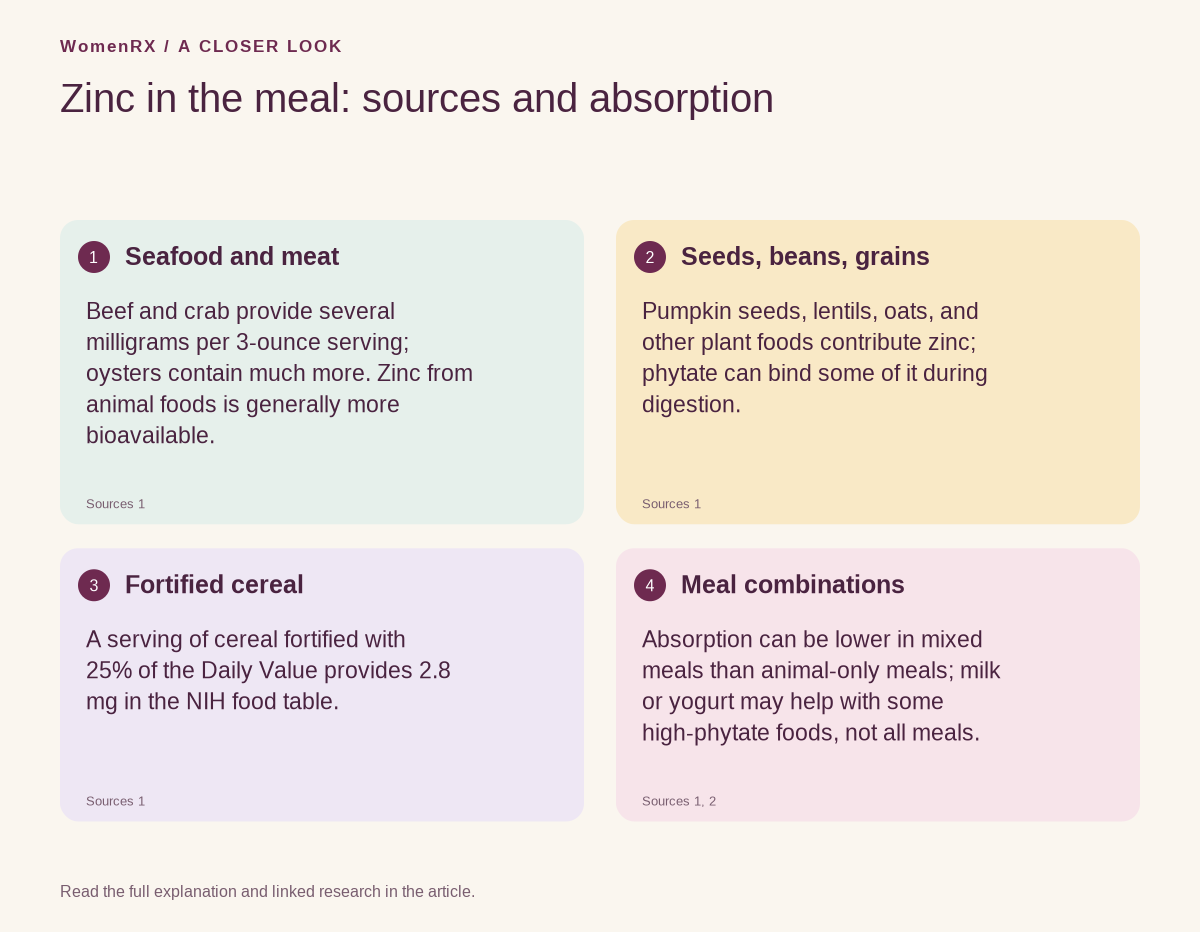
Zinc in the meal: sources and absorption
Seafood and meat: Beef and crab provide several milligrams per 3-ounce serving; oysters contain much more. Zinc from animal foods is generally more bioavailable.1
Seeds, beans, grains: Pumpkin seeds, lentils, oats, and other plant foods contribute zinc; phytate can bind some of it during digestion.1
Fortified cereal: A serving of cereal fortified with 25% of the Daily Value provides 2.8 mg in the NIH food table.1
Meal combinations: Absorption can be lower in mixed meals than animal-only meals; milk or yogurt may help with some high-phytate foods, not all meals.12
Read the figure as text
Compare example serving amounts with the food patterns that can affect how much zinc is absorbed.- Seafood and meat: Beef and crab provide several milligrams per 3-ounce serving; oysters contain much more. Zinc from animal foods is generally more bioavailable.1
- Seeds, beans, grains: Pumpkin seeds, lentils, oats, and other plant foods contribute zinc; phytate can bind some of it during digestion.1
- Fortified cereal: A serving of cereal fortified with 25% of the Daily Value provides 2.8 mg in the NIH food table.1
- Meal combinations: Absorption can be lower in mixed meals than animal-only meals; milk or yogurt may help with some high-phytate foods, not all meals.12
Sources you can check
- Zinc - Health Professional Fact SheetAccessed 2026-09-25Return to first citation
- Influence of Dairy Products on Bioavailability of Zinc from Other Food Products: A Review of Complementarity at a Meal Level.Shkembi B, Huppertz T. · Nutrients · 2021Return to first citation
- Zinc and vegetarian diets.Saunders AV, Craig WJ, Baines SK. · The Medical journal of Australia · 2013Return to first citation