Can Food Provide Enough Selenium? Sources and Variation
For many women, everyday foods can add up to the selenium intake reference, but a food list gives an estimate, not a precise personal total.
For adult women, the recommended intake is 55 mcg a day when not pregnant or breastfeeding, 60 mcg during pregnancy, and 70 mcg while breastfeeding. Seafood, meat, poultry, eggs, grains, and dairy all contribute. A few ordinary servings can reach the reference, but plant-food selenium varies with growing conditions, and supplements count toward the total too. 1
Start with the right reference
The recommended dietary allowance (RDA) is 55 micrograms (mcg) of selenium per day for adult women who aren’t pregnant or breastfeeding. It’s 60 mcg during pregnancy and 70 mcg while breastfeeding. These are total-intake references, so selenium from food and supplements both count. 1
The RDA is a planning reference, not a score you need to calculate exactly from every meal. It’s set at a level expected to meet the needs of nearly all healthy people in a group. 1
Ordinary servings can contribute meaningfully
Selenium is found in protein-rich foods such as seafood, meat, and poultry, as well as eggs, grains, and dairy. The NIH reference lists about 42 mcg in 3 ounces of cooked shrimp, 15 mcg in a large hard-boiled egg, and 8 mcg in a slice of whole-wheat bread. A cup of plain low-fat yogurt has about 8 mcg. These are food-table estimates, not guaranteed amounts in every serving. 1
For example, a day that includes 3 ounces of shrimp, an egg, and a slice of whole-wheat bread adds up to about 65 mcg using those listed values. That’s around the nonpregnant adult-woman RDA and above the pregnancy reference, but close to the breastfeeding reference. It’s an illustration, not a menu prescription: portions and food composition vary, and a real day includes other foods too. 1
The U.S. survey average for adult women was 94 mcg per day from foods and beverages, and 102 mcg when supplements were included. Those are population averages, not proof that every woman, or even most women individually, gets enough from food alone. The NIH reference says most people in the United States consume adequate selenium, but that broad finding doesn’t establish food-only adequacy for each person. 1
Why the estimate can be imprecise
For plant foods, selenium depends partly on the soil where crops grow, so the amount can differ by location. The NIH reference notes that selenium in animal products is less affected by local soil differences because animals maintain more predictable tissue levels. Even so, food values are estimates rather than a guarantee for your particular serving. A study measuring meat from different species and cuts in Switzerland also found differences in selenium concentrations, reinforcing that food composition can vary. 1 2
Brazil nuts are a special case. The NIH reference lists an average of 544 mcg per ounce, but reported analyses vary widely. That’s far more than the daily reference in the average listed portion, so Brazil nuts aren’t a dependable way to measure or fine-tune selenium intake. 1
A useful food-first check
To make a rough estimate, look at what you typically eat over several days, not just one meal. Note portions of seafood, meat or poultry, eggs, grains, and dairy, then use a food-composition database for approximate values. Add the selenium listed on any multivitamin, prenatal, or standalone supplement label. Many multivitamins contain 55 mcg, though amounts vary. 1
Here’s how the arithmetic works: the example day above provides about 65 mcg from the listed foods. If someone also takes a multivitamin labeled as containing 55 mcg of selenium, the estimated total becomes about 120 mcg. That total is an estimate, not a reason by itself to start or stop a supplement. Check the whole supplement label, especially if more than one product contains selenium, and remember that the food values may not match the actual foods eaten. 1
Pregnancy and breastfeeding change the reference, so include a prenatal or other supplement in the same total rather than treating it as separate from food. If your usual diet is mostly plant-based, it may be especially hard to estimate from a generic food list because plant selenium varies with growing conditions. The goal is a sensible estimate of your overall pattern, not precision from one food.
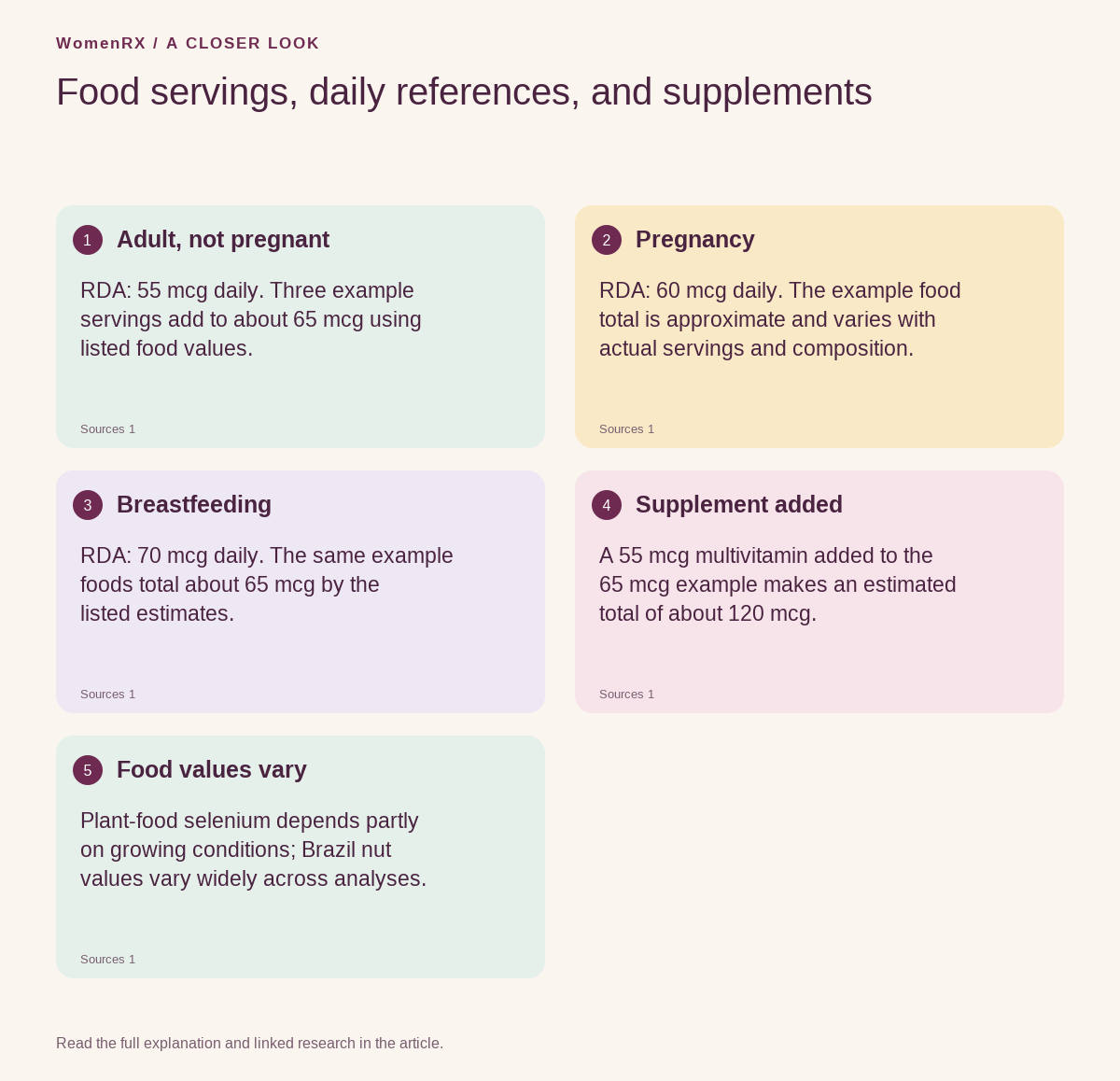
Food servings, daily references, and supplements
Adult, not pregnant: RDA: 55 mcg daily. Three example servings add to about 65 mcg using listed food values.1
Pregnancy: RDA: 60 mcg daily. The example food total is approximate and varies with actual servings and composition.1
Breastfeeding: RDA: 70 mcg daily. The same example foods total about 65 mcg by the listed estimates.1
Supplement added: A 55 mcg multivitamin added to the 65 mcg example makes an estimated total of about 120 mcg.1
Food values vary: Plant-food selenium depends partly on growing conditions; Brazil nut values vary widely across analyses.1
Read the figure as text
Compare selected food-table estimates with adult-woman intake references, then see how a supplement adds to the same daily total.- Adult, not pregnant: RDA: 55 mcg daily. Three example servings add to about 65 mcg using listed food values.1
- Pregnancy: RDA: 60 mcg daily. The example food total is approximate and varies with actual servings and composition.1
- Breastfeeding: RDA: 70 mcg daily. The same example foods total about 65 mcg by the listed estimates.1
- Supplement added: A 55 mcg multivitamin added to the 65 mcg example makes an estimated total of about 120 mcg.1
- Food values vary: Plant-food selenium depends partly on growing conditions; Brazil nut values vary widely across analyses.1
More questions, answered
Does one food have to meet the whole daily reference?
No. Selenium can come from several foods across the day. The food values are useful for estimating contributions, but no single food has to provide the full amount. 1
Should I take a selenium supplement if my estimate is low?
A rough food estimate alone doesn’t establish that you need a supplement. First count selenium from any multivitamin, prenatal, or other product you already use; supplement amounts vary, and they add to food intake. 1
Sources you can check
- Selenium - Health Professional Fact SheetAccessed 2026-09-25Return to first citation
- Variability of selected trace elements of different meat cuts determined by ICP-MS and DRC-ICPMS.Gerber N, Brogioli R, Hattendorf B, Scheeder MR, Wenk C, Günther D. · Animal : an international journal of animal bioscience · 2009Return to first citation