Which Foods Provide Selenium, and How Much?
Seafood, meat, eggs, grains, and dairy all contribute selenium, but growing conditions can shift plant-food amounts and Brazil nuts are unusually concentrated.
Useful sources include seafood, poultry, meat, eggs, grains, and dairy. In listed U.S. food-composition data, 3 ounces of cooked yellowfin tuna provides 92 mcg and one hard-boiled egg provides 15 mcg. Brazil nuts average 544 mcg per ounce, but amounts vary widely; that average is above the adult upper limit of 400 mcg per day, so an ounce isn’t a sensible serving target. 12
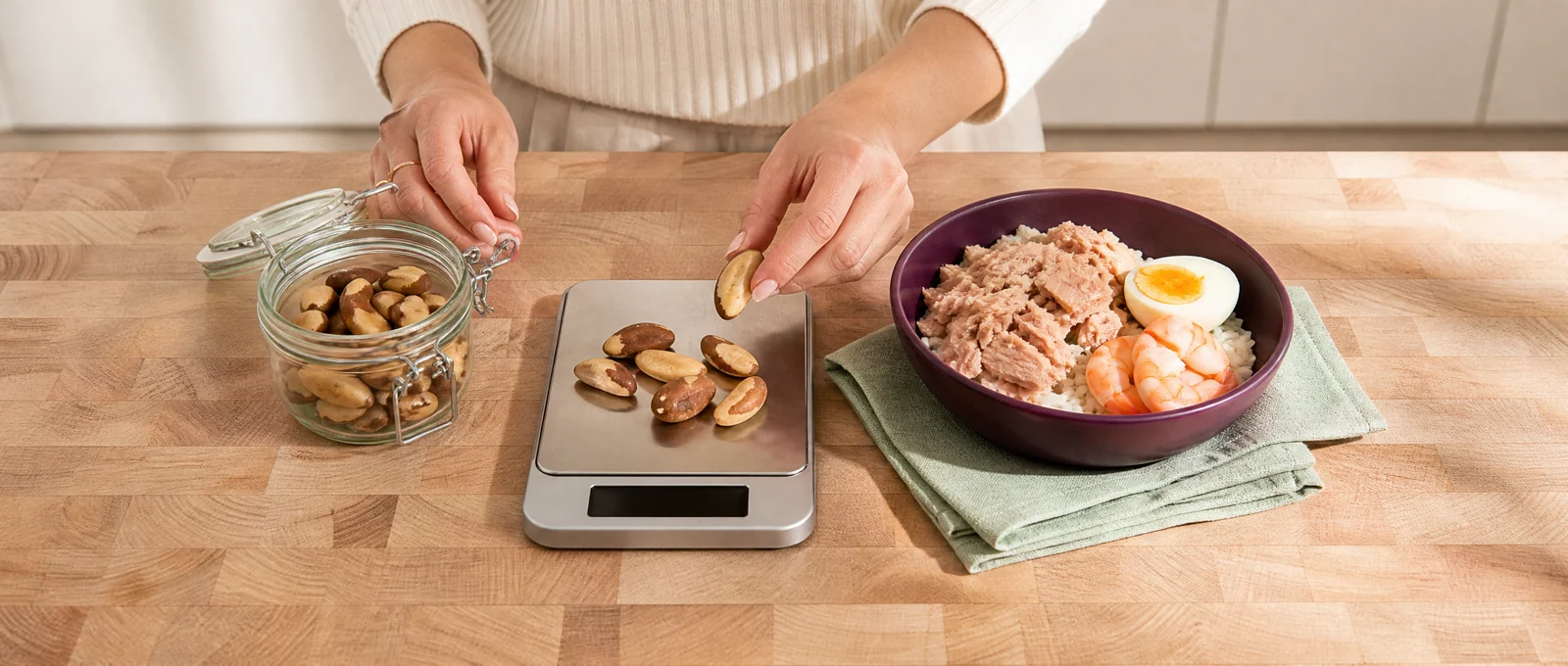
Everyday foods can contribute across the day
Selenium doesn’t have to come from one standout food. In the United States, breads and grains, meat, poultry, seafood, and eggs are major sources; dairy contributes too. For a sense of serving size, the listed food-composition values are 92 mcg for 3 ounces of cooked yellowfin tuna, 42 mcg for 3 ounces of cooked shrimp, 15 mcg for one hard-boiled egg, and 13 mcg for a cup of cooked oatmeal. These are comparison figures, not guarantees for every product or meal. 1
That mix gives you options: an egg, seafood or poultry, or a grain or dairy food can all add selenium to an eating pattern. The figures don’t need to be treated as a daily scorecard. The recommended intake is 55 mcg a day for adult women, 60 mcg during pregnancy, and 70 mcg while breastfeeding. 1
Why food lists aren’t universal rankings
Plant foods draw selenium from the soil where they grow. Soil selenium levels and other growing conditions differ, so the selenium content of the same plant food can vary by origin. A food table can help you compare examples, but it can’t tell you the exact amount in a particular loaf of bread or serving of rice. 1
Animal products tend to be less affected by local soil differences: animals regulate selenium in their tissues, and livestock feed is generally formulated with consistent selenium levels. That makes foods such as meat, poultry, seafood, and eggs practical sources, without making every serving identical. 1
Food patterns also vary by place. In a cross-sectional study of adults in Brazil, nuts, cooked fish, meat, bread, and rice were leading contributors to selenium intake. That describes the foods people ate in that population, not a fixed ranking for every country or diet. 2
Brazil nuts need upper-limit context
An ounce of Brazil nuts, listed as about 6 to 8 nuts, averages 544 mcg of selenium in U.S. food-composition data. That average exceeds the adult tolerable upper intake level of 400 mcg per day. The upper limit is the maximum daily intake unlikely to cause adverse effects; it is not a target. And the amount in any particular serving of Brazil nuts is uncertain because measured values vary widely. 12
So don’t use an ounce as an everyday selenium portion or treat Brazil nuts like a precisely dosed supplement. Their unusually high average is a reason to avoid assuming a particular number of nuts provides a predictable amount. For routine food choices, other familiar sources offer more moderate examples, such as an egg, seafood, meat, grains, or dairy. 12
What these numbers do, and don’t, tell you
Food-source values explain how much selenium foods may contain. They don’t show that adding a particular food prevents or treats a thyroid condition or improves fertility. The guidance supports different recommended intakes during pregnancy and breastfeeding, but those recommendations don’t establish a special benefit from any one selenium-rich food. 1
One practical wrinkle: selenium usually isn’t required on the Nutrition Facts label unless it has been added to the product, so a label may not let you compare foods for this nutrient. 1
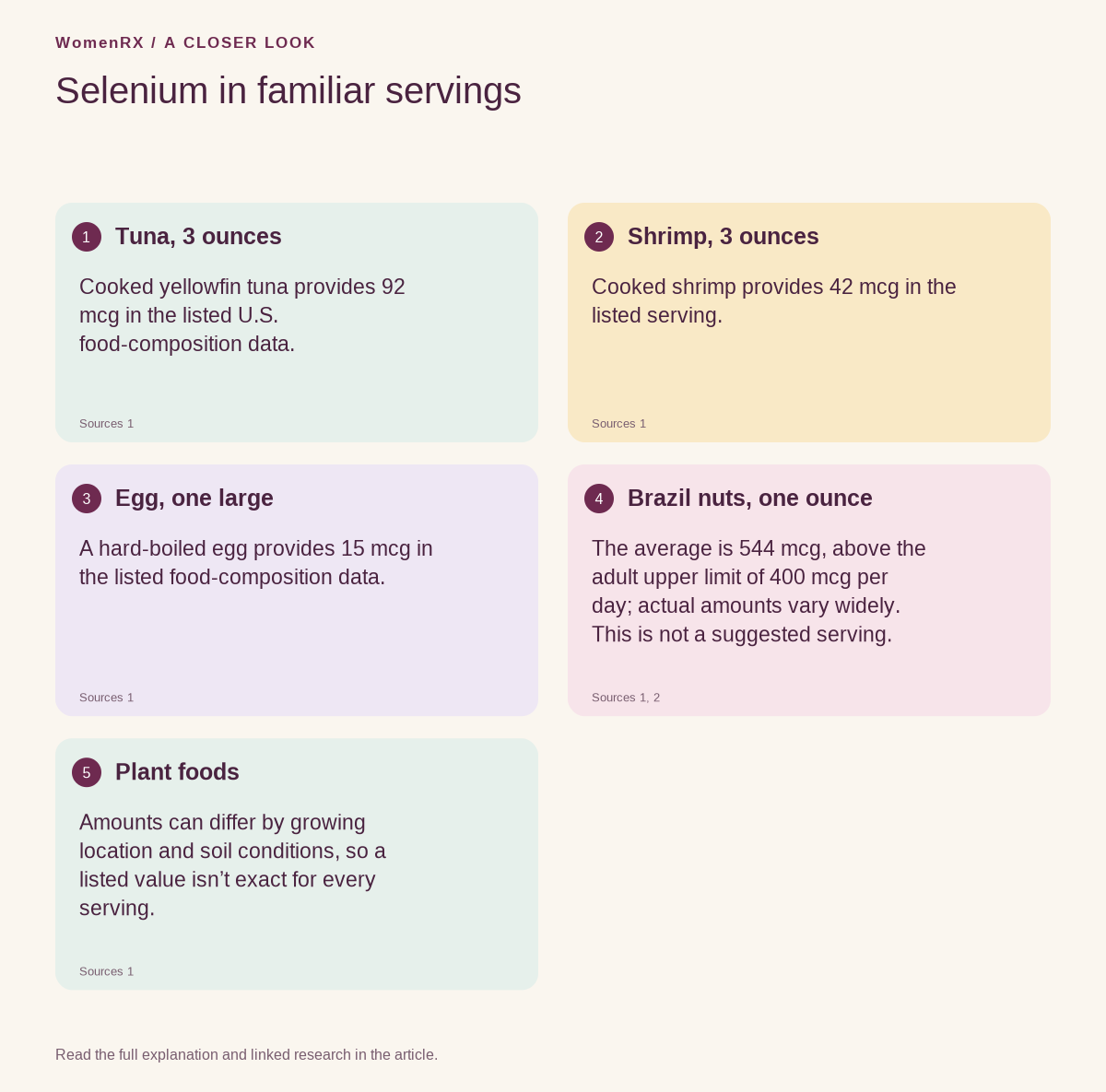
Selenium in familiar servings
Tuna, 3 ounces: Cooked yellowfin tuna provides 92 mcg in the listed U.S. food-composition data.1
Shrimp, 3 ounces: Cooked shrimp provides 42 mcg in the listed serving.1
Egg, one large: A hard-boiled egg provides 15 mcg in the listed food-composition data.1
Brazil nuts, one ounce: The average is 544 mcg, above the adult upper limit of 400 mcg per day; actual amounts vary widely. This is not a suggested serving.12
Plant foods: Amounts can differ by growing location and soil conditions, so a listed value isn’t exact for every serving.1
Read the figure as text
Compare example serving amounts with the unusually high Brazil-nut average and the adult daily upper limit. Food values, especially for plant foods, can vary.- Tuna, 3 ounces: Cooked yellowfin tuna provides 92 mcg in the listed U.S. food-composition data.1
- Shrimp, 3 ounces: Cooked shrimp provides 42 mcg in the listed serving.1
- Egg, one large: A hard-boiled egg provides 15 mcg in the listed food-composition data.1
- Brazil nuts, one ounce: The average is 544 mcg, above the adult upper limit of 400 mcg per day; actual amounts vary widely. This is not a suggested serving.12
- Plant foods: Amounts can differ by growing location and soil conditions, so a listed value isn’t exact for every serving.1
More questions, answered
Does the selenium recommendation change during pregnancy or breastfeeding?
Yes. The recommended intake is 60 mcg per day during pregnancy and 70 mcg while breastfeeding, compared with 55 mcg for adult women ages 19 to 50. These are daily intake recommendations, not amounts one food needs to provide. 1
Does 400 mcg mean Brazil nuts are unsafe?
The 400 mcg figure is the adult tolerable upper intake level for daily selenium intake, not a recommended target. An ounce of Brazil nuts averages 544 mcg, but individual amounts vary widely, so that average cannot predict the selenium in a specific serving. 12
Sources you can check
- Selenium - Health Professional Fact SheetAccessed 2026-09-25Return to first citation
- Selenium intake, food sources, and associated factors in Brazilian Longitudinal Study of Adult Health (ELSA-Brasil): a cross-sectional study.Pedro ECV, Levy J, Marchioni DML, Bensenor IJM. · Sao Paulo medical journal = Revista paulista de medicina · 2025Return to first citation