CoQ10 Timing: What Food and Formulation Studies Show
Some studies compare CoQ10 absorption with food or fasting, and with specific formulations; they don’t compare morning with night.
If your CoQ10 product says to take it with food, choose a meal that fits your routine. Food may affect absorption, though the result can depend on the formulation. The human comparisons here don’t establish that morning or night works better, improves health outcomes, or feels easier on your stomach. They also don’t establish a best time for fertility use. 1 2 3 4
A meal is not the same thing as a time of day
CoQ10 doesn’t dissolve easily in water, which makes its absorption a challenge. Researchers have studied food and specially designed formulations to see whether they change how much CoQ10 reaches the bloodstream. That doesn’t answer whether taking a supplement at breakfast works better than taking it at dinner. 1 2 3
One study reported greater CoQ10 absorption with food, including for an emulsion formulation. Its abstract doesn’t identify the study population, so that finding alone can’t establish a meal rule for women. 4 A human comparison found that one water-soluble formulation, PureSorb-Q40, was absorbed both when taken fasting and after a meal. That’s useful to know about the product tested, not a reason to assume every CoQ10 supplement works equally well without food. 2
For a practical choice, start with the directions on your particular product. If they say to take it with food, pair it with a meal you regularly eat. If you skip breakfast, for example, lunch or dinner may be simpler to remember. That choice is about following the product’s directions consistently, not a proven advantage of one hour over another.
The formula can change what an absorption study finds
In human studies, PureSorb-Q40 produced higher blood CoQ10 levels than a conventional lipid-soluble product under fasting and meal conditions. In a separate randomized crossover study of healthy human subjects, two tested water-soluble forms produced greater blood exposure than a CoQ10 softgel in soybean oil. Neither comparison establishes that all water-soluble products are better, or that a higher blood level leads to a better health outcome. 1 3
This is why a claim about taking one formulation without food may not apply to the bottle in your hand. These comparisons also weren’t morning-versus-night trials, so they don’t show whether either clock time changes absorption. 1 2 3
What about stomach comfort and fertility use?
The meal and formulation comparisons don’t establish whether taking CoQ10 with food, fasting, in the morning, or at night changes tolerability. A separate four-week study of a tested formulation in healthy volunteers reported no significant symptom changes, but it didn’t compare those schedules. So there’s no basis here for promising that bedtime or a meal will prevent an unwanted effect. 1 2 3
If you’re taking CoQ10 while trying to conceive, the same distinction applies. The human absorption study abstracts don’t report a women-specific timing analysis or compare fertility outcomes by morning, night, or meal schedule. Better absorption in a blood test isn’t itself evidence of better fertility outcomes. 1 2 3
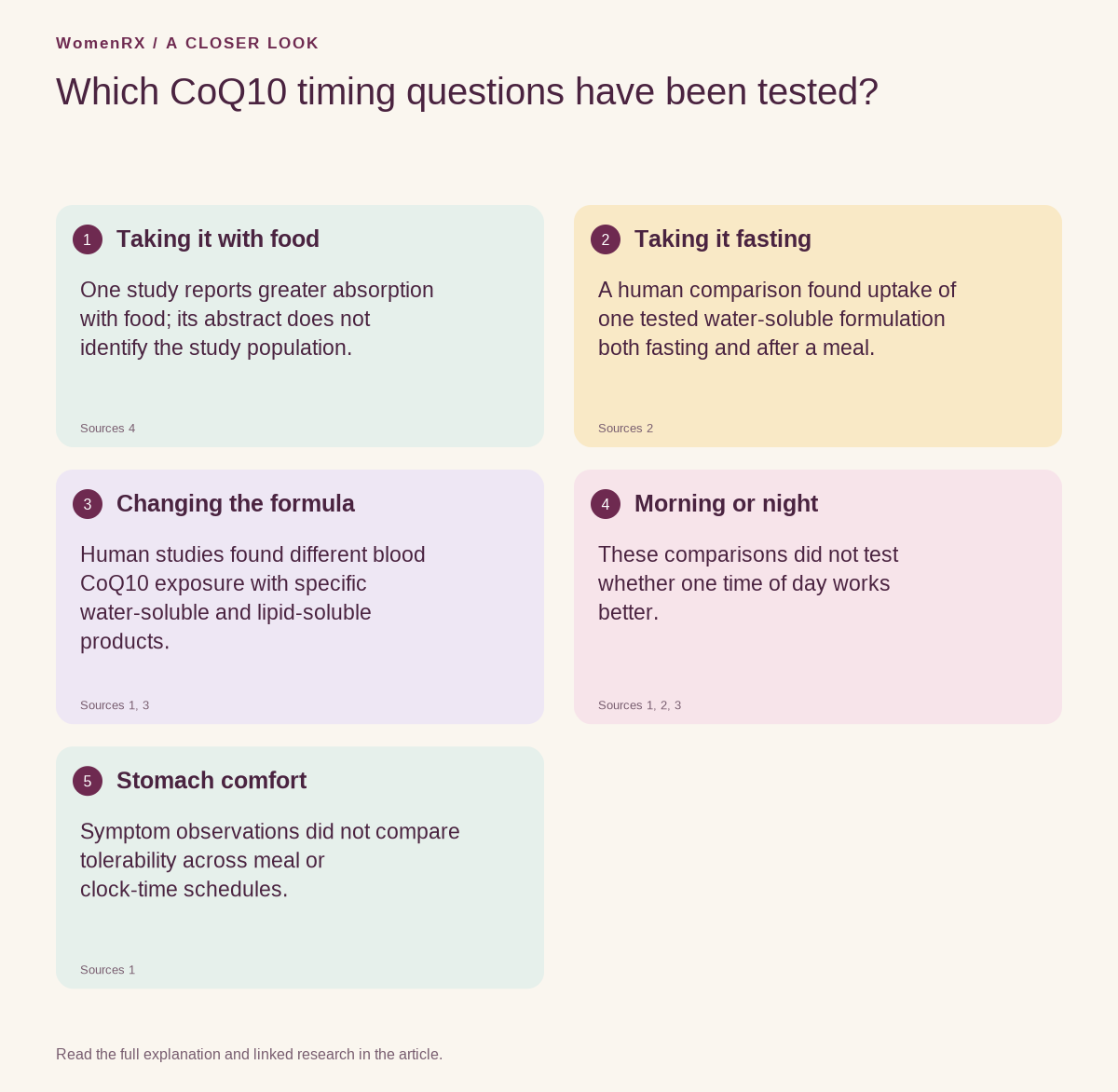
Which CoQ10 timing questions have been tested?
Taking it with food: One study reports greater absorption with food; its abstract does not identify the study population.4
Taking it fasting: A human comparison found uptake of one tested water-soluble formulation both fasting and after a meal.2
Changing the formula: Human studies found different blood CoQ10 exposure with specific water-soluble and lipid-soluble products.13
Morning or night: These comparisons did not test whether one time of day works better.123
Stomach comfort: Symptom observations did not compare tolerability across meal or clock-time schedules.1
Read the figure as text
Food and product comparisons can inform a routine, but they don’t answer every timing question.- Taking it with food: One study reports greater absorption with food; its abstract does not identify the study population.4
- Taking it fasting: A human comparison found uptake of one tested water-soluble formulation both fasting and after a meal.2
- Changing the formula: Human studies found different blood CoQ10 exposure with specific water-soluble and lipid-soluble products.13
- Morning or night: These comparisons did not test whether one time of day works better.123
- Stomach comfort: Symptom observations did not compare tolerability across meal or clock-time schedules.1
More questions, answered
Do I need a fatty meal with CoQ10?
These studies don’t establish that every CoQ10 product requires a fatty meal. A study reported increased absorption with food, while a human comparison found uptake of one specially formulated product both fasting and after a meal. Follow the directions for your particular product rather than assuming the same meal rule applies to all formulations. 2 4
Sources you can check
- Blood CoQ10 levels and safety profile after single-dose or chronic administration of PureSorb-Q40: animal and human studies.Nukui K, Yamagishi T, Miyawaki H, Kettawan A, Okamoto T, Belardinelli R, Tiano L, Littarru GP, Sato K. · BioFactors (Oxford, England) · 2008Return to first citation
- Comparison of uptake between PureSorb-Q40 and regular hydrophobic coenzyme Q10 in rats and humans after single oral intake.Nukui K, Yamagishi T, Miyawaki H, Kettawan A, Okamoto T, Sato K. · Journal of nutritional science and vitaminology · 2007Return to first citation
- Relative bioavailability of two forms of a novel water-soluble coenzyme Q10.Zmitek J, Smidovnik A, Fir M, Prosek M, Zmitek K, Walczak J, Pravst I. · Annals of nutrition & metabolism · 2008Return to first citation
- Improvement in intestinal coenzyme q10 absorption by food intake.Ochiai A, Itagaki S, Kurokawa T, Kobayashi M, Hirano T, Iseki K. · Yakugaku zasshi : Journal of the Pharmaceutical Society of Japan · 2007Return to first citation