CoQ10 With Food: What Timing Can Really Change
Food may affect CoQ10 absorption, but the evidence is limited and depends on the preparation.
There’s no one food rule for every CoQ10 product. One study reported greater absorption with food, but its abstract doesn’t establish that result for conventional oil-based softgels. A human study found favorable uptake with or without food for one specially prepared formulation. These absorption findings don’t show that a particular schedule improves health outcomes. 2 3
The meal question depends on the product
CoQ10 is poorly soluble in water, which can make it difficult for the body to absorb. But “CoQ10” covers different preparations, and research suggests those formulations can affect absorption. So a finding about one product shouldn’t automatically become a rule for every capsule. 1 4 5
A study of CoQ10 supplementation reported that food enhanced intestinal absorption, including when CoQ10 was given in an emulsion. However, the abstract doesn’t identify the study population or establish that the result applies to conventional oil-based softgels. It supports a limited conclusion: food improved absorption in the preparations studied, not that every CoQ10 product must be taken with a meal. 2
If your product directions don’t specify otherwise, taking it with a meal can be a cautious practical choice. Think of that as an option informed by limited food-absorption research, not a proven requirement for standard softgels or a guarantee of better results.
Why one fasting result doesn’t settle the question
A human study compared a specially prepared product called PureSorb-Q40 with conventional lipid-soluble CoQ10. The researchers reported favorable uptake for PureSorb-Q40 when taken fasting, and uptake after food as well. That is evidence about this particular preparation, not proof that ordinary CoQ10 works just as well on an empty stomach. 3
Other human studies also show why the product form matters, but they don’t answer the meal-timing question. In healthy subjects, a randomized crossover study found higher absorption measures for tested water-soluble CoQ10 forms than for a softgel containing CoQ10 in soybean oil. A separate study in healthy volunteers reported greater absorption with a phytosome preparation than with the comparison CoQ10 capsules. Neither study establishes that those products should be taken fasting or with food. 4 5
The useful thing to check is the preparation and its own directions, rather than assuming that a label term such as “ubiquinol” or “water-soluble” settles the timing question. These studies don’t establish a general fasting rule based on those terms.
If taking it without food feels uncomfortable
The absorption studies don’t establish whether a meal prevents stomach discomfort. If you notice discomfort when taking your product without food, taking it with a meal may be a reasonable comfort experiment, provided that fits the product directions. That’s different from claiming that food is proven to prevent side effects or improve CoQ10’s health effects.
If the discomfort continues, check the label and consider asking a pharmacist or clinician whether the product or another factor could be involved.
Absorption isn’t the same as a health benefit
These timing and formulation studies measure CoQ10 absorption, uptake, or blood levels. They don’t show that a particular time of day, fasting schedule, or meal pairing improves symptoms or other health outcomes. A preparation that changes measured absorption doesn’t, by itself, establish a better clinical result. 2 3 4 5
The human studies described here don’t report results for pregnant or breastfeeding participants. Their absorption findings therefore don’t answer whether CoQ10 is appropriate during pregnancy or breastfeeding; that’s a separate safety question.
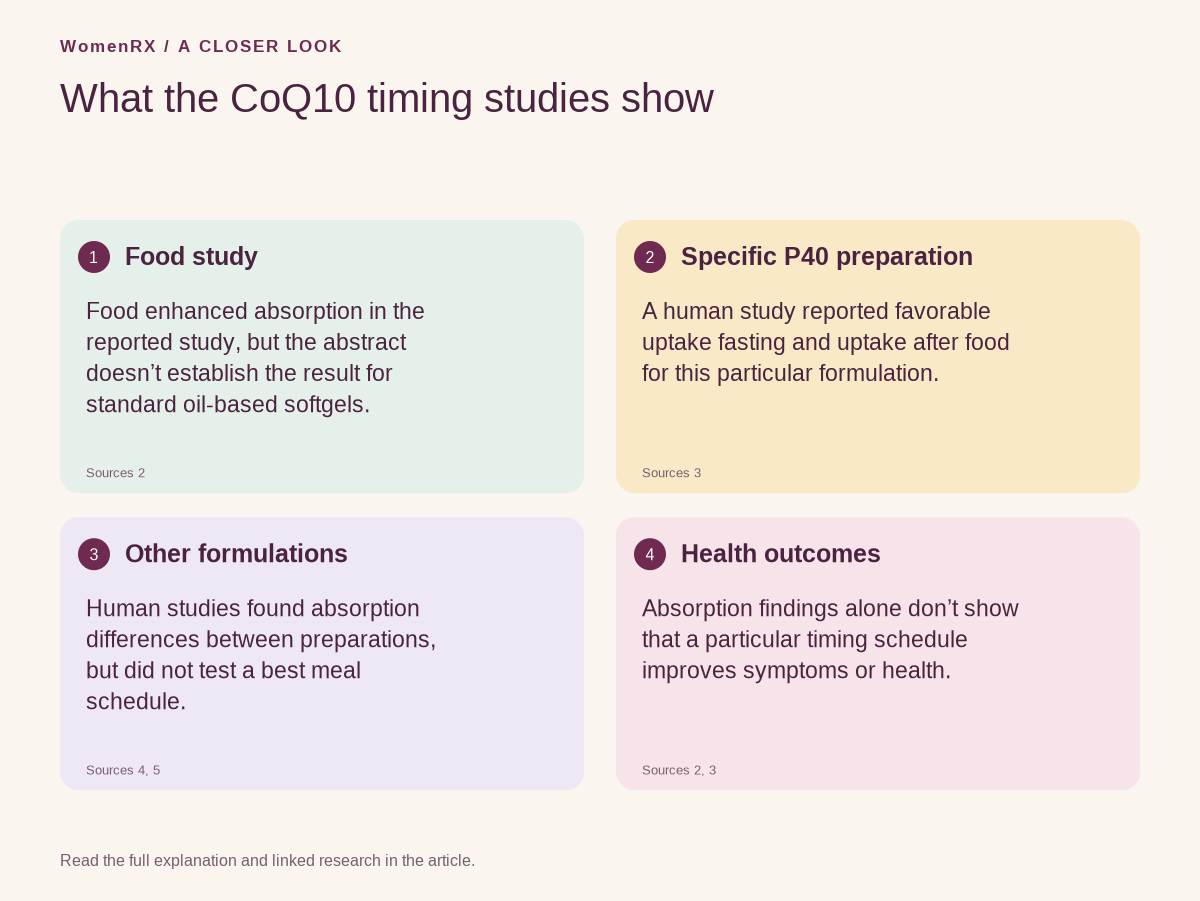
What the CoQ10 timing studies show
Food study: Food enhanced absorption in the reported study, but the abstract doesn’t establish the result for standard oil-based softgels.2
Specific P40 preparation: A human study reported favorable uptake fasting and uptake after food for this particular formulation.3
Other formulations: Human studies found absorption differences between preparations, but did not test a best meal schedule.45
Health outcomes: Absorption findings alone don’t show that a particular timing schedule improves symptoms or health.23
Read the figure as text
Food and formulation findings apply to the preparations studied; they don’t establish a universal schedule.- Food study: Food enhanced absorption in the reported study, but the abstract doesn’t establish the result for standard oil-based softgels.2
- Specific P40 preparation: A human study reported favorable uptake fasting and uptake after food for this particular formulation.3
- Other formulations: Human studies found absorption differences between preparations, but did not test a best meal schedule.45
- Health outcomes: Absorption findings alone don’t show that a particular timing schedule improves symptoms or health.23
More questions, answered
Does “ubiquinol” mean I can take CoQ10 without food?
The timing studies described here don’t establish that ubiquinol, or a label term by itself, means a product can be taken fasting. The reported fasting finding applies to one specially prepared formulation, so check the directions for your product rather than generalizing from that study. 3
Sources you can check
- Formation of Food Grade Microemulsion with Rice Glycosphingolipids to Enhance the Oral Absorption of Coenzyme Q10.Uchiyama H, Chae J, Kadota K, Tozuka Y. · Foods (Basel, Switzerland) · 2019Return to first citation
- Improvement in intestinal coenzyme q10 absorption by food intake.Ochiai A, Itagaki S, Kurokawa T, Kobayashi M, Hirano T, Iseki K. · Yakugaku zasshi : Journal of the Pharmaceutical Society of Japan · 2007Return to first citation
- Comparison of uptake between PureSorb-Q40 and regular hydrophobic coenzyme Q10 in rats and humans after single oral intake.Nukui K, Yamagishi T, Miyawaki H, Kettawan A, Okamoto T, Sato K. · Journal of nutritional science and vitaminology · 2007Return to first citation
- Relative bioavailability of two forms of a novel water-soluble coenzyme Q10.Zmitek J, Smidovnik A, Fir M, Prosek M, Zmitek K, Walczak J, Pravst I. · Annals of nutrition & metabolism · 2008Return to first citation
- A New Food-grade Coenzyme Q10 Formulation Improves Bioavailability: Single and Repeated Pharmacokinetic Studies in Healthy Volunteers.Petrangolini G, Ronchi M, Frattini E, De Combarieu E, Allegrini P, Riva A. · Current drug delivery · 2019Return to first citation