CoQ10: What the Evidence Says Before You Take It
CoQ10 has been studied for several different reasons, but the evidence ranges from a possible benefit in heart failure to low-certainty fertility findings.
CoQ10 isn’t a one-size-fits-all supplement: evidence depends on why you’re considering it. A review reports benefits in a specific type of heart failure, while results for statin-related muscle symptoms are inconsistent. In infertility studies, a possible increase in clinical pregnancy comes from low-certainty evidence. If you’re receiving cancer treatment, ask your treatment team or pharmacist to review the exact product: interaction concerns are potential or predicted, not proof of a harmful combination. 5 6 4
Start with the reason, not the bottle
CoQ10, also called ubiquinone, is a substance involved in cellular energy production. That role has made it a subject of research in several conditions, but a plausible mechanism or a change in a lab marker doesn’t automatically mean people feel better or have better health outcomes. The useful question is what CoQ10 has been shown to do for the specific reason you’re considering it. 5
The studies don’t establish a “best” CoQ10 product or show that one form, brand, or dose is best for women. They concern particular health situations; they don’t establish a general benefit from taking CoQ10.
Heart failure: promising findings, but condition-specific
A 2026 review describes evidence, including the Q-SYMBIO trial, as supporting improvements in functional capacity and heart function, and fewer major cardiovascular events, among people with heart failure with reduced ejection fraction. That’s a specific medical condition, not evidence that CoQ10 prevents heart disease or benefits everyone. The cited findings do not establish whether the effects differ for women. 5
CoQ10 should not replace prescribed heart-failure treatment; a review of online heart-failure supplements raises concern about products being used in place of guideline-directed care. 2
Statin-related muscle symptoms: results don’t agree
CoQ10 has been studied for muscle symptoms associated with statins, but a 2026 cardiovascular review describes the results as inconsistent: some studies report relief, while others don’t find a significant benefit. The review says routine supplementation for all statin users isn’t recommended. If muscle symptoms are why you’re considering CoQ10, discuss the symptoms and your medicines with the clinician managing your statin rather than assuming the supplement will solve them. 5
Fertility: a signal, but not a settled answer
A network meta-analysis of 30 studies involving 3,977 people with female infertility reported a higher clinical pregnancy rate with CoQ10 than placebo: relative risk 1.84, with a 95% credible interval of 1.06 to 3.31. The authors rated the certainty for this CoQ10 finding as low. The reported relative estimate doesn’t include the underlying pregnancy rate, so it can’t tell you the absolute chance of pregnancy for an individual. Because this estimate is for clinical pregnancy, it does not, by itself, show a live-birth benefit. 6
This is a finding in people being treated for infertility, not proof that CoQ10 improves fertility for everyone or that it should be added to fertility treatment. The review notes that clinical guidance on supplements for infertility remains limited. If you’re trying to conceive, pregnant, or in fertility care, discuss the supplement with your care team in that specific context. 6
Other proposed uses: don’t mistake early evidence for a treatment
For Parkinson’s disease, a review describes CoQ10 among compounds with effects in experimental models and says controlled clinical trials are needed to establish safety and efficacy. That is preclinical promise, not proof that CoQ10 slows Parkinson’s in people. 3
For antiphospholipid syndrome, a review describes reasons to study natural supplements, including CoQ10, but frames them as a case for further research. It doesn’t establish CoQ10 as a way to prevent clots or pregnancy complications. 1
A study of chronic COVID symptoms reported improvement in a group taking CoQ10 together with alpha-lipoic acid, but it was observational and did not test CoQ10 on its own. The authors say the finding needs confirmation in a blinded, placebo-controlled trial. It can’t show that CoQ10 treats long COVID. 7
What to check before choosing a supplement
Start with your reason for taking CoQ10 and the exact product you’re considering. Bring a complete list of medicines and other supplements to your clinician or pharmacist, especially if you’re receiving cancer treatment or care for heart failure. In a retrospective review of inquiries at a cancer center, CoQ10 was among supplements for which potential or predicted interaction or treatment issues were reported alongside conventional cancer therapies. Human studies were lacking, and many potential interactions were predicted from laboratory or animal evidence. Those findings don’t establish that a particular CoQ10-medicine combination will cause harm, but they do give you a reason to have your treatment team review the product. 4
For heart failure, don’t use a supplement in place of prescribed treatment. If you’re considering CoQ10 for statin-related symptoms, raise that specific concern with the clinician managing your statin, since the evidence is inconsistent. If you’re trying to conceive, pregnant, or receiving fertility care, discuss that context rather than assuming fertility findings establish safety or benefit for you. 2 5 6
If a product promises fertility, heart, or disease-prevention benefits, compare that promise with the evidence for that exact outcome. The studies above don’t establish that one commercial product is superior, or that a label’s claims match the outcomes studied. 5 6
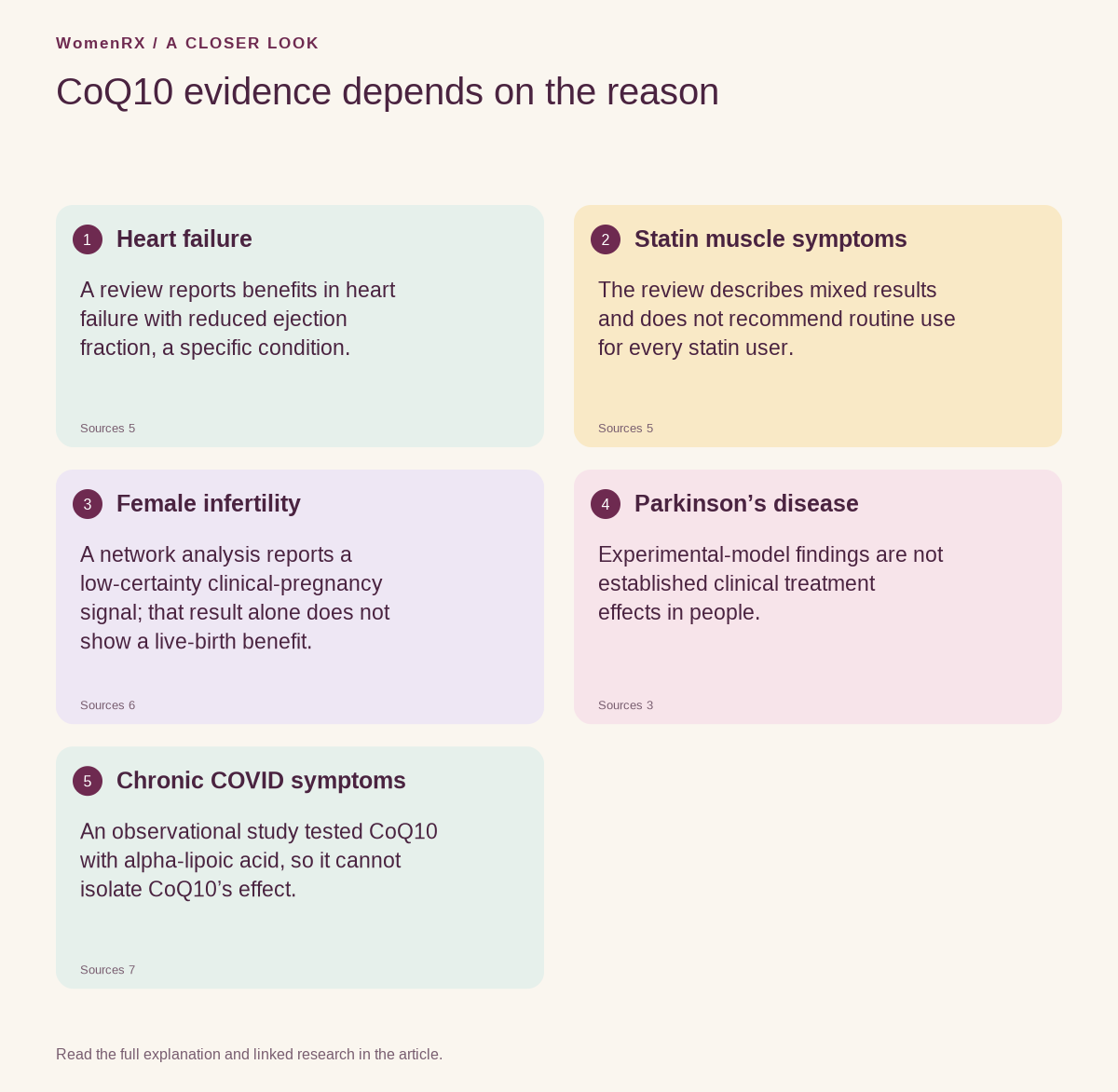
CoQ10 evidence depends on the reason
Heart failure: A review reports benefits in heart failure with reduced ejection fraction, a specific condition.5
Statin muscle symptoms: The review describes mixed results and does not recommend routine use for every statin user.5
Female infertility: A network analysis reports a low-certainty clinical-pregnancy signal; that result alone does not show a live-birth benefit.6
Parkinson’s disease: Experimental-model findings are not established clinical treatment effects in people.3
Chronic COVID symptoms: An observational study tested CoQ10 with alpha-lipoic acid, so it cannot isolate CoQ10’s effect.7
Read the figure as text
These findings differ in population and outcome: a condition-specific cardiovascular review, low-certainty fertility evidence, and early signals that do not establish treatment benefit.- Heart failure: A review reports benefits in heart failure with reduced ejection fraction, a specific condition.5
- Statin muscle symptoms: The review describes mixed results and does not recommend routine use for every statin user.5
- Female infertility: A network analysis reports a low-certainty clinical-pregnancy signal; that result alone does not show a live-birth benefit.6
- Parkinson’s disease: Experimental-model findings are not established clinical treatment effects in people.3
- Chronic COVID symptoms: An observational study tested CoQ10 with alpha-lipoic acid, so it cannot isolate CoQ10’s effect.7
More questions, answered
Does the fertility research show that CoQ10 improves the chance of a live birth?
The reported CoQ10 finding is for clinical pregnancy, not live birth, and its certainty is low. That result alone cannot show whether CoQ10 improves the chance of a live birth. It also doesn’t include the underlying pregnancy rate needed to calculate an individual’s absolute chance of pregnancy. 6
Is a harmful CoQ10 interaction with cancer treatment established?
The cancer-center review reports potential or predicted interaction or treatment concerns among queried supplements, including CoQ10, but those findings do not establish a particular harmful CoQ10-medicine combination. Human evidence was lacking, making the clinical significance difficult to quantify. If you’re receiving cancer treatment, have your treatment team or pharmacist review the exact product and its ingredients. 4
Sources you can check
- Natural supplements in antiphospholipid syndrome: A case for further study.Kello N, Cho YM. · Clinical immunology (Orlando, Fla.) · 2024Return to first citation
- Online Marketing of Alternative Medicine for Heart Failure: An Assessment of Amazon.com.Vinsdata N, Heidel RE, Hauptman PJ. · The American journal of medicine · 2025Return to first citation
- Unveiling Nature's potential: Promising natural compounds in Parkinson's disease management.Bhusal CK, Uti DE, Mukherjee D, Alqahtani T, Alqahtani S, Bhattacharya A, Akash S. · Parkinsonism & related disorders · 2023Return to first citation
- Potential issues with complementary medicines commonly used in the cancer population: A retrospective review of a tertiary cancer center's experience.Brooks SL, Rowan G, Michael M. · Asia-Pacific journal of clinical oncology · 2018Return to first citation
- Coenzyme Q10 in Cardiovascular Medicine: Mechanisms, Clinical Evidence, and Future Integration in Heart Failure and Statin Myopathy.Kumble J, Frishman WH. · Cardiology in review · 2026Return to first citation
- Efficacy and safety of nutritional supplements in female infertility: a network meta-analysis.Du J, Liu J, Liu Q, Li C, Zhu H, Ji R, Shang Z, Zheng X, Yang J. · Reproductive biology and endocrinology : RB&E · 2025Return to first citation
- Coenzyme Q10 + alpha lipoic acid for chronic COVID syndrome.Barletta MA, Marino G, Spagnolo B, Bianchi FP, Falappone PCF, Spagnolo L, Gatti P. · Clinical and experimental medicine · 2023Return to first citation