CoQ10: Match the Dose to the Reason You’re Taking It
CoQ10 doses studied for fertility and statin-related muscle symptoms differ, and neither trial dose is a one-size-fits-all recommendation.
There isn’t one established CoQ10 dose for every use. Fertility studies report widely varying amounts, while studies of statin-related muscle symptoms used 100-600 mg daily for 30-90 days. These are research doses, not personal instructions. Pregnancy evidence is limited to one specific trial, breastfeeding wasn’t addressed, and the studies don’t establish a reliable list of medication interactions. 3 5 1
CoQ10 helps cells make energy, but that biological role doesn’t mean taking a supplement will help with every symptom or health goal. The useful question is what you’d take it for. Doses studied in fertility care, for example, shouldn’t be borrowed for muscle symptoms or general wellness. 3
If you’re considering it for fertility treatment
Research in women has focused mainly on specific fertility-treatment groups, including women with poor ovarian response or diminished ovarian reserve. A narrative review reports that studies in poor ovarian response used a wide range: 200 mg three times daily to 600 mg twice daily. That spread is a sign that there isn’t one agreed fertility dose, not a menu for self-dosing. 3
The outcomes also need context. A systematic review and meta-analysis included 16 studies and 2,773 participants, but combined studies of vitamins, CoQ10, and DHEA. Its overall improvements in ovarian-reserve measures and clinical pregnancy therefore can’t be attributed to CoQ10 alone. 4 A separate randomized trial in women with poor ovarian response reported improvements in some egg-related measures, but pregnancy outcomes did not differ significantly between groups. 2
So, if you’re undergoing fertility treatment, ask your fertility team whether CoQ10 fits your diagnosis and treatment plan, and what amount and timing they mean. A dose reported in an infertility review doesn’t show that the same amount improves the chance of a live birth for you.
If you’re considering it for muscle symptoms on a statin
Seven randomized trials involving 389 adults taking statins studied 100-600 mg of CoQ10 daily for 30-90 days. Four trials found a significant reduction in muscle symptoms and three did not. The pooled analysis found an overall reduction in pain intensity, but the mixed results mean it isn’t a guaranteed fix. Both sexes were included, with men making up about half the participants on average; the review did not report a women-only effect. 5
One smaller trial offers a more specific example: 60 people with prior statin intolerance took 100 mg daily or placebo for three months after restarting a reduced statin dose. The CoQ10 group reported less myalgia, but that single trial doesn’t settle how well CoQ10 works for everyone with statin-related symptoms. 6 Discuss persistent muscle symptoms and your statin plan with the prescriber rather than replacing or changing your prescription on your own.
Pregnancy and breastfeeding are separate questions
A review describes one randomized trial in pregnant women at risk of preeclampsia: 200 mg daily from 20 weeks of pregnancy onward was associated with nearly half the incidence of preeclampsia, with no notable side effects reported in that trial. That finding is specific to that group and situation; it doesn’t establish CoQ10 as routine pregnancy care or prove safety for every stage of pregnancy. 1
Breastfeeding wasn’t addressed in that pregnancy evidence, so don’t assume the trial result applies while nursing. If you’re pregnant, trying to conceive, or breastfeeding, ask your obstetric or fertility team about the exact product and your circumstances before starting it.
Make the medication check specific
The fertility and statin studies described here weren’t designed to test how CoQ10 interacts with different prescription medicines, so they can’t provide a dependable list of safe or unsafe drug pairings. Before adding it, show a pharmacist or prescriber the exact product label and your full medication list. Ask them to check that particular combination, rather than relying on a general claim that CoQ10 is safe with medicines.
Bring the reason you’re considering it, the dose and form on the label, and whether you’re pregnant or breastfeeding. That makes it easier to compare your plan with the research that actually matches your situation.
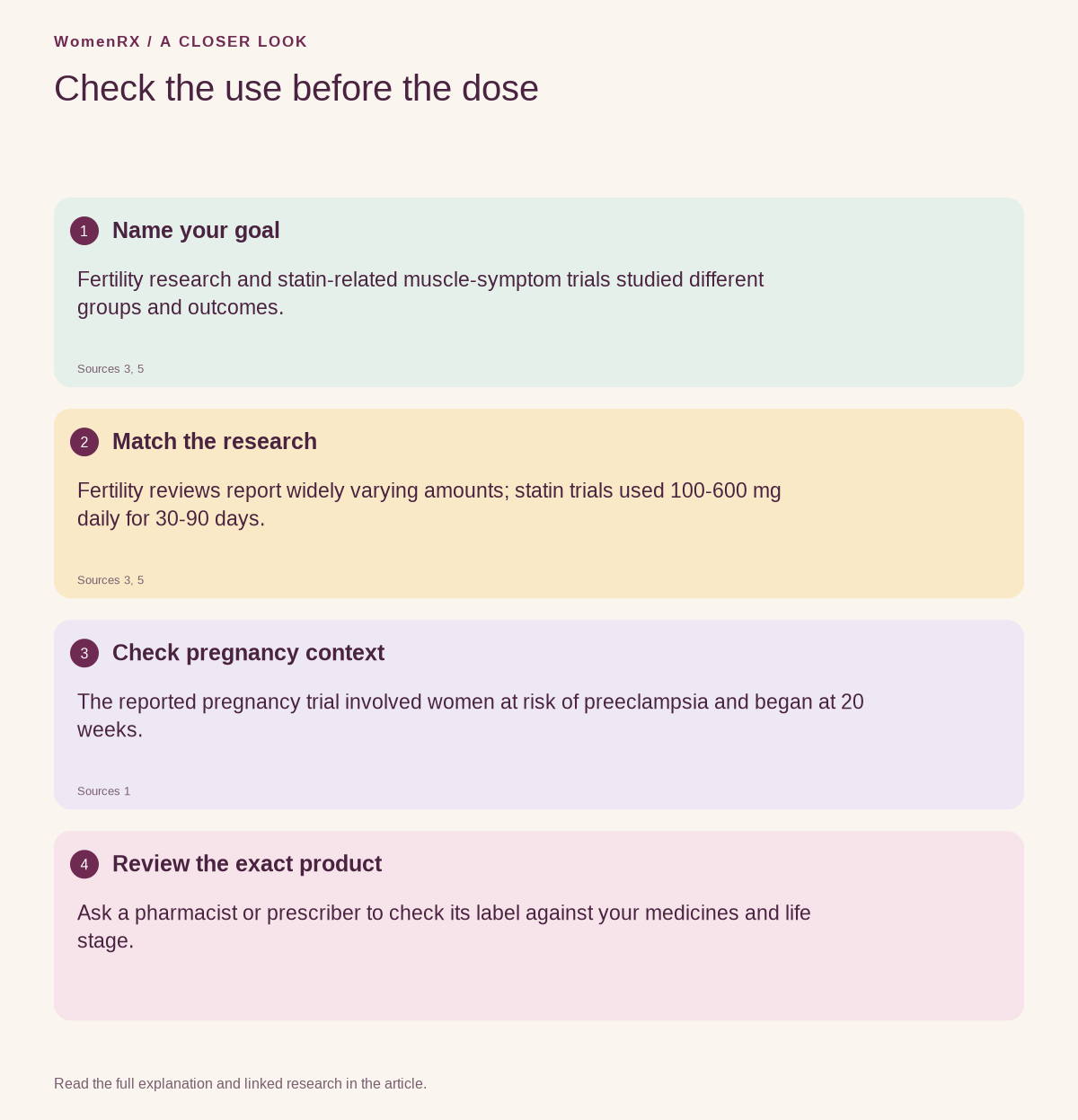
Check the use before the dose
Name your goal: Fertility research and statin-related muscle-symptom trials studied different groups and outcomes.35
Match the research: Fertility reviews report widely varying amounts; statin trials used 100-600 mg daily for 30-90 days.35
Check pregnancy context: The reported pregnancy trial involved women at risk of preeclampsia and began at 20 weeks.1
Review the exact product: Ask a pharmacist or prescriber to check its label against your medicines and life stage.
Read the figure as text
Use these questions to distinguish the research setting from a personal supplement plan.- Name your goal: Fertility research and statin-related muscle-symptom trials studied different groups and outcomes.35
- Match the research: Fertility reviews report widely varying amounts; statin trials used 100-600 mg daily for 30-90 days.35
- Check pregnancy context: The reported pregnancy trial involved women at risk of preeclampsia and began at 20 weeks.1
- Review the exact product: Ask a pharmacist or prescriber to check its label against your medicines and life stage.
More questions, answered
Is there one standard CoQ10 dose for women?
No single dose applies across uses. Fertility studies report widely varying amounts, and statin-related muscle-symptom trials used 100-600 mg daily. Those are study doses, not a general recommendation. 3 5
Does fertility research show that CoQ10 increases live births?
That hasn’t been established. A narrative review reports that a meta-analysis found improved clinical pregnancy rates with CoQ10, but no effect on live birth or miscarriage. A clinical pregnancy result doesn’t by itself show that more pregnancies led to live births. 3
Sources you can check
- A role for the antioxidants coenzyme Q10 and pyrroloquinoline quinone in mitigating obesity-associated reproductive dysfunction†.Castillo-Castrejon M, McClurg HE, Maxted MF, Myers DA, Jonscher KR. · Biology of reproduction · 2026Return to first citation
- Coenzyme Q10 Impact on Ovarian Reserve Measures and the Intra-Cytoplasmic Sperm Injection (ICSI) Outcomes in Women with Poor Ovarian Response: A Randomized Controlled Study.Abdelrahman MA, Gamal M, Salem SA, Ibrahim ARN, Rabea H. · Drug design, development and therapy · 2026Return to first citation
- Therapeutic Roles and Safety Profiles of Non-Vitamin Antioxidant Supplements in Female Infertility: A Narrative Review.Davoudi-Monfared E, Fotouk Kiaie SM, Ebrahimi M. · Journal of family & reproductive health · 2026Return to first citation
- The auxiliary effect of oral nutritional supplements on fertility in women with diminished ovarian reserve: a systematic review and meta-analysis.Li X, Zhao Q, Lin G, Xu L. · Annals of medicine · 2025Return to first citation
- Effects of coenzyme Q10 supplementation on myopathy in statin-treated patients: a systematic review and meta-analysis.Kovacic S, Habicht SD, Eckert GP. · Journal of nutritional science · 2025Return to first citation
- Coenzyme q10 liquid supplementation in dyslipidemic subjects with statin-related clinical symptoms: a double-blind, randomized, placebo-controlled study.Derosa G, D'Angelo A, Maffioli P. · Drug design, development and therapy · 2019Return to first citation