CoQ10: Which Uses Have Evidence?
CoQ10 shows promise for reducing adult migraine attacks, while studies of statin-related muscle pain disagree and reproductive questions remain unanswered.
CoQ10 isn’t a proven fix for every concern. An analysis of adult migraine trials suggests it may reduce how often attacks occur, but two reviews of statin-related muscle pain reached different conclusions. Those findings don’t establish a fertility benefit or safety during pregnancy or breastfeeding. The useful question is what you hope CoQ10 will change. 3 4 6
Start with the outcome you care about
Coenzyme Q10, or CoQ10, is often discussed as though one positive study settles whether it “works.” It doesn’t. Preventing migraine attacks and easing muscle pain in people taking statins are different questions, studied in different groups. A result for one use can’t be carried over to the other.
Migraine: the clearest signal is fewer attacks
A 2026 network meta-analysis brought together 14 randomized trials involving 791 adults with migraine. It estimated a 1.91 reduction on its migraine-frequency measure with CoQ10 compared with placebo. The analysis did not find that supplements significantly shortened attacks, and it could not show that CoQ10 worked better than another supplement. That makes the frequency finding promising, not a prediction of what will happen for you. 6
A trial in children and adolescents illustrates why the outcome and age group matter. Migraine symptoms improved over time in both its CoQ10 and placebo groups, but there was no difference between groups at the study endpoint. That pediatric result doesn’t cancel out the adult analysis; it also shouldn’t be presented as proof that CoQ10 prevents migraine in children. 5 6
If you’re considering CoQ10 for migraine, focus on the claim the adult research supports: it may reduce attack frequency. It hasn’t been shown here to shorten attacks or outperform other supplements. MedlinePlus also lists CoQ10 as a natural treatment that may help prevent migraine. 1 6
Statin-related muscle pain: two reviews, different answers
A 2025 meta-analysis combined seven randomized trials involving 389 statin-treated adults. It found an overall reduction in muscle-pain intensity with CoQ10, although four trials found a significant reduction and three did not. The trials were small, lasted 30 to 90 days, and studied different amounts of CoQ10. The authors said more research was needed for evidence-based recommendations. 3
A 2020 meta-analysis reached a less encouraging conclusion. Across seven trials with 321 participants, it found no significant muscle-pain benefit compared with placebo. It also found no improvement in the proportion of participants who stayed on statin treatment. 4
That disagreement is more useful than a blanket yes or no: CoQ10 isn’t a reliably established solution for statin-related pain. The 2025 review lists trials with both men and women, but its pooled estimate is not a women-only estimate. If you develop muscle symptoms while taking a statin, bring the symptoms, your medication list, and the exact supplement label to your prescriber or pharmacist. Ask how they would assess the pain and check whether the product fits your medication plan. The symptom findings don’t establish whether CoQ10 is suitable alongside your other medicines. 3 4
Pregnancy, breastfeeding, and fertility need their own evidence
The migraine and statin findings don’t answer whether CoQ10 is safe during pregnancy or breastfeeding. At least one trial included in the statin review excluded pregnant and breastfeeding participants; a separate trial of CoQ10 alongside paclitaxel in women with breast cancer excluded them too. Exclusion from those studies is a limit on what their results can tell us, not evidence that CoQ10 is harmful or safe in either circumstance. 2 3
Nor do findings about migraine or muscle pain establish that CoQ10 improves fertility. Its proposed role in cellular energy production is not a measure of someone’s chance of becoming pregnant. If you’re planning pregnancy, pregnant, or breastfeeding, make that part of the discussion about the specific product you’re considering. 2 3 6
The practical comparison is straightforward: for adult migraine, there’s a promising result for how often attacks happen; for statin-related pain, pooled results conflict. For fertility and reproductive safety, neither symptom finding supplies the answer. Decide which of those questions is yours before treating a general CoQ10 claim as relevant to you. 3 4 6
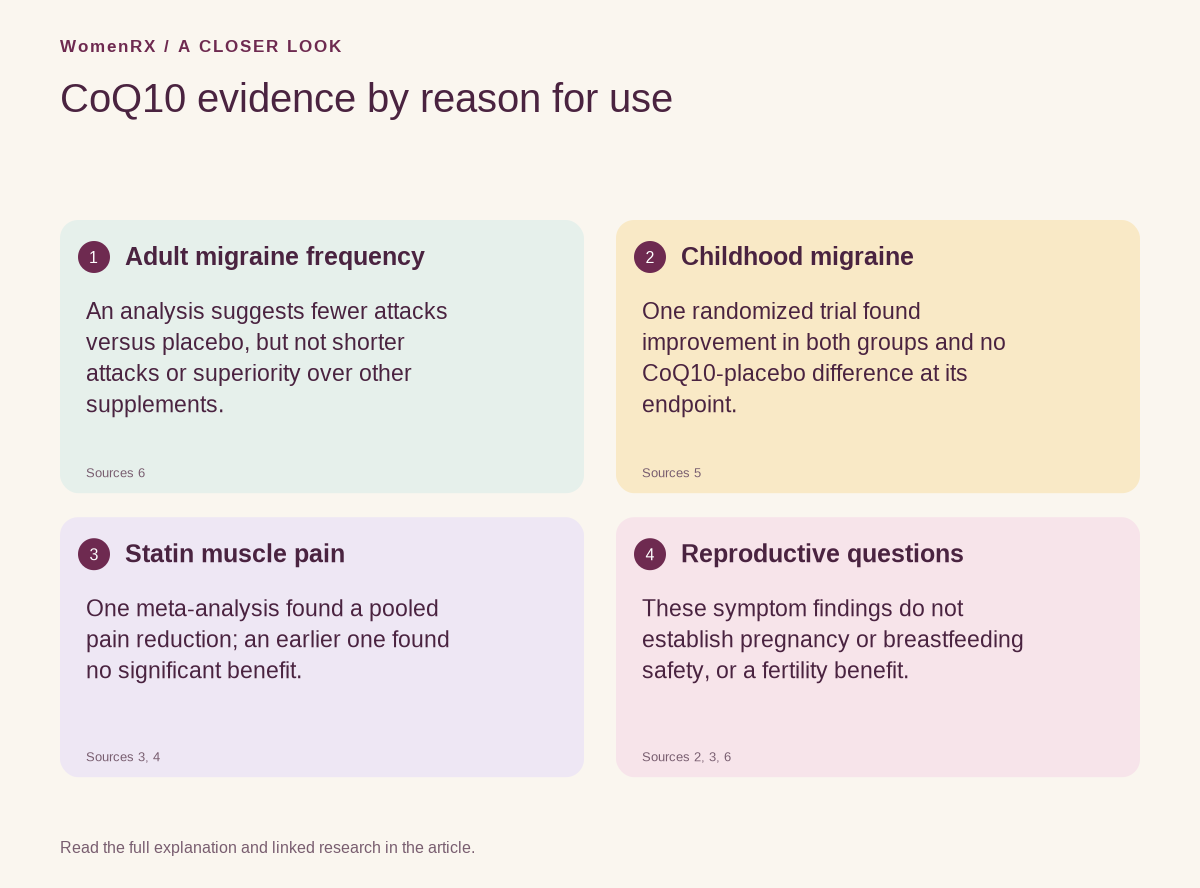
CoQ10 evidence by reason for use
Adult migraine frequency: An analysis suggests fewer attacks versus placebo, but not shorter attacks or superiority over other supplements.6
Childhood migraine: One randomized trial found improvement in both groups and no CoQ10-placebo difference at its endpoint.5
Statin muscle pain: One meta-analysis found a pooled pain reduction; an earlier one found no significant benefit.34
Reproductive questions: These symptom findings do not establish pregnancy or breastfeeding safety, or a fertility benefit.236
Read the figure as text
The finding changes depending on the population and the outcome measured.- Adult migraine frequency: An analysis suggests fewer attacks versus placebo, but not shorter attacks or superiority over other supplements.6
- Childhood migraine: One randomized trial found improvement in both groups and no CoQ10-placebo difference at its endpoint.5
- Statin muscle pain: One meta-analysis found a pooled pain reduction; an earlier one found no significant benefit.34
- Reproductive questions: These symptom findings do not establish pregnancy or breastfeeding safety, or a fertility benefit.236
More questions, answered
Does the research identify a CoQ10 form or amount to choose?
The cited adult migraine summary doesn’t give a CoQ10 form or dose to choose. Statin trials in the 2025 review studied 100 to 600 mg per day, but that range describes research interventions for a different concern, not a recommended dose for migraine or muscle pain. 3 6
Sources you can check
- Migraine | MedlinePlusAccessed 2026-09-25Return to first citation
- Coenzyme Q10 as an adjunctive strategy to reduce paclitaxel-induced toxicities in breast cancer: a randomized controlled trial.Hassoub G, El-Bassiouny NA, Abdelkader Y, Badawy AA, Kassem AB. · BMC pharmacology & toxicology · 2026Return to first citation
- Effects of coenzyme Q10 supplementation on myopathy in statin-treated patients: a systematic review and meta-analysis.Kovacic S, Habicht SD, Eckert GP. · Journal of nutritional science · 2025Return to first citation
- Effect of Coenzyme Q10 on statin-associated myalgia and adherence to statin therapy: A systematic review and meta-analysis.Kennedy C, Köller Y, Surkova E. · Atherosclerosis · 2020Return to first citation
- A randomized, double-blinded, placebo-controlled, crossover, add-on study of CoEnzyme Q10 in the prevention of pediatric and adolescent migraine.Slater SK, Nelson TD, Kabbouche MA, LeCates SL, Horn P, Segers A, Manning P, Powers SW, Hershey AD. · Cephalalgia : an international journal of headache · 2011Return to first citation
- Nutritional supplements for migraine prevention: evaluating evidence sufficiency and effect modifiers through network meta-analysis, trial sequential analysis, and meta-regression.Peng J, Zhou L, Chen Y, Li J, Zhang R. · Frontiers in nutrition · 2026Return to first citation