CoQ10 and Egg Quality: What Fertility Studies Show
CoQ10 may improve some IVF measures for people with poor ovarian response, but whether it increases live births is still unclear.
CoQ10 has a plausible role in egg development, and a randomized IVF trial found more eggs retrieved and more embryos rated highly after pretreatment. It did not establish a significant improvement in pregnancy or live birth. Most evidence concerns people receiving fertility treatment for low ovarian reserve or poor ovarian response, not everyone trying to conceive. 1 3
“Egg quality” sounds like one thing you could measure. In fertility care, it often stands in for several different questions: How many eggs were retrieved? Did they fertilize? How did the embryos develop? Did treatment lead to pregnancy or a live birth? CoQ10 research has more to say about the earlier steps than the last one. 1 3
Why CoQ10 is being studied
CoQ10 helps mitochondria produce energy and has antioxidant activity. Eggs and early embryos depend on cellular energy, so researchers have proposed that CoQ10 supplementation might affect ovarian response or embryo development. That’s a reason to test it, not evidence that a supplement can repair an individual egg or reverse age-related fertility changes. 1
The distinction matters when you see a claim that CoQ10 “improves egg quality.” A higher egg count measures response to ovarian stimulation. An embryo rating describes what a laboratory observed during development. Neither result, on its own, tells you whether taking CoQ10 raises your chance of having a baby. 1
What happened in the randomized IVF trial
A 2018 trial enrolled 186 women under 35 who had poor ovarian reserve measures and were preparing for IVF or intracytoplasmic sperm injection (ICSI). Researchers compared 60 days of CoQ10 pretreatment with no pretreatment; 169 participants were evaluated. The median number of eggs retrieved was four in the CoQ10 group and two in the control group. The CoQ10 group also had a higher fertilization rate and more day-three embryos rated as high quality. 1
Those findings suggest a possible benefit for ovarian response and laboratory outcomes in this particular treatment group. They don’t establish that the eggs were more likely to be chromosomally normal. Pregnancy and live-birth rates tended to be higher with CoQ10 in the trial, but the differences weren’t statistically significant. The trial therefore cannot tell someone that taking CoQ10 will improve her chance of a live birth. 1
Age and treatment context limit how far you can carry these results. Women under 35 with poor ovarian reserve aren’t interchangeable with older IVF patients, people whose fertility difficulty has another cause, or people trying to conceive without treatment. The comparison also used no pretreatment rather than a placebo, and 17 randomized participants were excluded because of low adherence to CoQ10. 1
Why a review sounds more positive about pregnancy
A 2020 systematic review and network meta-analysis examined add-on treatments for poor responders undergoing IVF. It reported higher odds of clinical pregnancy with CoQ10 than with control treatment: an odds ratio of 2.22, with a 95% confidence interval of 1.08 to 4.58. That’s a relative comparison across trials, not a promise that any one person’s chance will double. The review called for higher-quality trials using consistent definitions of poor ovarian response; its reported result does not establish a live-birth benefit. 3
So the review and the randomized trial answer related but different questions. The trial’s egg and embryo findings were clearer than its pregnancy findings. The review combined pregnancy evidence across trials and found a signal, while also identifying reasons more reliable research is needed. Clinical pregnancy is meaningful, but it isn’t the same outcome as live birth. 1 3
Other comparisons need equally careful reading. In a retrospective study of people with decreased ovarian reserve, researchers compared DHEA plus CoQ10 with DHEA alone during IUI or IVF. Some ovarian-response measures differed, but pregnancy and delivery rates were similar. Because this wasn’t a randomized comparison, it offers less confidence about cause and effect; it also cannot tell you what CoQ10 does when taken without DHEA. 2
What this means for your next decision
If you’re planning IVF after a poor response to stimulation, the findings about egg retrieval and embryo numbers may be relevant to a conversation about your treatment plan. If you’re trying to conceive without fertility treatment, these IVF results don’t establish that CoQ10 will help you get pregnant. And if age is part of your concern, a trial limited to women under 35 cannot settle whether the same benefit applies to you. 1 3
CoQ10 is an add-on being investigated, not a substitute for understanding why pregnancy hasn’t happened or choosing fertility care that fits your circumstances. The useful question is more specific than “Does it improve egg quality?” It’s whether the outcome measured in a study matches the outcome you’re hoping to change.
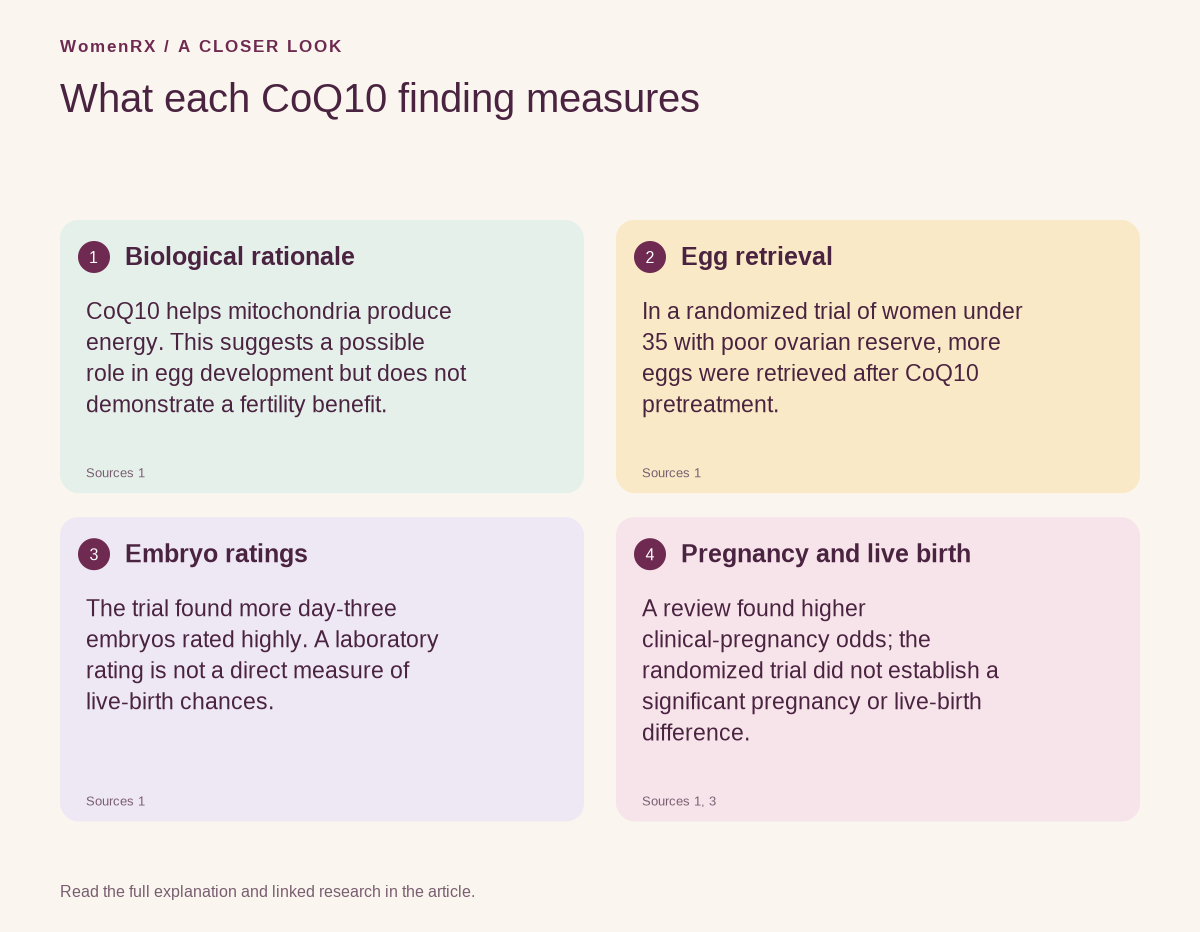
What each CoQ10 finding measures
Biological rationale: CoQ10 helps mitochondria produce energy. This suggests a possible role in egg development but does not demonstrate a fertility benefit.1
Egg retrieval: In a randomized trial of women under 35 with poor ovarian reserve, more eggs were retrieved after CoQ10 pretreatment.1
Embryo ratings: The trial found more day-three embryos rated highly. A laboratory rating is not a direct measure of live-birth chances.1
Pregnancy and live birth: A review found higher clinical-pregnancy odds; the randomized trial did not establish a significant pregnancy or live-birth difference.13
Read the figure as text
Follow the distinction between a reason to study CoQ10, outcomes measured during IVF, and outcomes that matter after treatment.- Biological rationale: CoQ10 helps mitochondria produce energy. This suggests a possible role in egg development but does not demonstrate a fertility benefit.1
- Egg retrieval: In a randomized trial of women under 35 with poor ovarian reserve, more eggs were retrieved after CoQ10 pretreatment.1
- Embryo ratings: The trial found more day-three embryos rated highly. A laboratory rating is not a direct measure of live-birth chances.1
- Pregnancy and live birth: A review found higher clinical-pregnancy odds; the randomized trial did not establish a significant pregnancy or live-birth difference.13
More questions, answered
Does getting more eggs mean CoQ10 improved egg quality?
Not necessarily. Egg retrieval counts show how the ovaries responded to stimulation. The randomized trial also found more embryos rated highly, but it did not establish a statistically significant improvement in pregnancy or live birth. 1
Is there evidence that CoQ10 helps with conception without IVF?
The clearest trial and the systematic review focused on IVF treatment, while another study examined IUI and IVF alongside DHEA use. Those findings do not establish a benefit for conception without fertility treatment. 1 2 3
Sources you can check
- Pretreatment with coenzyme Q10 improves ovarian response and embryo quality in low-prognosis young women with decreased ovarian reserve: a randomized controlled trial.Xu Y, Nisenblat V, Lu C, Li R, Qiao J, Zhen X, Wang S. · Reproductive biology and endocrinology : RB&E · 2018Return to first citation
- The use of coenzyme Q10 and DHEA during IUI and IVF cycles in patients with decreased ovarian reserve.Gat I, Blanco Mejia S, Balakier H, Librach CL, Claessens A, Ryan EA. · Gynecological endocrinology : the official journal of the International Society of Gynecological Endocrinology · 2016Return to first citation
- Adjuvant treatment strategies in ovarian stimulation for poor responders undergoing IVF: a systematic review and network meta-analysis.Zhang Y, Zhang C, Shu J, Guo J, Chang HM, Leung PCK, Sheng JZ, Huang H. · Human reproduction update · 2020Return to first citation