Does Inositol Improve Egg Quality During IVF?
Myo-inositol may improve some lab measures, but better egg or fertilization markers haven’t yet been shown to mean more pregnancies or live births.
There’s a promising but incomplete signal. In a review of 11 IVF studies involving 981 participants, myo-inositol was linked with higher rates of mature eggs and fertilization. The review did not find significant improvements in high-quality embryos or clinical pregnancy, so these lab results don’t establish that inositol improves the chance of taking home a baby. Evidence also varies by patient group. 1
“Egg quality” can mean several different things
In IVF research, egg quality isn’t one universal score. Studies may count how many retrieved eggs reached the mature metaphase II (MII) stage, inspect features of an egg’s structure, or look at what happens after fertilization, such as embryo appearance. These measures describe different steps in the lab, not one interchangeable outcome. 12
That distinction matters when you’re deciding what a reported improvement means. A higher MII rate suggests more eggs reached a stage suitable for fertilization. A better morphology score describes how an egg or embryo looked under particular assessment methods. Neither result, by itself, tells you whether an embryo will lead to a pregnancy or live birth.
What the IVF evidence suggests
A 2025 systematic review and meta-analysis pooled 11 studies, with 981 participants undergoing IVF. It found higher MII egg rates and fertilization rates among women taking myo-inositol than among control groups. The MII result was statistically significant overall and in the PCOS subgroup, including non-obese women with PCOS. The review did not find a significant MII improvement for poor ovarian responders. 1
The next steps in the outcome chain were less convincing. The review found no significant improvement in cleavage rate, high-quality embryo rate, or clinical pregnancy. That’s why it’s more accurate to say myo-inositol may affect some laboratory measures than to say it has been shown to improve egg quality in a way that increases the chance of a baby. 1
The findings are not a guarantee for any one person or cycle. The review combined studies in different groups, and its authors called for stronger prospective randomized research. In particular, its results don’t establish a live-birth benefit. 1
Why one positive morphology study isn’t the whole answer
A small randomized pilot study looked at non-PCOS women with overweight or obesity undergoing IVF. It reported differences in some egg-structure measures and in one day-two embryo score. But participants received myo-inositol together with alpha-lipoic acid and folic acid, so the study can’t show that myo-inositol alone caused the findings. Embryo development measured by time-lapse analysis was comparable between groups, and the authors called for larger trials to assess clinical IVF outcomes. 2
This example shows why the supplement and the endpoint both matter. A result for a combination product isn’t proof about myo-inositol by itself, and a change in an egg or embryo measure isn’t the same as a demonstrated change in pregnancy or birth outcomes.
What this may mean for your treatment decision
The clearest signal in the pooled evidence is for myo-inositol and certain lab outcomes, especially in the PCOS subgroup. It is not consistent evidence that every IVF patient will get more mature eggs, and the review did not show that the lab signals reliably carry through to high-quality embryos or clinical pregnancy. Evidence about myo-inositol also shouldn’t automatically be applied to every product described simply as “inositol,” including blends with other ingredients. 12
If you’re considering a supplement during fertility treatment, ask your fertility team whether the evidence applies to your diagnosis and treatment plan, and have them check the exact product ingredients. That keeps the discussion focused on the question that matters to you: whether a possible change in a lab measure is meaningful for your cycle, rather than assuming it predicts a pregnancy.
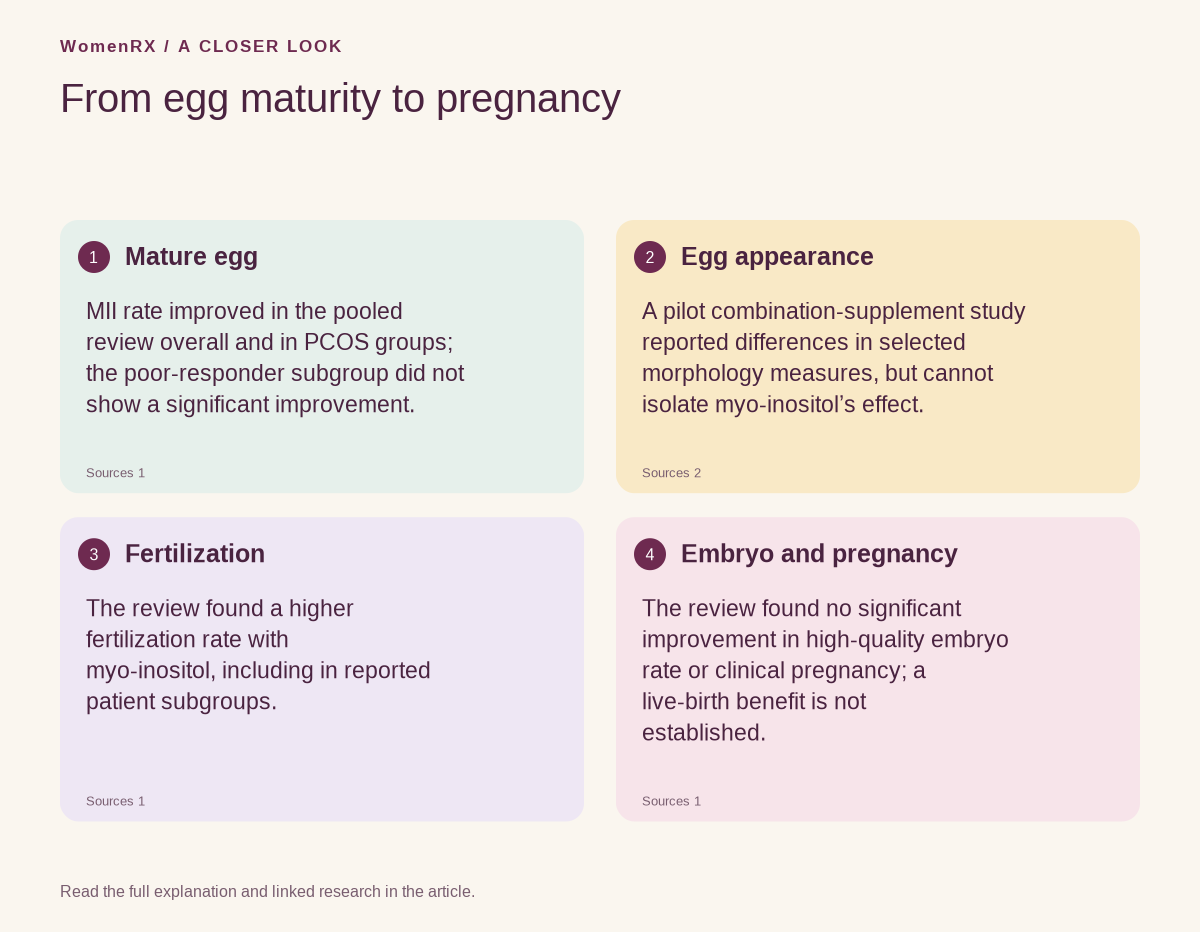
From egg maturity to pregnancy
Mature egg: MII rate improved in the pooled review overall and in PCOS groups; the poor-responder subgroup did not show a significant improvement.1
Egg appearance: A pilot combination-supplement study reported differences in selected morphology measures, but cannot isolate myo-inositol’s effect.2
Fertilization: The review found a higher fertilization rate with myo-inositol, including in reported patient subgroups.1
Embryo and pregnancy: The review found no significant improvement in high-quality embryo rate or clinical pregnancy; a live-birth benefit is not established.1
Read the figure as text
These IVF outcomes sit at different points in the lab-to-pregnancy chain. A change at one stage does not establish a benefit at the next.- Mature egg: MII rate improved in the pooled review overall and in PCOS groups; the poor-responder subgroup did not show a significant improvement.1
- Egg appearance: A pilot combination-supplement study reported differences in selected morphology measures, but cannot isolate myo-inositol’s effect.2
- Fertilization: The review found a higher fertilization rate with myo-inositol, including in reported patient subgroups.1
- Embryo and pregnancy: The review found no significant improvement in high-quality embryo rate or clinical pregnancy; a live-birth benefit is not established.1
Sources you can check
- Effect of myo-inositol supplementation in mixed ovarian response IVF cohort: a systematic review and meta-analysis.Zhang J, Zhang H, Zhou W, Jiang M, Lin X. · Frontiers in endocrinology · 2025Return to first citation
- Effect of a Combination of Myo-Inositol, Alpha-Lipoic Acid, and Folic Acid on Oocyte Morphology and Embryo Morphokinetics in non-PCOS Overweight/Obese Patients Undergoing IVF: A Pilot, Prospective, Randomized Study.Canosa S, Paschero C, Carosso A, Leoncini S, Mercaldo N, Gennarelli G, Benedetto C, Revelli A. · Journal of clinical medicine · 2020Return to first citation