Does Inositol Improve Blood Sugar?
Studies in women with PCOS have tracked glucose and insulin markers, but those results don’t show that inositol prevents or treats diabetes.
Inositol may affect insulin-related markers in women with PCOS, but results depend on what it’s compared with. A review of trials adding inositol to metformin found no statistically significant extra improvement in fasting glucose or HOMA-IR; a broader PCOS review reported improved HOMA-IR. These findings don’t establish diabetes prevention or treatment, or show the same effects in women without PCOS. 2 5
What “better blood sugar” meant in these studies
Inositol research often measures markers that offer different kinds of information. Fasting glucose is a blood sugar reading taken after fasting. Fasting insulin measures insulin in the blood. HOMA-IR is an estimate used to assess insulin resistance. Some studies also use an oral glucose tolerance test, which tracks glucose and insulin responses after a glucose drink. These are not interchangeable measures, and a change in one doesn’t automatically mean a meaningful change in a person’s health.
A1C is a different measure: it reflects average blood glucose over roughly the past three months. The inositol findings described here focus on markers such as fasting glucose and HOMA-IR, not evidence that inositol lowers A1C or prevents someone from developing diabetes. 1 2 5
In PCOS, the comparison changes the answer
One systematic review and meta-analysis combined six randomized trials, with 388 women with PCOS followed for three to six months. It compared metformin plus inositol with metformin alone. The combination did not show a statistically significant additional improvement in fasting glucose or HOMA-IR. That result answers a specific question: whether adding inositol to metformin improves these markers beyond metformin alone. It doesn’t tell us whether inositol alone works, or how it compares with placebo. 2
A broader umbrella meta-analysis of supplement research in women with PCOS reported that myo-inositol improved HOMA-IR. That finding points in a more favorable direction, but it doesn’t cancel out the metformin comparison: the reviews considered different comparisons and evidence groupings. The umbrella review also describes inconsistencies across supplement research and a need for more high-quality studies. Together, the findings suggest a possible effect on an insulin-resistance marker in PCOS, not a settled answer about clinical benefit. 5
A small retrospective study offers another example of why the details matter. In 25 overweight or obese women with PCOS, a 12-week combination containing myo-inositol plus four other ingredients was associated with lower glucose and insulin responses during an oral glucose tolerance test. Because it wasn’t a randomized comparison and the treatment included multiple ingredients, the result can’t establish that inositol itself caused the changes. 3
What this means outside diagnosed PCOS
The results above come from women with PCOS. They don’t establish that inositol improves blood sugar in women without PCOS, or that any possible effect applies to people with prediabetes or diabetes. A reproductive-health review discusses myo-inositol in IVF care for people with and without PCOS, but those fertility outcomes don’t answer whether it improves glucose control in people without PCOS. 4
So if your concern is a high glucose result, don’t treat a supplement’s effect on HOMA-IR as proof that it will lower your glucose or change your risk of diabetes. Those are separate outcomes, and the findings discussed here don’t establish either. For someone already receiving diabetes care, this evidence doesn’t support substituting inositol for that care. Blood glucose targets and treatment plans can be individualized. 1 2 5
A practical way to read an inositol claim
When you see a claim that inositol “balances blood sugar,” ask what was actually measured, in whom, and against what comparison. A result for HOMA-IR in women with PCOS is not the same as a lower fasting glucose, a lower A1C, or fewer cases of diabetes. Also check whether the study tested inositol by itself or as part of a combination. Those distinctions tell you how closely the research matches your own question.
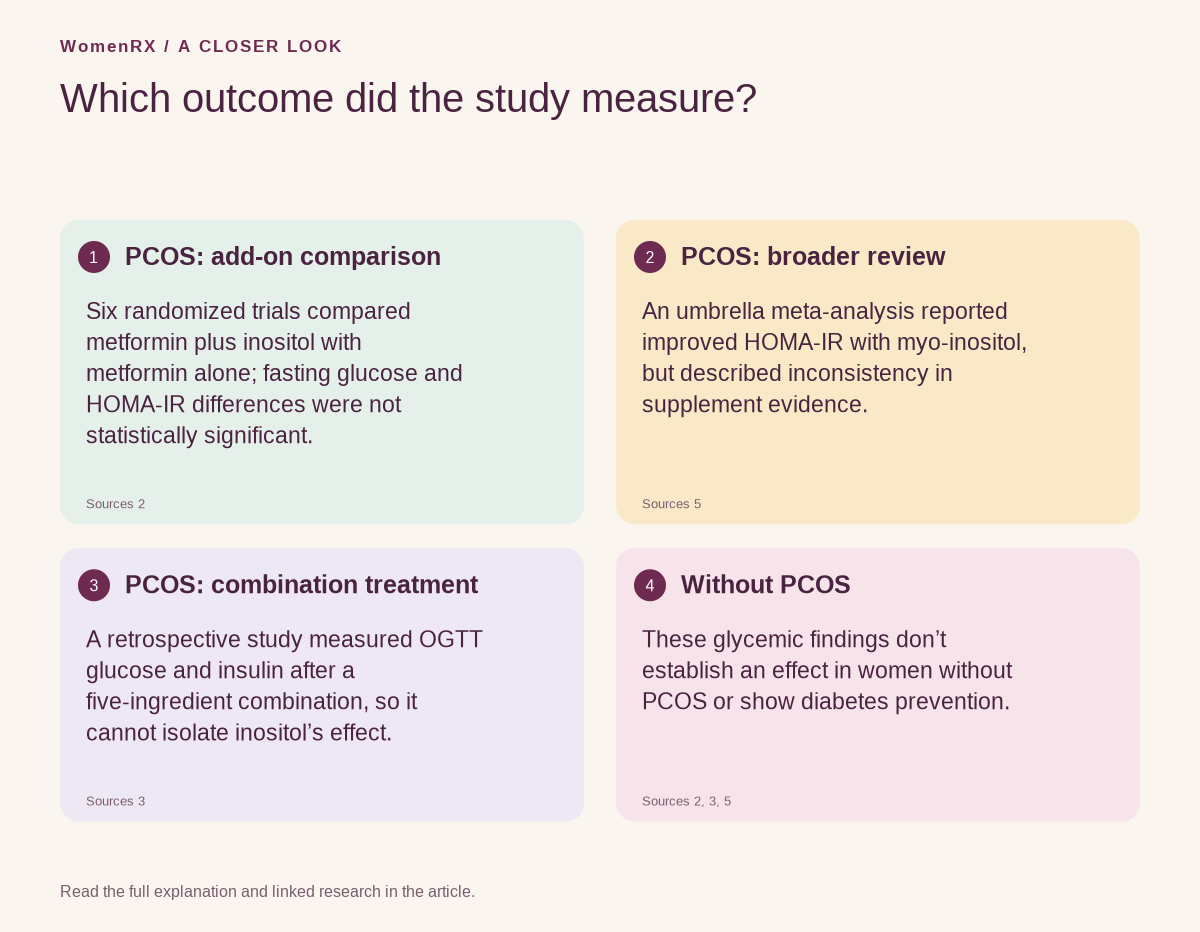
Which outcome did the study measure?
PCOS: add-on comparison: Six randomized trials compared metformin plus inositol with metformin alone; fasting glucose and HOMA-IR differences were not statistically significant.2
PCOS: broader review: An umbrella meta-analysis reported improved HOMA-IR with myo-inositol, but described inconsistency in supplement evidence.5
PCOS: combination treatment: A retrospective study measured OGTT glucose and insulin after a five-ingredient combination, so it cannot isolate inositol’s effect.3
Without PCOS: These glycemic findings don’t establish an effect in women without PCOS or show diabetes prevention.235
Read the figure as text
The population and comparison help show what each inositol finding can, and cannot, tell you about blood sugar.- PCOS: add-on comparison: Six randomized trials compared metformin plus inositol with metformin alone; fasting glucose and HOMA-IR differences were not statistically significant.2
- PCOS: broader review: An umbrella meta-analysis reported improved HOMA-IR with myo-inositol, but described inconsistency in supplement evidence.5
- PCOS: combination treatment: A retrospective study measured OGTT glucose and insulin after a five-ingredient combination, so it cannot isolate inositol’s effect.3
- Without PCOS: These glycemic findings don’t establish an effect in women without PCOS or show diabetes prevention.235
Sources you can check
- Blood Glucose | Blood Sugar | Diabetes | MedlinePlusAccessed 2026-09-25Return to first citation
- Comparison of metformin with inositol versus metformin alone in women with polycystic ovary syndrome: a systematic review and meta-analysis of randomized controlled trials.Kelly FA, de Oliveira Macena Lôbo A, Cardoso JHCO, de Moraes FCA. · Endocrine · 2025Return to first citation
- Improved insulin sensitivity and reproductive profile in overweight/obese PCOS patients undergoing integrative treatment with carnitines, L-arginine, L-cysteine and myo-inositol.Genazzani AD, Battipaglia C, Foschi M, Semprini E, Aio C, Spelta E, Kostrzak A, Rusce ML, Szeliga A, Meczekalski B. · Gynecological endocrinology : the official journal of the International Society of Gynecological Endocrinology · 2025Return to first citation
- The Clinical Use of Myo-Inositol in IVF-ET: A Position Statement from the Experts Group on Inositol in Basic and Clinical Research and on PCOS (EGOI-PCOS), the Polish Society of Andrology, and the International Scientific Association for the Support and Development of Medical Technologies.Wdowiak A, Bakalczuk S, Filip M, Laganà AS, Unfer V. · Journal of clinical medicine · 2025Return to first citation
- Efficacy of dietary supplements as an adjunctive therapy for polycystic ovary syndrome: an umbrella meta-analysis.Wang R, Huang K, Wang M, Zou W, Huang Y, Jiang W, Feng Y, Shen H, Lei X. · Frontiers in nutrition · 2025Return to first citation