Can Inositol Improve Fertility or Pregnancy Chances?
Inositol has possible fertility signals in PCOS research, but better ovulation or pregnancy measures don’t yet establish a higher chance of live birth.
Inositol is studied mainly in women with PCOS. It may affect ovarian function, and a review found a possible increase in clinical pregnancy in PCOS and/or assisted-reproduction studies, but the evidence was very low certainty. That doesn’t establish better odds of live birth, or show that inositol improves chances when trying without fertility treatment. 2 5
Inositol may be worth asking about if you have PCOS, but it isn’t a proven way to increase your chance of having a baby. The key is to separate changes in ovulation or ovarian measures from becoming pregnant, and from having a live birth. A result at one step doesn’t prove a benefit at the next.
The evidence depends on the outcome
Ovulation and ovarian function: PCOS-focused research suggests myo-inositol might affect ovarian function. But findings across studies vary, and a scoping review describes the evidence as heterogeneous, with some results for egg and embryo quality remaining inconsistent. A meta-analysis comparing myo-inositol with metformin also couldn’t establish a difference in ovarian function. 3 5
These findings don’t show that inositol reliably restores ovulation for everyone with PCOS. And a change in cycle regularity or an ovarian measure, on its own, doesn’t establish that pregnancy or live birth is more likely.
Clinical pregnancy: An umbrella review of research reviews found a possible increase in clinical pregnancy with myo-inositol in studies involving women with PCOS and/or assisted reproduction. The certainty was very low. The review concluded that the overall evidence was insufficient to recommend nutrient supplements to improve female infertility, whether trying spontaneously or using medically assisted reproduction. 2
Clinical pregnancy is not the same outcome as live birth. This finding doesn’t show that inositol improves the chance of conceiving while trying at home, or that a pregnancy will continue to birth.
Live birth: The available findings don’t establish that inositol increases live-birth rates. The review’s reported inositol signal concerned clinical pregnancy, while a small IVF study reported pregnancy measures, not proof of a live-birth benefit. 1 2
Why IVF findings don’t answer every fertility question
A retrospective pilot study looked at 92 women with PCOS undergoing IVF-ICSI. It reported more favorable fertilization and pregnancy measures among those using a supplement combining myo-inositol, D-chiro-inositol, and antioxidants. Because the study was observational, it can’t show that the supplement caused the differences. And because it tested a combination, it can’t identify inositol as the reason for any result. 1
This is a different situation from trying to conceive without treatment. The study doesn’t establish that the same supplement, or inositol alone, improves spontaneous conception or live birth.
If you have PCOS, keep treatment options in view
If you have PCOS and irregular or absent ovulation, inositol is best understood as a supplement with uncertain fertility benefits, not a proven substitute for ovulation-induction treatment. A review describing the 2023 international PCOS guideline identifies letrozole as the preferred first-line medicine for ovulation induction in anovulatory PCOS. 4
If you’re considering inositol, it may help to ask what outcome you’re hoping to change: ovulation, pregnancy, or live birth. Also check whether the research relates to your situation, especially if you’re having fertility treatment. Formulas may combine myo-inositol, D-chiro-inositol, antioxidants, or other ingredients, so findings for one combination don’t prove that a different product will have the same effect. 1
For women without PCOS, the available fertility findings don’t answer whether inositol helps when trying without treatment. The clearest takeaway is that PCOS research offers some early signals, but inositol hasn’t been shown to improve live-birth chances.
From ovulation to live birth
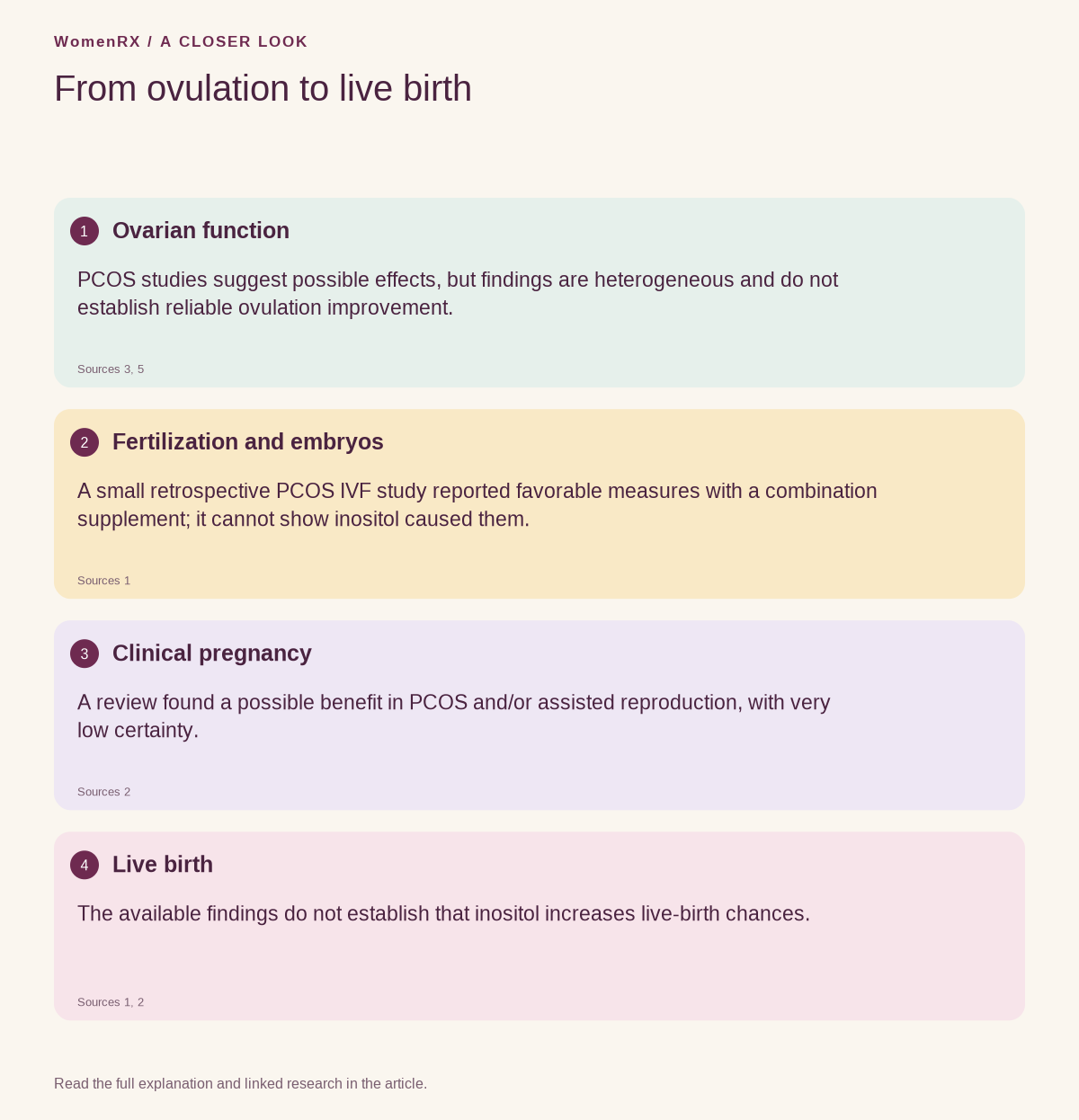
Ovarian function: PCOS studies suggest possible effects, but findings are heterogeneous and do not establish reliable ovulation improvement.35
Fertilization and embryos: A small retrospective PCOS IVF study reported favorable measures with a combination supplement; it cannot show inositol caused them.1
Clinical pregnancy: A review found a possible benefit in PCOS and/or assisted reproduction, with very low certainty.2
Live birth: The available findings do not establish that inositol increases live-birth chances.12
Read the figure as text
Follow the fertility outcomes studied with inositol, and see why a possible signal at one stage doesn’t prove a benefit at the next.- Ovarian function: PCOS studies suggest possible effects, but findings are heterogeneous and do not establish reliable ovulation improvement.35
- Fertilization and embryos: A small retrospective PCOS IVF study reported favorable measures with a combination supplement; it cannot show inositol caused them.1
- Clinical pregnancy: A review found a possible benefit in PCOS and/or assisted reproduction, with very low certainty.2
- Live birth: The available findings do not establish that inositol increases live-birth chances.12
More questions, answered
Does inositol help fertility if I don’t have PCOS?
The fertility findings described in reviews focus on PCOS and/or assisted reproduction. They don’t answer whether inositol improves fertility for women without PCOS who are trying without treatment. 2 5
Can inositol replace ovulation-induction medicine for PCOS?
The findings don’t establish inositol as a replacement. A review describing the 2023 international PCOS guideline identifies letrozole as the preferred first-line medicine for ovulation induction in anovulatory PCOS. 4
Sources you can check
- A 3.6:1 myo-inositol to D-chiro-inositol ratio and antioxidant-based food supplement before IVF improves fertility in women with PCOS: a pilot observational retrospective cohort study.Belchín Fernández P, Calvente V, Gómez Roso MJ, González Expósito E, Silván Bueno A, Aparicio Fluge M, Ordoñez Pérez D. · Journal of obstetrics and gynaecology : the journal of the Institute of Obstetrics and Gynaecology · 2026Return to first citation
- The Role of Nutrient Supplements in Female Infertility: An Umbrella Review and Hierarchical Evidence Synthesis.Pandey C, Maunder A, Liu J, Vaddiparthi V, Costello MF, Bahri-Khomami M, Mousa A, Ee C. · Nutrients · 2024Return to first citation
- The effects of myo-inositol vs. metformin on the ovarian function in the polycystic ovary syndrome: a systematic review and meta-analysis.Azizi Kutenaei M, Hosseini Teshnizi S, Ghaemmaghami P, Eini F, Roozbeh N. · European review for medical and pharmacological sciences · 2021Return to first citation
- Treatment Options for Managing Anovulation in Women with PCOS: An Extensive Literature Review of Evidence-Based Recommendations for Future Directions.Mahoney A, D'Angelo A. · Life (Basel, Switzerland) · 2025Return to first citation
- Effect of Myo-Inositol Supplementation in Polycystic Ovary Syndrome-Scoping Review.Habryka J, Ławniczek M, Krupa-Nurcek S. · Nutrients · 2026Return to first citation