How to Vet CoQ10 Supplement Labels and Quality Claims
A clear label is a starting point, but the form, formulation, and product-specific testing matter too.
Compare the amount per serving, whether the label names ubiquinone or ubiquinol, and what else is in the capsule. Neither form guarantees better absorption on its own: small human studies suggest the formulation can affect how much CoQ10 enters the bloodstream. Ask for a recent test report tied to the product’s lot, and treat absorption claims as different from proof of health benefit. 13
A CoQ10 label can tell you what a company says is in the bottle. It may not tell you whether the finished product contains the stated amount, how well it stays stable, or whether the formulation has been tested in people. A useful comparison starts with what you can verify, not a brand ranking.
Start with the amount and serving
Find the amount of CoQ10 per serving, then check how many capsules make up that serving. Compare products on the same basis rather than comparing a front-label number with a serving-size number on another bottle.
Look for a specific amount of CoQ10, not just a proprietary blend total. If the label lists a blend, ask how much of that blend is CoQ10 itself. A laboratory analysis of 13 supplements and medicines found both reduced and oxidized forms in 85% of the tested products; in some, the form not declared on the label accounted for up to 75% of measured CoQ10. That small product sample does not tell you how common this is across the market, but it shows why a label alone may not confirm the finished product’s contents. 2
Ubiquinone or ubiquinol: compare the whole formulation
Ubiquinone is the oxidized form; ubiquinol is the reduced form. The body can interconvert between them, and the label’s form is only one part of the product. Carrier oils, solubilization, and other ingredients can affect how CoQ10 is absorbed. In a crossover study of 14 healthy people comparing seven 100-mg formulations, absorption differed substantially among products, including products using different forms and formulation ingredients. The study measured blood levels after a single dose, not health outcomes. 14
One small crossover study in 12 healthy adults found higher blood exposure from a particular cocrystal ubiquinol soft gel than from the ubiquinone product it was compared with. That result applies to those specific products and conditions; it does not establish that every ubiquinol product absorbs better than every ubiquinone product. 3
So, don’t choose by form alone or assume a “more bioavailable” claim means a proven health benefit. Ask what finished-product study supports the claim, which exact formulation was tested, and whether the result was a blood-level measure or a clinical outcome.
Read the other ingredients without assuming they’re bad
Check the “other ingredients” list for oils, emulsifiers, preservatives, and any added vitamins or antioxidants. Their presence isn’t automatically a problem. In the 14-person formulation study, the matrix used to dissolve CoQ10 and ingredients such as vitamin C affected absorption. 1
If you have a dietary restriction, allergy, or reason to avoid a particular ingredient, the list can help you rule out a product. If a company claims an ingredient improves absorption, ask for evidence on the finished formula rather than relying on a general statement about that ingredient.
Turn quality claims into questions you can check
Words such as “tested,” “verified,” or “high quality” are less useful than a specific report. Ask the manufacturer:
- Is there a test report for this exact product and lot, and can I see it?
- Who performed the testing, and was the laboratory independent of the manufacturer?
- Did the analysis measure the amount of CoQ10 in the finished product, not just the raw ingredient?
- Does it distinguish ubiquinone from ubiquinol, or report only total CoQ10?
- What did the testing cover besides CoQ10 content, if anything?
- How does the company check that the contents remain stable through the stated shelf life?
A laboratory method has been developed to measure ubiquinone, ubiquinol, and total CoQ10 in products. Separate product testing found that measured total CoQ10 ranged from 82% to 166% of the declared amount in 11 tested products. These findings come from small sets of products, not a survey of every brand. They make a lot-specific report more informative than a broad quality slogan, but a report is only as useful as the product, lot, and measurements it actually covers. 24
A testing seal or certificate is not proof that a supplement improves health. Check what was tested and whether the document identifies the product and lot you’re considering. Also distinguish an analysis of ingredients or content from a clinical study of effects.
Keep the evidence in perspective, including for women
The human absorption studies described here were small, and their reported results do not provide sex-specific comparisons. They can’t tell you whether absorption differs in women. Nor does a label showing ubiquinol, a particular amount, or a testing mark establish a women-specific benefit or a need for a women’s formulation.
Pregnancy, breastfeeding, and fertility treatment are contexts where a product label or an absorption study does not establish suitability. If one applies to you, show the exact product and ingredient list to the clinician managing that care before you start it. That’s a question about your situation, not evidence that CoQ10 is a proven treatment for fertility or another women’s health concern.
A quick label audit
Before buying, write down: the CoQ10 amount per serving; the named form, if provided; the full other-ingredients list; and whether you can obtain testing tied to the specific product lot. Then check whether any absorption claim refers to the exact finished formulation and whether it measures blood levels or a meaningful health outcome. If those details aren’t available, you can compare what is stated without treating the missing information as proof of quality or poor quality.
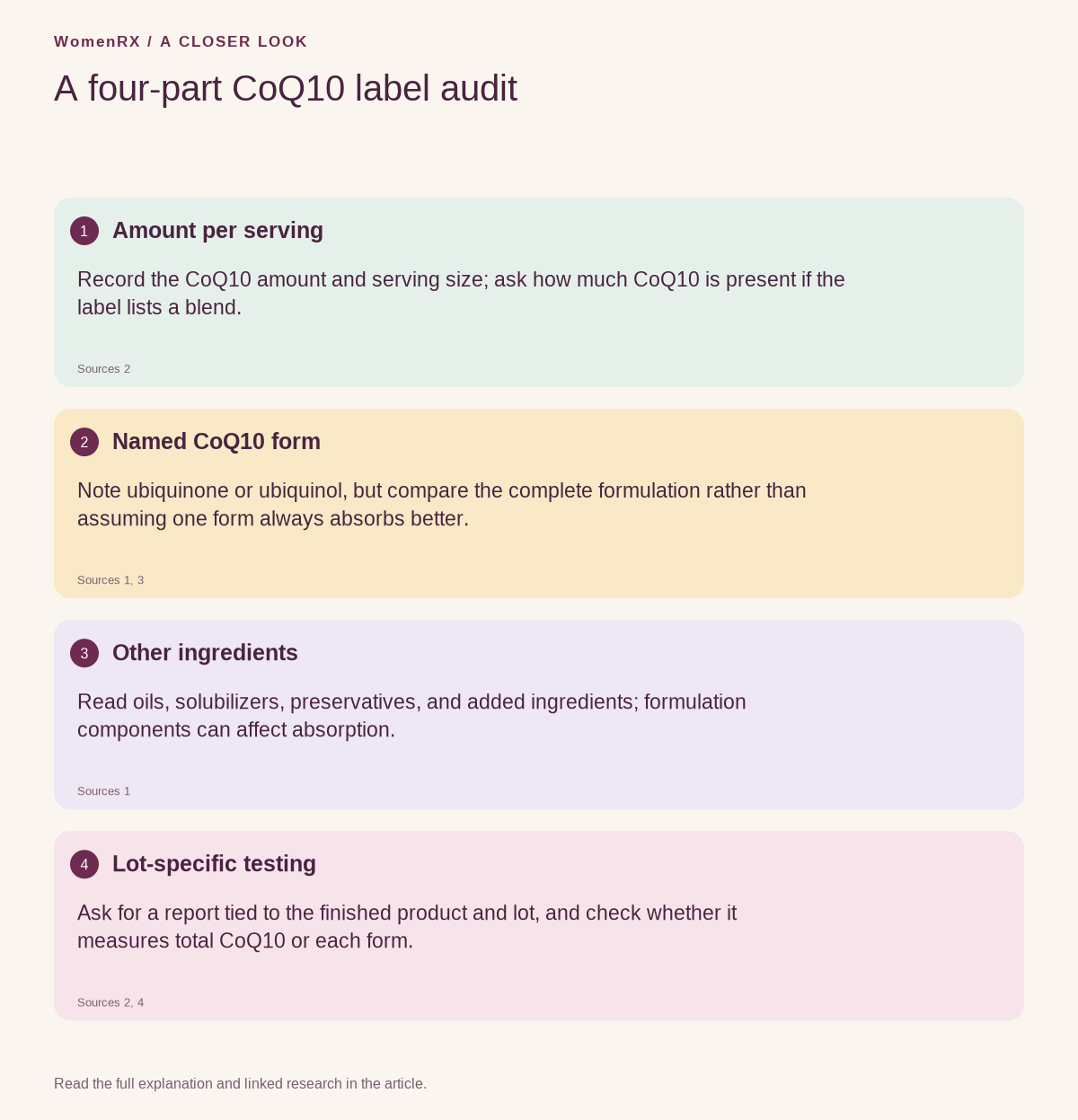
A four-part CoQ10 label audit
Amount per serving: Record the CoQ10 amount and serving size; ask how much CoQ10 is present if the label lists a blend.2
Named CoQ10 form: Note ubiquinone or ubiquinol, but compare the complete formulation rather than assuming one form always absorbs better.13
Other ingredients: Read oils, solubilizers, preservatives, and added ingredients; formulation components can affect absorption.1
Lot-specific testing: Ask for a report tied to the finished product and lot, and check whether it measures total CoQ10 or each form.24
Read the figure as text
Use these checks to separate details printed on the label from claims that need product-specific evidence.- Amount per serving: Record the CoQ10 amount and serving size; ask how much CoQ10 is present if the label lists a blend.2
- Named CoQ10 form: Note ubiquinone or ubiquinol, but compare the complete formulation rather than assuming one form always absorbs better.13
- Other ingredients: Read oils, solubilizers, preservatives, and added ingredients; formulation components can affect absorption.1
- Lot-specific testing: Ask for a report tied to the finished product and lot, and check whether it measures total CoQ10 or each form.24
More questions, answered
Does ubiquinol always absorb better than ubiquinone?
No. One small human study found higher blood exposure for a specific cocrystal ubiquinol product than for its specific ubiquinone comparator, while another small study found that formulation ingredients also affected absorption. Those results don’t establish a universal winner across products. 13
Does a testing seal show that CoQ10 works?
A testing mark or product report may describe what was checked, but content testing and evidence of a health benefit are different things. Ask what the test covered and whether it applies to the finished product and lot you’re considering.
Sources you can check
- Bioavailability of coenzyme Q10 supplements depends on carrier lipids and solubilization.López-Lluch G, Del Pozo-Cruz J, Sánchez-Cuesta A, Cortés-Rodríguez AB, Navas P. · Nutrition (Burbank, Los Angeles County, Calif.) · 2019Return to first citation
- Quantification of reduced and oxidized coenzyme Q10 in supplements and medicines by HPLC-UV.Temova Rakuša Ž, Kristl A, Roškar R. · Analytical methods : advancing methods and applications · 2020Return to first citation
- A Randomized, Double-Blind, Two-Treatment, Two-Period, Crossover Study Investigating the Systemic Bioavailability of a Novel Cocrystal Ubiquinol Formulation Compared with a Ubiquinone Formulation in Healthy Adults.Mei X, Zhu B, Soni K, Kasaraneni K, Panchal N. · Clinical pharmacology in drug development · 2026Return to first citation
- Stability of Reduced and Oxidized Coenzyme Q10 in Finished Products.Temova Rakuša Ž, Kristl A, Roškar R. · Antioxidants (Basel, Switzerland) · 2021Return to first citation