CoQ10 for Egg Quality: What Fertility Studies Show
CoQ10 has a plausible role in egg development, but the most relevant human findings come from fertility-treatment populations and don’t establish a live-birth benefit.
CoQ10 helps cells produce energy, which makes it a plausible supplement to study for egg development. Human findings are most relevant to people with diminished ovarian reserve or a poor response during fertility treatment. Some studies report more retrieved eggs or improved embryo measures, but those outcomes don’t prove CoQ10 improves egg quality or live births for everyone trying to conceive. 124
Why CoQ10 comes up in fertility care
An egg needs energy as it matures and begins developing after fertilization. Coenzyme Q10, usually shortened to CoQ10, participates in the cell machinery that produces that energy and also has antioxidant activity. That gives researchers a reasonable question: could adding CoQ10 help eggs under stress? The mechanism explains why it’s being studied. It doesn’t, by itself, tell us whether taking a supplement leads to a baby. 1
“Egg quality” can also mean several different things in a conversation about fertility. A study might count eggs retrieved during IVF, assess how many fertilize, or grade developing embryos. Those are useful observations, but they aren’t interchangeable with a live birth. Keeping the outcome in view makes the research easier to judge. 24
What human studies have looked at
The clearest reason to consider the research is a specific fertility-treatment situation, not simply being someone who hopes to conceive. A 2025 systematic review and meta-analysis brought together 16 studies involving 2,773 people with diminished ovarian reserve. It evaluated several oral supplements, including CoQ10, vitamins, and DHEA. Across those supplements, the analysis reported differences in ovarian reserve measures, the number of eggs retrieved, and clinical pregnancy rates. Because its headline results combine different supplements, they cannot be read as the effect of CoQ10 alone. Its clinical-pregnancy finding also does not answer whether more babies were born. 4
A network-pharmacology paper cites a human fertility-treatment study in women with poor ovarian response that reported more eggs retrieved, a higher fertilization rate, and more high-quality embryos after CoQ10 pretreatment. That is a narrower, more relevant observation for someone facing a similar IVF concern. It is still a report of intermediate treatment outcomes in a selected group, not proof of a live-birth benefit or a result that automatically applies to someone conceiving without treatment. 2
These population differences matter. Diminished ovarian reserve, poor response to ovarian stimulation, and trying to conceive without a known fertility problem are not the same starting point. The findings above offer a reason to discuss CoQ10 in some treatment settings; they do not establish that it improves eggs for otherwise unselected people trying to conceive. 24
What laboratory findings can and can’t add
Laboratory work helps researchers test the proposed mechanism, but its results need a clear label. In one experiment, researchers placed mouse eggs in culture medium containing follicular fluid from people undergoing fertility treatment, then tested CoQ10 in the medium. Adding it did not significantly improve egg maturation under the conditions reported for fluid from patients with endometriosis. The authors also examined preliminary measures of egg-cell structure. This was not a trial in which people took oral CoQ10 and then had their pregnancy outcomes measured. 3
That distinction protects you from a common leap in supplement claims: an effect on cells, an egg count, or an embryo grade is treated as though it were a demonstrated improvement in the chance of having a baby. Each step asks a different research question. 34
How to use the evidence in your own decision
If you’re preparing for IVF, the useful question is more specific than “Is CoQ10 good for egg quality?” Ask which of your treatment concerns it’s meant to address: an expected low egg yield, a previous poor response, fertilization, or embryo development. Then ask what outcome would make the supplement worthwhile to you and whether the evidence for that outcome comes from people with a similar treatment history. The distinction is especially useful when a study reports more retrieved eggs but not a live-birth result. 24
Before adding any product to an active treatment plan, bring its label to your fertility team. Some products are labeled ubiquinol, the reduced form of CoQ10, but the fertility findings here do not establish that choosing it produces better outcomes. Ask whether the proposed product and timing fit your plan, what to do if you become pregnant, and whether your current medicines change the decision. The fertility outcomes discussed here do not establish pregnancy safety or identify specific medication interactions, so neither should be assumed from an egg or embryo result. 524
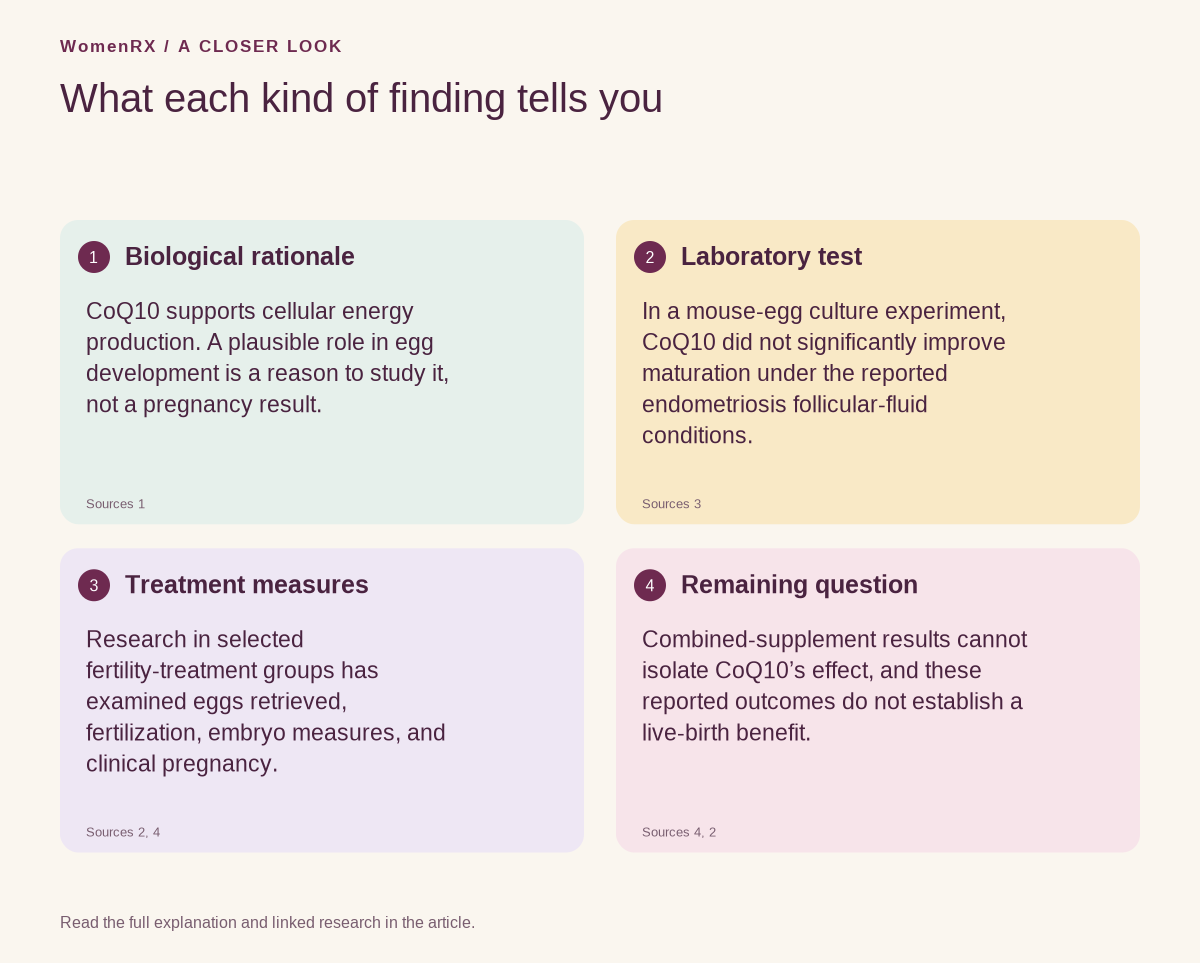
What each kind of finding tells you
Biological rationale: CoQ10 supports cellular energy production. A plausible role in egg development is a reason to study it, not a pregnancy result.1
Laboratory test: In a mouse-egg culture experiment, CoQ10 did not significantly improve maturation under the reported endometriosis follicular-fluid conditions.3
Treatment measures: Research in selected fertility-treatment groups has examined eggs retrieved, fertilization, embryo measures, and clinical pregnancy.24
Remaining question: Combined-supplement results cannot isolate CoQ10’s effect, and these reported outcomes do not establish a live-birth benefit.42
Read the figure as text
Follow the evidence from CoQ10’s proposed role in an egg to outcomes measured during fertility treatment.- Biological rationale: CoQ10 supports cellular energy production. A plausible role in egg development is a reason to study it, not a pregnancy result.1
- Laboratory test: In a mouse-egg culture experiment, CoQ10 did not significantly improve maturation under the reported endometriosis follicular-fluid conditions.3
- Treatment measures: Research in selected fertility-treatment groups has examined eggs retrieved, fertilization, embryo measures, and clinical pregnancy.24
- Remaining question: Combined-supplement results cannot isolate CoQ10’s effect, and these reported outcomes do not establish a live-birth benefit.42
More questions, answered
Does a better ovarian reserve test mean better eggs?
Not necessarily. The supplement review measured reserve markers alongside eggs retrieved and clinical pregnancy. Those are different outcomes; a change in a blood test or egg count does not, on its own, show that eggs are more likely to result in a live birth. 4
Sources you can check
- Exploring the protective effects of coenzyme Q10 on female fertility.Jiang Y, Han Y, Qiao P, Ren F. · Frontiers in cell and developmental biology · 2025Return to first citation
- Systematic Understanding of Anti-Aging Effect of Coenzyme Q10 on Oocyte Through a Network Pharmacology Approach.Yang L, Wang H, Song S, Xu H, Chen Y, Tian S, Zhang Y, Zhang Q. · Frontiers in endocrinology · 2022Return to first citation
- Coenzyme Q10 improves the in vitro maturation of oocytes exposed to the intrafollicular environment of patients on fertility treatment.Romero S, Pella R, Zorrilla I, Berrío P, Escudero F, Pérez Y, García M, Gonzalez C, Orihuela P. · JBRA assisted reproduction · 2020Return to first citation
- The auxiliary effect of oral nutritional supplements on fertility in women with diminished ovarian reserve: a systematic review and meta-analysis.Li X, Zhao Q, Lin G, Xu L. · Annals of medicine · 2025Return to first citation
- Ubiquinol in Fertility and Reproduction: A Conditionally Essential Nutrient for Critical Early-Life Stages.Derbyshire EJ, Ostojic SM, Alahmar AT. · Nutrients · 2026Return to first citation