Does CoQ10 Affect Body Weight?
Trials that measured weight or body composition haven’t shown a clear change attributable to CoQ10.
CoQ10 hasn’t been shown to reliably lower or raise body weight. In a 12-week trial of people with metabolic syndrome, weight was a secondary outcome and did not differ significantly among the CoQ10, curcumin, combination, and placebo groups. A small trial in older adults found no body-composition difference. Neither finding establishes a weight effect for women specifically. 2 3
Look at the comparison, not just the scale
If your weight changes while you’re taking CoQ10, the question is whether CoQ10 caused the change. A trial helps answer that by comparing people taking it with people who aren’t. Weight can also reflect changes in muscle, bone, fat, and water, so a scale reading alone doesn’t tell you what changed. 1
In a 12-week randomized trial, 88 people with metabolic syndrome received CoQ10, curcumin, both, or placebo. Weight and body mass index (BMI) were secondary outcomes; waist circumference was among the primary outcomes. Average weight fell in each group, including the placebo group, but the differences between groups were not statistically significant for weight, BMI, or waist circumference. The drop within the CoQ10 group therefore isn’t evidence that CoQ10 caused weight loss. 3
A different randomized trial followed 40 community-dwelling older adults, whose average age was about 74, for 12 weeks. Body composition was assessed alongside the study’s main focus on mitochondrial function. CoQ10 raised blood levels of CoQ10, but body composition did not differ from placebo. A higher blood level shows that the supplement changed that measure, not that it changed body fat or weight. 2
What research in women adds
A 2023 review of randomized supplement trials in women aged 18 to 49 with polycystic ovary syndrome (PCOS) considered body weight and BMI as well as metabolic measures. Its reported weight and BMI reductions versus placebo were for carnitine, inositol, and probiotics. CoQ10 stood out in the review’s findings for blood lipids, not for weight reduction. A lipid result cannot be treated as a weight-loss result. 4
That review is relevant to women with PCOS, but it isn’t a finding for women at every age or life stage. The reported findings do not provide a menopause-specific CoQ10 weight result. Likewise, the reported results from the metabolic-syndrome and older-adult trials do not break out weight or body composition by sex, and their descriptions do not give enough detail to assess women’s representation. They cannot tell us whether women respond differently. 2 3 4
So, does it help or hurt your weight?
The direct human findings here don’t support using CoQ10 for weight loss, and they don’t show that it causes weight gain. They also have limits: the metabolic-syndrome trial treated weight as a secondary outcome, and the older-adult trial was small and lasted 12 weeks. Neither answers what might happen with longer use or in every population. 2 3
If you’re weighing CoQ10 for another reason, keep that question separate from what you expect on the scale. And if your weight changes suddenly without an apparent reason, it’s worth having that change assessed rather than assuming a supplement explains it. 1
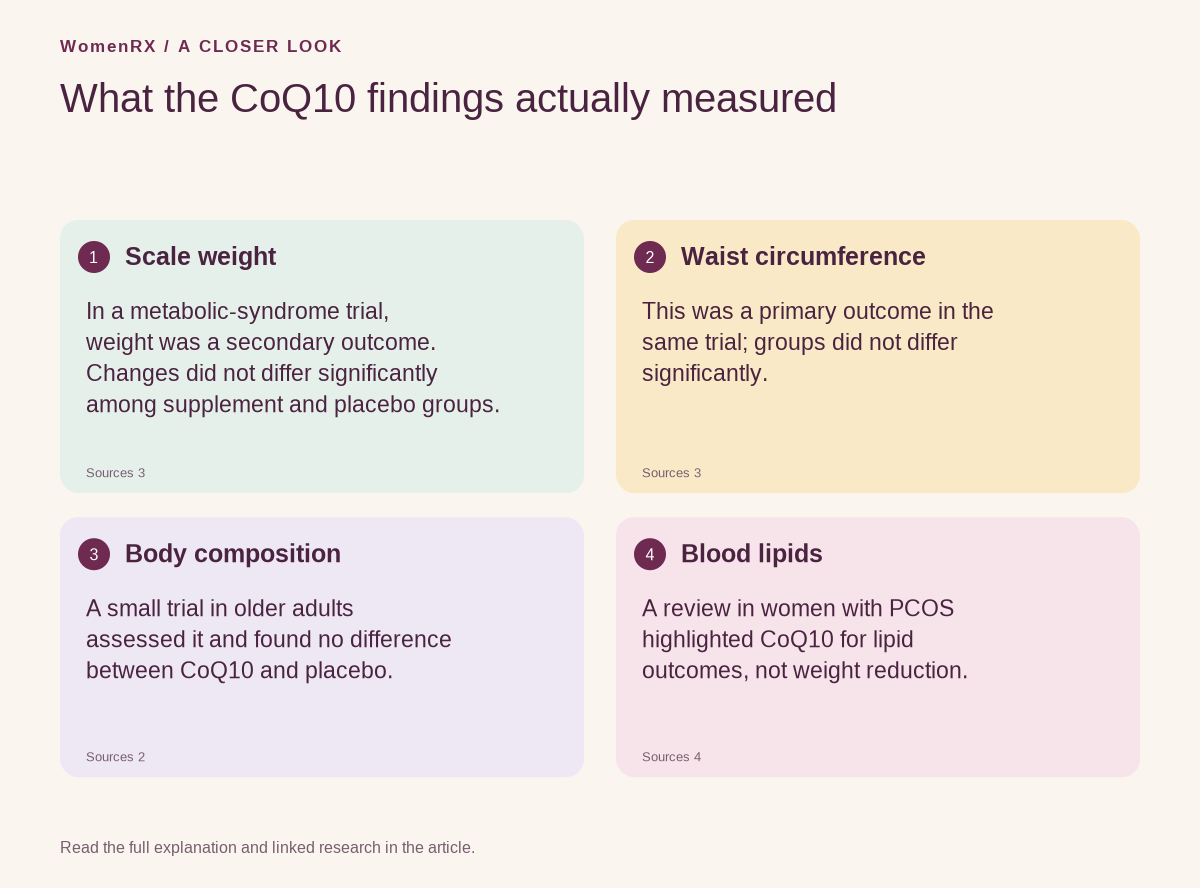
What the CoQ10 findings actually measured
Scale weight: In a metabolic-syndrome trial, weight was a secondary outcome. Changes did not differ significantly among supplement and placebo groups.3
Waist circumference: This was a primary outcome in the same trial; groups did not differ significantly.3
Body composition: A small trial in older adults assessed it and found no difference between CoQ10 and placebo.2
Blood lipids: A review in women with PCOS highlighted CoQ10 for lipid outcomes, not weight reduction.4
Read the figure as text
A quick comparison of weight outcomes, body composition, and blood markers.- Scale weight: In a metabolic-syndrome trial, weight was a secondary outcome. Changes did not differ significantly among supplement and placebo groups.3
- Waist circumference: This was a primary outcome in the same trial; groups did not differ significantly.3
- Body composition: A small trial in older adults assessed it and found no difference between CoQ10 and placebo.2
- Blood lipids: A review in women with PCOS highlighted CoQ10 for lipid outcomes, not weight reduction.4
More questions, answered
Could CoQ10 change body fat without changing scale weight?
A small 12-week trial in older adults assessed body composition and found no difference between CoQ10 and placebo. That result doesn’t settle the question for other ages or health conditions, but it doesn’t show a body-composition benefit hidden by an unchanged scale weight. 2
Sources you can check
- Body Weight: MedlinePlusAccessed 2026-09-25Return to first citation
- Coenzyme Q10 supplementation raises plasma levels without improving mitochondrial function in older adults.Schmücker M, Tranberg C, Borch J, Kaae MK, Damgaard M, Flensted-Jensen M, Blom I, Morosetti M, Barbarossa S, Orlando P, Tiano L, Dela F, Helge JW, Larsen S. · GeroScience · 2026Return to first citation
- Effects of curcumin and/or coenzyme Q10 supplementation on metabolic control in subjects with metabolic syndrome: a randomized clinical trial.Sangouni AA, Taghdir M, Mirahmadi J, Sepandi M, Parastouei K. · Nutrition journal · 2022Return to first citation
- Comparison of nutritional supplements in improving glycolipid metabolism and endocrine function in polycystic ovary syndrome: a systematic review and network meta-analysis.Hu X, Wang W, Su X, Peng H, Tan Z, Li Y, Huang Y. · PeerJ · 2023Return to first citation