How Can You Tell Perimenopause Has Started?
A changing period pattern is often the clearest clue, especially when hot flashes or night sweats are new.
Perimenopause often becomes recognizable when your periods start coming at less predictable intervals, sometimes alongside new hot flashes or night sweats. No single symptom marks its exact start, and there’s no routine blood test that does so. Age, your usual cycle pattern, symptoms, and anything that changes your bleeding all help make sense of what’s happening. 246
Look for a change from your usual pattern
If your periods used to be fairly predictable and now arrive closer together, farther apart, or with skipped months, perimenopause is one possible explanation. Bleeding may also become lighter or heavier. These changes can begin before periods stop altogether. 25
New hot flashes or night sweats make the picture more suggestive, particularly when they appear along with a changing cycle. Sleep problems, low mood, and memory concerns can occur too, but none of these symptoms on its own tells you when perimenopause began. The transition varies from person to person. 456
Age adds context rather than giving you an answer by itself. Menopause usually occurs between ages 45 and 55, though it can happen earlier. Perimenopause is the transition leading up to the final period, while menopause is identified after 12 months without a period when you’re not using hormonal contraception. That means you generally can’t identify your final period while it’s happening. 26
Why a hormone test usually isn’t the shortcut
There’s no routine test for perimenopause or menopause; a clinician may identify the transition from your age and symptoms. A blood test isn’t a universal way to pinpoint its start. 6
Testing can matter in a different situation: possible early menopause. NICE guidance says an FSH blood test may be considered to help confirm menopause in people ages 40 to 45 who have menopause-related symptoms, including a cycle change. For someone under 40 with suspected premature ovarian insufficiency, its guidance calls for assessment that includes elevated FSH on two blood samples taken weeks apart. These are reasons to seek an assessment, not reasons to interpret one test result on your own. 4
When the period clue is missing or misleading
Hormonal contraception can make periods irregular or stop them, so its bleeding pattern may not show where you are in the transition. NICE also advises against using FSH to identify menopause while someone is using combined estrogen-progestogen contraception or high-dose progestogen. If you’re using a method that changes your periods, symptoms and your treatment history become especially relevant to the conversation. 45
A hysterectomy removes the menstrual clue: without periods, you can’t use a 12-month gap to identify a final one. It doesn’t, by itself, tell you whether your ovaries were removed. That distinction is worth making when discussing symptoms, because surgery to remove the ovaries can cause early menopause. Chemotherapy, radiotherapy, and certain hormone medicines can also be involved in early menopause. 27
If you’re under 45 and having menopause-like symptoms or your periods are becoming irregular or stopping, arrange a clinical assessment rather than assuming it’s the usual midlife transition. Early menopause is defined as periods becoming irregular or stopping before 45; before 40, it’s considered premature. 7
Changes that deserve attention even if perimenopause seems likely
A changing cycle doesn’t make every kind of bleeding a normal part of perimenopause. Heavy bleeding that disrupts your life, severe period pain, bleeding between periods, or bleeding after sex warrants assessment. Heavy periods can occur as menopause approaches, but fibroids, adenomyosis, and other conditions can cause them too. A clinician may also check for iron-deficiency anemia when bleeding is heavy. 13
Any vaginal bleeding after 12 months without a period should be assessed, even if it’s only spotting. And if pregnancy is possible, don’t take an irregular or missed period as proof that you can’t become pregnant: pregnancy remains possible during perimenopause. 5
The useful question isn’t whether one symptom proves you’ve entered perimenopause. It’s whether your changing pattern fits the transition and whether anything about your age, bleeding, contraception, or treatment history calls for another explanation. 1457
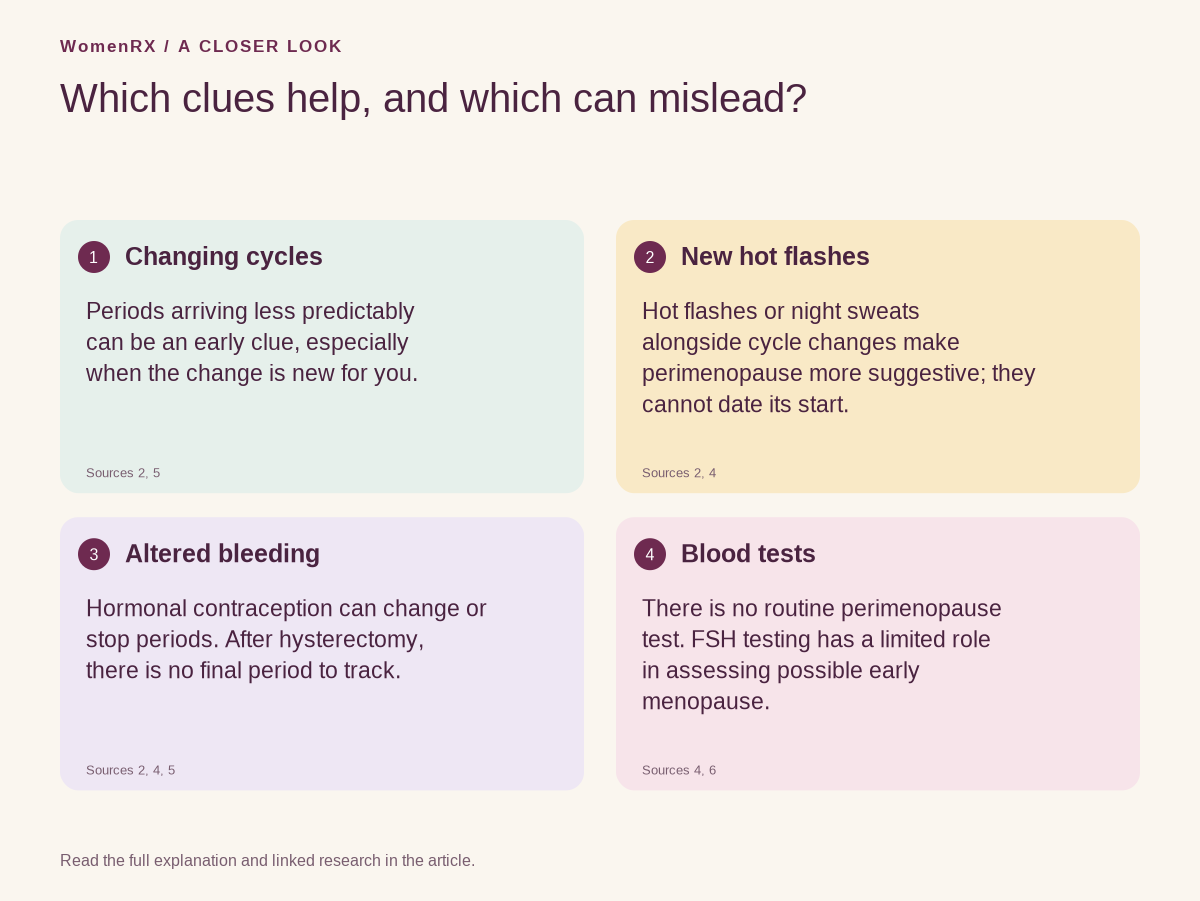
Which clues help, and which can mislead?
Changing cycles: Periods arriving less predictably can be an early clue, especially when the change is new for you.25
New hot flashes: Hot flashes or night sweats alongside cycle changes make perimenopause more suggestive; they cannot date its start.24
Altered bleeding: Hormonal contraception can change or stop periods. After hysterectomy, there is no final period to track.245
Blood tests: There is no routine perimenopause test. FSH testing has a limited role in assessing possible early menopause.46
Read the figure as text
A quick comparison of the signals used to recognize the transition and the situations that change their meaning.- Changing cycles: Periods arriving less predictably can be an early clue, especially when the change is new for you.25
- New hot flashes: Hot flashes or night sweats alongside cycle changes make perimenopause more suggestive; they cannot date its start.24
- Altered bleeding: Hormonal contraception can change or stop periods. After hysterectomy, there is no final period to track.245
- Blood tests: There is no routine perimenopause test. FSH testing has a limited role in assessing possible early menopause.46
Sources you can check
- Heavy periods - NHSAccessed 2026-09-25Return to first citation
- Hormone Therapy for the Primary Prevention of Chronic Conditions in Postmenopausal Persons: US Preventive Services Task Force Recommendation Statement.US Preventive Services Task Force, Mangione CM, Barry MJ, Nicholson WK, Cabana M, Caughey AB, Chelmow D, Coker TR, Davis EM, Donahue KE, Jaén CR, Kubik M, Li L, Ogedegbe G, Pbert L... · JAMA · 2022Return to first citation
- Uterine Leiomyomas Across the Menopausal Transition.Encalada-Soto D, Hochberg LS, Laughlin-Tommaso S. · Obstetrics and gynecology · 2026Return to first citation
- Recommendations | Menopause: identification and management | Guidance | NICEAccessed 2026-09-25Return to first citation
- Symptoms of menopause and perimenopause - NHSAccessed 2026-09-25Return to first citation
- What are menopause and perimenopause? - NHSAccessed 2026-09-25Return to first citation
- Early or premature menopause - NHSAccessed 2026-09-25Return to first citation