After Menopause: Symptoms, Health Changes, and What May Be Unrelated
Some symptoms can remain menopause-related, but bone-health risks and new or changing symptoms call for a different kind of attention.
Menopause is reached after 12 months without a period. Afterward, hot flashes, vaginal changes, and some urinary problems may still be relevant, but a new symptom shouldn’t automatically be blamed on hormones. Bone-density loss is a separate health risk, influenced by menopause as well as age, family history, health conditions, and medications. The pattern and your health history help determine what deserves assessment. 1 2 3
First, separate symptoms from health risks
Menopause is defined by having gone 12 months without a period. The hormone changes around this transition can cause symptoms, but reaching menopause doesn’t mean every later health change is a side effect of menopause. 1
A useful distinction is between symptoms you feel, health changes that may not cause obvious symptoms, and new concerns that need their own explanation. These categories can overlap, but they shouldn’t be treated as interchangeable.
Symptoms that may still fit the menopause picture
Hot flashes and night sweats are vasomotor symptoms associated with menopause. Sleep difficulties, mood changes, and decreased vaginal moisture are also described among symptoms in women going through the transition to postmenopause. Symptoms vary from one woman to another. 3
Vaginal dryness or discomfort during sex can relate to changes in vaginal tissue after menopause. Bladder symptoms, including urinary incontinence, may also occur. These are real symptoms worth addressing; they’re not something you have to dismiss as an inevitable part of aging. 1 4
A symptom’s connection to menopause is more plausible when it fits a recognized pattern, such as hot flashes or ongoing vaginal dryness. But that pattern is a clue, not proof of the cause. For example, continuing hot flashes can remain a menopause-related concern, while a new urinary problem that makes you suspect an infection shouldn’t simply be written off as hormones. MedlinePlus lists both incontinence and urinary tract infections among possible bladder issues around menopause, which makes it especially useful to distinguish a familiar, ongoing symptom from a new concern. 1 3
Bone loss is a health risk, not a menopause “side effect” you can feel
Lower estrogen after menopause contributes to bone loss, which can increase the chance of osteoporosis and fractures. That’s different from a symptom such as a hot flash: bone density is a health measure, and osteoporosis can weaken bones. Menopause contributes to risk, but it isn’t the only factor. Age, genetics, smoking, thinness, certain diseases, and some medications also matter. 1 2
That distinction changes the next step. A symptom-focused conversation is useful for hot flashes, sleep problems, or vaginal discomfort. Bone health calls for considering your overall fracture risk and whether screening or prevention makes sense for you. The North American Menopause Society’s position statement recommends assessing risk factors and individualizing decisions; it does not treat every postmenopausal woman as having the same risk. 2
When a new symptom deserves its own explanation
A new, worsening, or persistent problem shouldn’t be labeled a menopause effect just because it began after your periods stopped. This is particularly worth remembering when a symptom is different from your usual pattern, or when a health condition or medication could also be relevant. Some diseases and drugs can affect bone health, for example, so even a familiar risk category may have more than one contributor. 2
You don’t need to decide the cause on your own. Describe what changed, when it began, whether it comes and goes, and how it differs from symptoms you already know. That gives a clinician useful context for considering menopause alongside other explanations. MedlinePlus recommends discussing symptoms in light of your medical and family history and preferences. 1
The practical takeaway: recognize familiar menopause-associated symptoms, treat bone health as a separate risk question, and give new or changing concerns an independent explanation. Time since your final period, age, health history, and medications all help put the pieces in context.
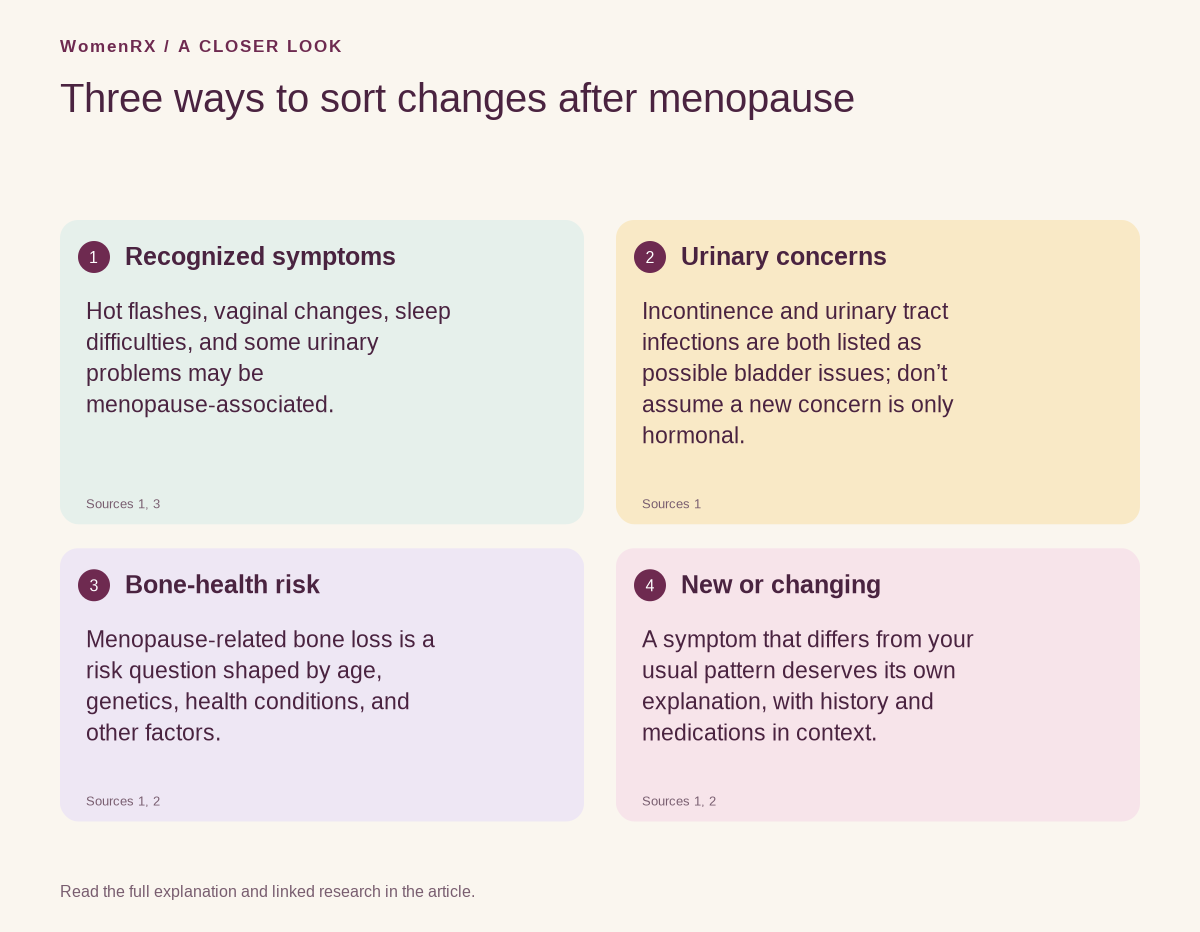
Three ways to sort changes after menopause
Recognized symptoms: Hot flashes, vaginal changes, sleep difficulties, and some urinary problems may be menopause-associated.13
Urinary concerns: Incontinence and urinary tract infections are both listed as possible bladder issues; don’t assume a new concern is only hormonal.1
Bone-health risk: Menopause-related bone loss is a risk question shaped by age, genetics, health conditions, and other factors.12
New or changing: A symptom that differs from your usual pattern deserves its own explanation, with history and medications in context.12
Read the figure as text
A symptom, a longer-term health risk, and a new concern may need different kinds of attention.- Recognized symptoms: Hot flashes, vaginal changes, sleep difficulties, and some urinary problems may be menopause-associated.13
- Urinary concerns: Incontinence and urinary tract infections are both listed as possible bladder issues; don’t assume a new concern is only hormonal.1
- Bone-health risk: Menopause-related bone loss is a risk question shaped by age, genetics, health conditions, and other factors.12
- New or changing: A symptom that differs from your usual pattern deserves its own explanation, with history and medications in context.12
More questions, answered
Does every woman develop osteoporosis after menopause?
No. Menopause-related estrogen loss contributes to bone loss, but risk also depends on factors such as age, genetics, smoking, body build, health conditions, and medications. Bone-health decisions are based on individual risk, not menopause status alone. 1 2
Can urinary symptoms be related to menopause?
They can. Incontinence and urinary tract infections are both listed among possible bladder issues around menopause. Because they are different kinds of problems, a new concern for infection shouldn’t automatically be assumed to be hormonal. 1
Sources you can check
- Menopause | Menopause Symptoms | MedlinePlusAccessed 2026-09-25Return to first citation
- Management of osteoporosis in postmenopausal women: the 2021 position statement of The North American Menopause Society.Menopause (New York, N.Y.) · 2021Return to first citation
- Effects of Physical Exercise on Symptoms and Quality of Life in Women in Climacteric: A Systematic Review and Meta-Analysis.Trujillo-Muñoz PJ, Sánchez-Ojeda MA, Rodríguez-Huamán EC, Mezyani-Haddu K, Hoyo-Guillot I, Navarro-Prado S. · Healthcare (Basel, Switzerland) · 2025Return to first citation
- Examining the Health-Related Needs of Females during Menopause: A Systematic Review Study.Rostami-Moez M, Masoumi SZ, Otogara M, Farahani F, Alimohammadi S, Oshvandi K. · Journal of menopausal medicine · 2023Return to first citation