Creatine and the Scale: What Weight Changes Mean
A higher number after starting creatine doesn’t tell you whether the change is water, lean mass, or fat.
Creatine can be associated with a small increase in body weight when paired with resistance training, but that doesn’t mean fat mass increased. In a meta-analysis, lean mass and body weight rose compared with resistance training alone, while the difference in fat mass wasn’t statistically significant. Lean-mass measures can also partly reflect water, especially in shorter studies. 4 2
The scale adds everything together
Your weight is the total mass of your body. It includes water, muscle, fat, and bone, so the scale can’t tell you what accounts for a change. A higher reading after starting creatine isn’t, by itself, evidence of fat gain. 1
The type of measure in a study matters, too. Researchers report outcomes such as body weight, lean mass, fat-free mass, fat mass, and body-fat percentage. These are separate measures, not interchangeable ways of saying “muscle.” In particular, a lean-mass or fat-free-mass increase doesn’t necessarily mean all the added mass is new muscle tissue.
A review of trials in healthy men aged 18 to 30 cautioned that increases in lean or fat-free mass, especially in shorter studies, may partly reflect creatine-related water retained inside cells. That finding helps explain why a body-composition result can rise without showing how much contractile muscle has been added. It is evidence from men, not a women-specific estimate. 2
What changes when creatine is paired with lifting?
A meta-analysis of 63 studies compared resistance training plus creatine with resistance training alone. The creatine-plus-training group had significantly greater lean mass and body weight. The difference in fat mass was not statistically significant, while body-fat percentage decreased slightly. These are group-level results, not a prediction of what will happen to your weight or body composition. 4
The findings don’t mean that every increase in weight is lean mass, or that creatine causes fat loss. They show why it helps to keep the outcomes separate: the pooled results for body weight, lean mass, fat mass, and body-fat percentage did not all move in the same way. The meta-analysis does not provide a women-only estimate in its reported results. 4
A separate review focused on healthy young men found increases in lean and fat-free mass when creatine was combined with resistance training, but not significant increases in those measures without resistance training. Its authors also noted that water could contribute to short-term lean-mass changes. Because the review included men aged 18 to 30, it can’t establish the same result for women. 2
What women’s research can and can’t tell you
A female-specific review included 34 studies with 692 female or female-eligible participants. Its body-composition category covered several distinct outcomes, including body mass, fat mass, lean or fat-free mass, and body-water measures. Because studies and measures varied, the review rated the body-composition evidence as low certainty. It suggests possible small effects on selected measures, not one dependable scale response for women. 3
The review summary doesn’t report whether body-composition measurements were consistently timed to menstrual-cycle phase or adjusted for cycle-related weight variation. So it can’t tell you whether cycle timing affected the results. If you track your own weight and notice a recurring cycle-related pattern, you can record that timing alongside the number; treat it as personal context, not proof of what changed in body composition.
Read the trend, then check the measure
If you want to see how your weight changes over time, compare readings taken under similar conditions and look at the pattern rather than drawing a conclusion from one weigh-in. If you’re also training, note that context. Training and creatine together were associated with changes in lean mass and body weight in pooled studies, but neither a scale reading nor a training log identifies exactly which tissue changed. 4
If you have a body-composition result, check what it actually reports. Lean mass can include water; fat mass is a separate outcome; and body-fat percentage is another measure. For example, in the resistance-training meta-analysis, body-fat percentage decreased slightly even though the difference in fat mass was not statistically significant. That doesn’t prove fat loss for any one person. 2 4
The useful takeaway is simple: a scale increase is a change in total body mass, not a fat measurement. Look at the measure, the timeframe, and whether resistance training was part of the study or your routine before deciding what the number means.
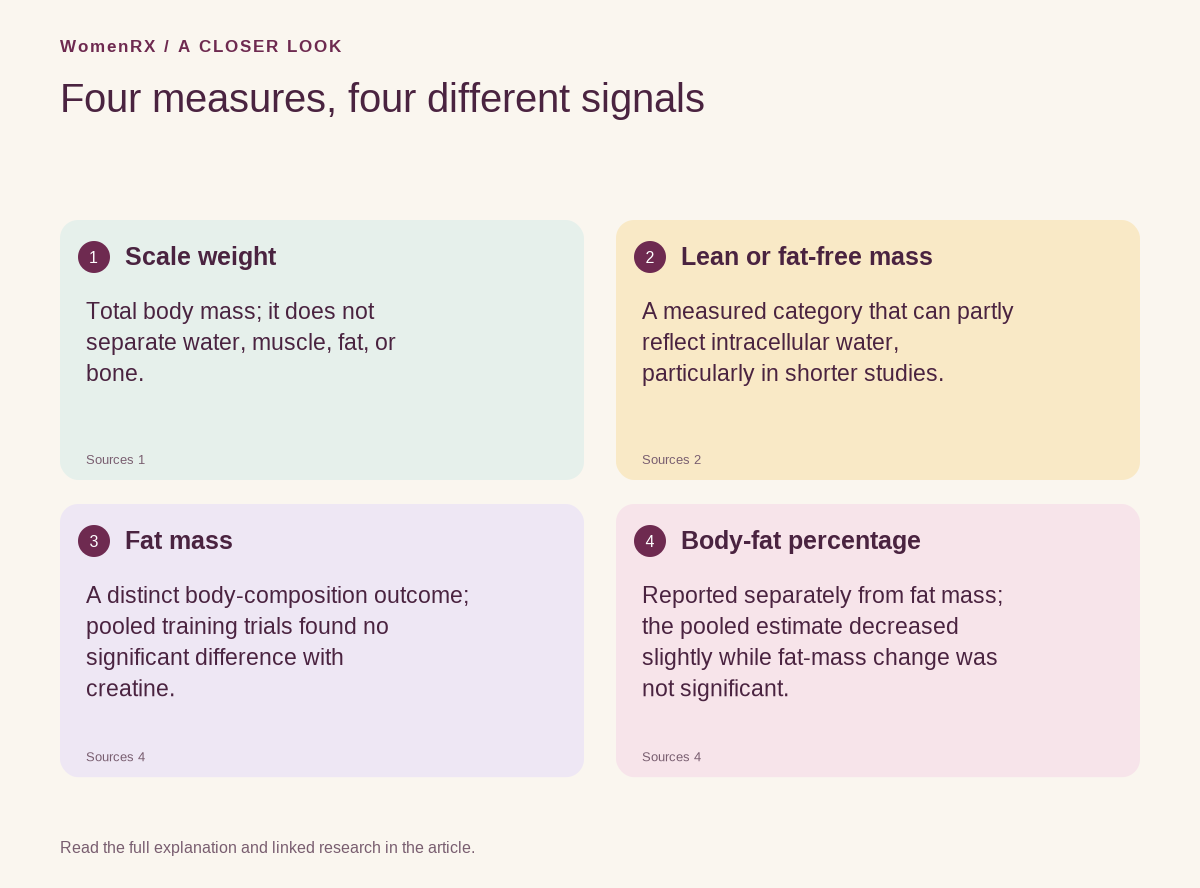
Four measures, four different signals
Scale weight: Total body mass; it does not separate water, muscle, fat, or bone.1
Lean or fat-free mass: A measured category that can partly reflect intracellular water, particularly in shorter studies.2
Fat mass: A distinct body-composition outcome; pooled training trials found no significant difference with creatine.4
Body-fat percentage: Reported separately from fat mass; the pooled estimate decreased slightly while fat-mass change was not significant.4
Read the figure as text
A change in one body measure doesn’t automatically mean the others changed in the same way.- Scale weight: Total body mass; it does not separate water, muscle, fat, or bone.1
- Lean or fat-free mass: A measured category that can partly reflect intracellular water, particularly in shorter studies.2
- Fat mass: A distinct body-composition outcome; pooled training trials found no significant difference with creatine.4
- Body-fat percentage: Reported separately from fat mass; the pooled estimate decreased slightly while fat-mass change was not significant.4
More questions, answered
Does a small decrease in body-fat percentage prove fat mass went down?
No. They’re separate outcomes. In a meta-analysis of resistance training plus creatine, body-fat percentage decreased slightly, but the difference in fat mass was not statistically significant. That group result doesn’t establish what happened for any individual. 4
Do women’s creatine studies account for menstrual-cycle timing?
The female-specific review’s reported summary doesn’t say whether body-composition measurements were consistently timed to cycle phase or adjusted for cycle-related weight variation. It therefore doesn’t establish how those factors affected the results. 3
Sources you can check
- Body Weight: MedlinePlusAccessed 2026-09-25Return to first citation
- Creatine supplementation in young men under resistance versus non-resistance training: a systematic review and meta-analysis of strength, performance, and lean mass.Gu J, Li Y, Xiao J, Zhang Y. · Frontiers in nutrition · 2026Return to first citation
- Effects of creatine supplementation on exercise performance, physiological outcomes, and body composition in females engaged in exercise or training: a systematic review and multilevel meta-analysis.Lin Y, Zhu W, Hong B. · Frontiers in nutrition · 2026Return to first citation
- Resistance training combined with creatine supplementation: a three-level meta-analysis of multidimensional outcomes from strength enhancement to body composition remodeling.Wang H, Wang H, Xin X, Yi Z. · Journal of the International Society of Sports Nutrition · 2026Return to first citation