Creatine Monohydrate or HCl: How to Choose
HCl mixes more readily with water, but that doesn’t establish better absorption, fewer digestive symptoms, or better results for women.
Creatine monohydrate is the more established choice. HCl is more water-soluble, which may matter if you dislike how a powder mixes, but that difference doesn’t prove better absorption or results. A short trial found advantages for HCl on selected measures in male soccer players; it doesn’t establish a winner for women. Check the form and serving details rather than choosing by an absorption claim. 2 4
What changes when you change the form?
If you’ve seen creatine HCl advertised as a smaller, easier-mixing alternative to monohydrate, there’s a real formulation difference behind part of that pitch. In a laboratory comparison, HCl was 38 times more soluble in water than monohydrate. That tells you something about dissolving a powder. It doesn’t tell you how much creatine reaches your muscles or whether your training results will improve more. 4
The distinction matters because dissolving, getting through the gut, and improving performance are separate questions. The solubility study found no significant difference between HCl and monohydrate in permeability across a laboratory cell model. Another study measured monohydrate in rats and modeled what might happen with HCl; its HCl absorption figures were predictions, not measurements in people taking both forms. Neither result proves that HCl is better absorbed by women. 3 4
What the training comparisons can tell you
An eight-week randomized resistance-training trial assigned 40 adults aged 18 to 25 to HCl, monohydrate with loading, monohydrate without loading, or placebo. The HCl and non-loading monohydrate groups used 0.03 grams per kilogram of body weight daily. The other monohydrate group used 0.3 grams per kilogram for five days, then 0.03 grams per kilogram for the remaining 51 days. Those are study protocols, not a reason to assume HCl requires a smaller amount. The trial description doesn’t identify participant sex, so it can’t support a women-specific comparison. 1
A separate, four-week randomized trial studied 40 young male collegiate soccer players doing repeated-sprint training. It compared monohydrate, HCl, another creatine form, and placebo, using 5 grams of each assigned powder daily. HCl produced greater gains than monohydrate on selected measures, including some physical-performance tests and peak power. That’s a meaningful head-to-head finding, but it applies to a short training period in male soccer players, not necessarily to your strength routine or to women generally. 2
There’s a further wrinkle when you compare serving sizes: the soccer trial used equal weights of powder, but the researchers noted that the different chemical forms did not provide identical amounts of creatine. Equal numbers on two scoops therefore weren’t a comparison of identical creatine amounts. 2
Let the product details do more work than the promise
If you want the established reference form, monohydrate is a reasonable place to start. If HCl’s ability to dissolve in water makes it more appealing to you, that’s a practical preference. Neither choice needs a claim that HCl is universally stronger, works at a particular smaller serving, or prevents stomach discomfort. The direct comparisons don’t establish those claims. 1 2 4
When you compare two products, look at the named creatine form and the amount listed per serving. A claim such as “more absorbable” needs human evidence of a useful difference, not just a solubility measurement or a predicted absorption figure from an animal model. And if your main concern is tolerability, pay attention to how you feel with a product rather than treating HCl’s easier mixing as proof it will be easier on your stomach. 3 4
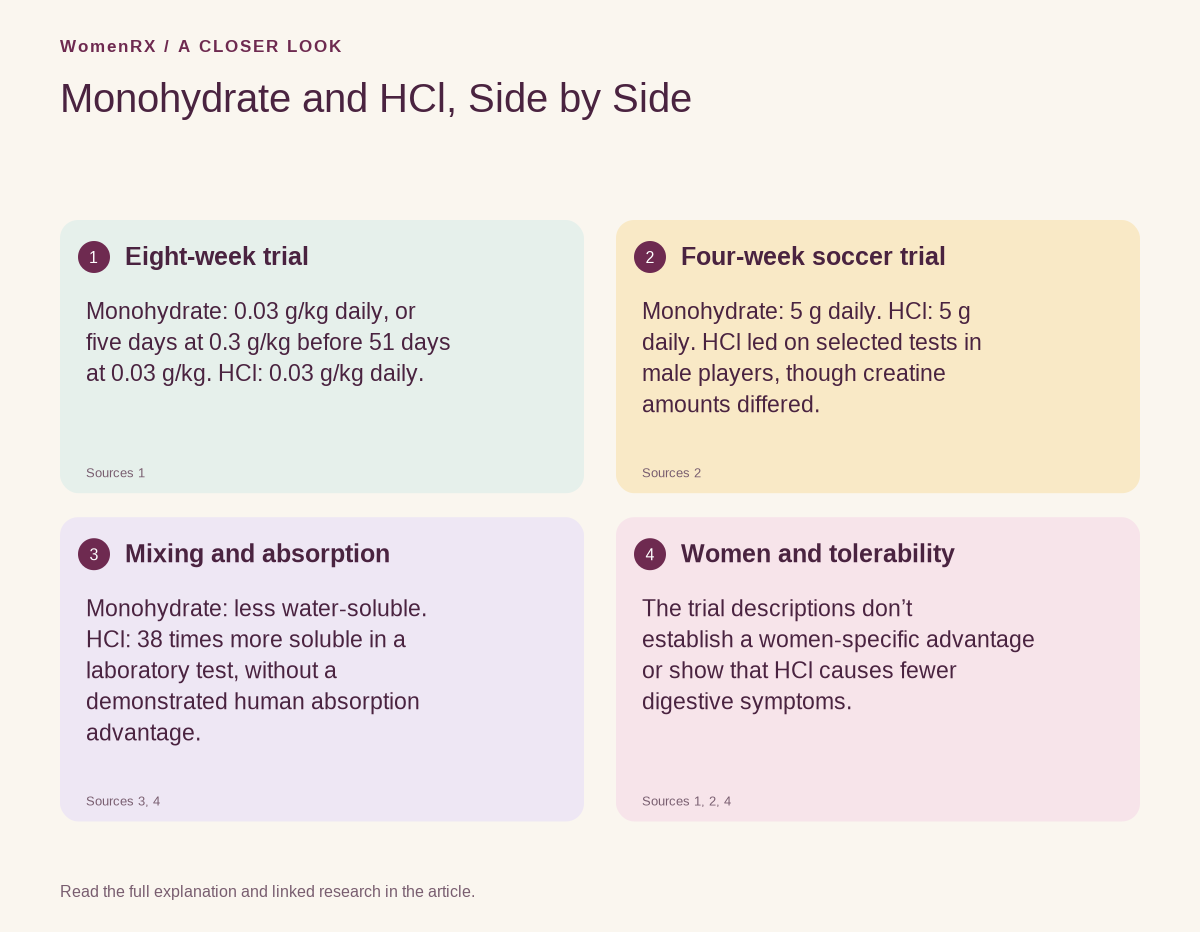
Monohydrate and HCl, Side by Side
Eight-week trial: Monohydrate: 0.03 g/kg daily, or five days at 0.3 g/kg before 51 days at 0.03 g/kg. HCl: 0.03 g/kg daily.1
Four-week soccer trial: Monohydrate: 5 g daily. HCl: 5 g daily. HCl led on selected tests in male players, though creatine amounts differed.2
Mixing and absorption: Monohydrate: less water-soluble. HCl: 38 times more soluble in a laboratory test, without a demonstrated human absorption advantage.34
Women and tolerability: The trial descriptions don’t establish a women-specific advantage or show that HCl causes fewer digestive symptoms.124
Read the figure as text
These are the forms and amounts used in the direct training comparisons, alongside what each comparison can tell you.- Eight-week trial: Monohydrate: 0.03 g/kg daily, or five days at 0.3 g/kg before 51 days at 0.03 g/kg. HCl: 0.03 g/kg daily.1
- Four-week soccer trial: Monohydrate: 5 g daily. HCl: 5 g daily. HCl led on selected tests in male players, though creatine amounts differed.2
- Mixing and absorption: Monohydrate: less water-soluble. HCl: 38 times more soluble in a laboratory test, without a demonstrated human absorption advantage.34
- Women and tolerability: The trial descriptions don’t establish a women-specific advantage or show that HCl causes fewer digestive symptoms.124
More questions, answered
Does creatine HCl cause less bloating or stomach discomfort?
HCl’s greater water solubility doesn’t by itself show that people have fewer digestive symptoms. The training comparisons discussed here don’t provide a direct head-to-head digestive-symptom result, so they don’t establish that HCl is gentler. 2 4
Sources you can check
- Supplementing With Which Form of Creatine (Hydrochloride or Monohydrate) Alongside Resistance Training Can Have More Impacts on Anabolic/Catabolic Hormones, Strength and Body Composition?Eghbali E, Arazi H, Suzuki K. · Physiological research · 2024Return to first citation
- Creatine formulations and repeated sprint training: effects on physical and physiological adaptations in soccer players during the short-term preparation phase.Duan C, Wang Z, Wang Q. · Journal of the International Society of Sports Nutrition · 2026Return to first citation
- Absolute Oral Bioavailability of Creatine Monohydrate in Rats: Debunking a Myth.Alraddadi EA, Lillico R, Vennerstrom JL, Lakowski TM, Miller DW. · Pharmaceutics · 2018Return to first citation
- Physicochemical characterization of creatine N-methylguanidinium salts.Gufford BT, Sriraghavan K, Miller NJ, Miller DW, Gu X, Vennerstrom JL, Robinson DH. · Journal of dietary supplements · 2010Return to first citation