Creatine for Women: How Daily Study Doses Compare
Women’s studies have tested several daily amounts, but the right way to read them is as research protocols, not one proven dose for every woman.
There isn’t one women-specific daily amount established for every goal. Studies have tested creatine monohydrate at 3 grams a day, 5 grams a day, and about 0.1 grams per kilogram of body weight daily; some short studies in postmenopausal women used a loading phase. Loading isn’t required to match every study protocol, and trials haven’t directly settled which approach is best for all women. 1 2 3
Start with the goal, not the scoop
Creatine is most relevant to a goal involving strength or resistance training. It isn’t necessary for training, and a study dose is not automatically a dose you need to take. The amounts below are examples of protocols researchers tested, not a single established recommendation for women.
| Study approach | Amount tested | What to take from it |
|---|---|---|
| Daily, without a reported loading phase | 3 g a day for 16 weeks | Tested in a randomized trial of older adults that included 57 women and 46 men. The abstract reports benefits alongside resistance training but doesn’t give women-specific results. 1 |
| Daily with resistance training | 5 g a day in some trials | A review of postmenopausal-women trials found the clearest pooled signals when creatine was combined with resistance training, particularly at 5 g a day or more. Individual trials did not all find an added benefit. 3 |
| Weight-based daily protocol | 0.1 g per kilogram of body weight daily for 10 weeks | Tested with resistance training in 45 older men and women; the results were not reported separately for women. 2 |
| Short loading protocol | 0.3 g per kilogram daily for about 7 days | Short postmenopausal-women studies reported temporary improvements in some performance measures. These protocols differ from longer training studies. 3 |
The comparison doesn’t prove that loading works better or that one approach is best. The postmenopausal review describes different protocols and outcomes, rather than a direct head-to-head test of loading versus steady daily use. If you’re comparing a product with research, check the amount of creatine in each serving and do the arithmetic from the label. A scoop size is not necessarily the amount of creatine in that scoop. Look for creatine monohydrate named as the ingredient, then compare the stated grams per serving with the study protocol you’re reading.
What the results mean for women
The most specific pooled evidence here is for postmenopausal women. Across five trials with 338 participants, creatine was associated with a modest average difference in lean mass of 0.37 kg compared with placebo. Across three trials with 111 participants, the average difference in leg-press strength was 7.5 kg. These pooled results don’t mean every participant gained that amount, and the review found bone density was unchanged overall. 3
A broader review of strength studies found some outcomes improved with creatine and resistance training, but results varied by exercise test. Its sex subgroup analysis found significant changes in several outcomes for men, but not women. That doesn’t establish that creatine cannot help women: it highlights uncertainty in a mixed set of studies, rather than a definitive result for every woman or life stage. 4
For younger women, menstrual-cycle differences, and perimenopause, these sources don’t provide enough specific results to set separate doses. The older-adult trials include both women and men, but don’t report all results by sex. The postmenopausal review is more directly relevant to women after menopause, though its included studies also differed in dose, training, and duration. 1 2 3
Pregnancy and breastfeeding are different questions
The exercise and postmenopausal studies described here don’t establish whether creatine is safe or beneficial during pregnancy or breastfeeding. Results in exercising adults or postmenopausal women can’t answer those life-stage questions, so don’t use those protocols as evidence for taking creatine while pregnant or nursing. 3
A practical way to read a label
First, decide whether you’re looking at a loading protocol or a steady daily protocol. Then check the grams of creatine monohydrate per serving and how many servings the label describes. Compare that amount with the study you’re using as a reference; don’t treat a product’s scoop or serving size as proof that it matches a study. If the label combines creatine with other ingredients, the creatine amount should still be clear enough to compare.
For a resistance-training goal, the postmenopausal evidence is more encouraging when creatine is paired with training, but the average gains were modest and not every trial found an added benefit. That makes the useful choice less about chasing a loading phase and more about whether the goal, training routine, and actual amount on the label match the evidence you’re trying to apply. 3
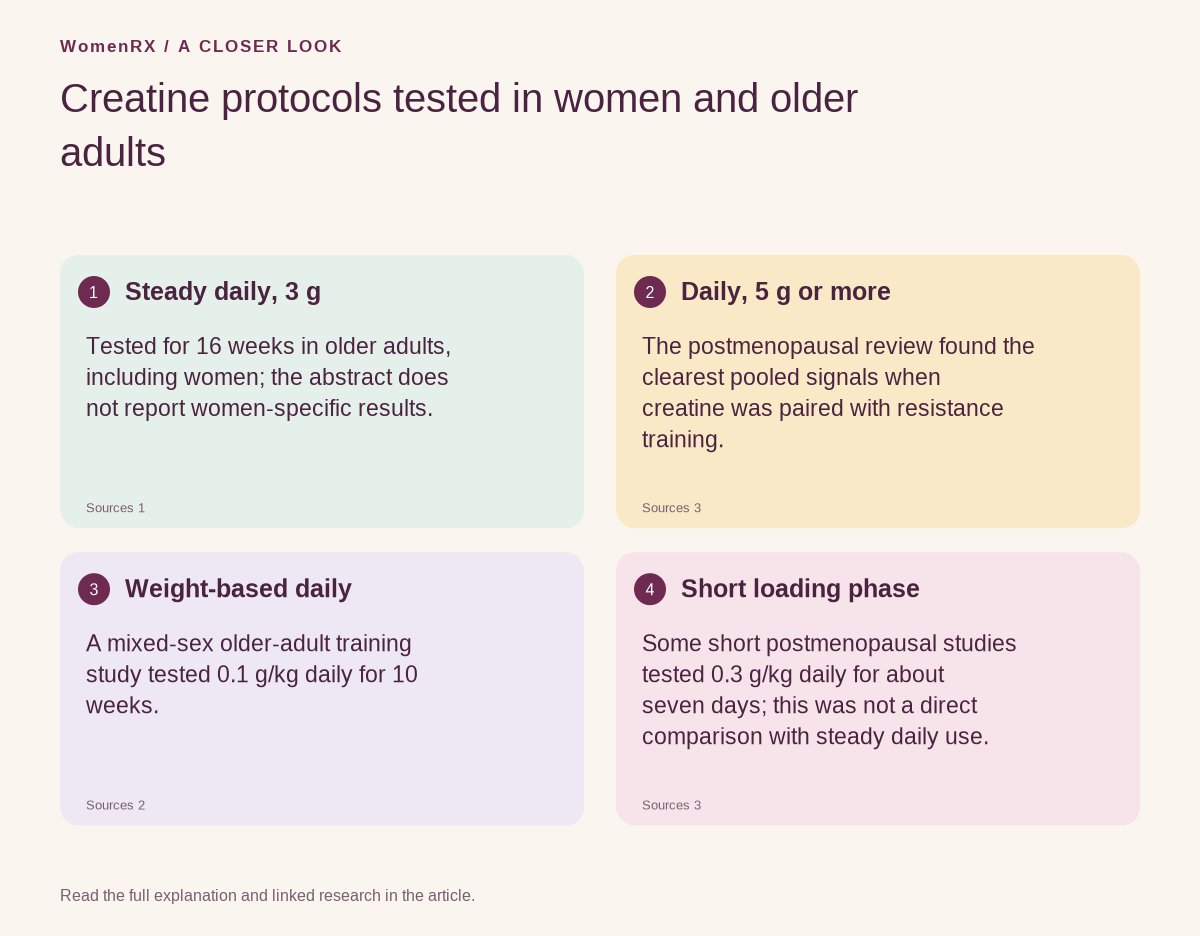
Creatine protocols tested in women and older adults
Steady daily, 3 g: Tested for 16 weeks in older adults, including women; the abstract does not report women-specific results.1
Daily, 5 g or more: The postmenopausal review found the clearest pooled signals when creatine was paired with resistance training.3
Weight-based daily: A mixed-sex older-adult training study tested 0.1 g/kg daily for 10 weeks.2
Short loading phase: Some short postmenopausal studies tested 0.3 g/kg daily for about seven days; this was not a direct comparison with steady daily use.3
Read the figure as text
These examples show how daily and loading protocols differ. They are study designs, not a universal dose recommendation.- Steady daily, 3 g: Tested for 16 weeks in older adults, including women; the abstract does not report women-specific results.1
- Daily, 5 g or more: The postmenopausal review found the clearest pooled signals when creatine was paired with resistance training.3
- Weight-based daily: A mixed-sex older-adult training study tested 0.1 g/kg daily for 10 weeks.2
- Short loading phase: Some short postmenopausal studies tested 0.3 g/kg daily for about seven days; this was not a direct comparison with steady daily use.3
More questions, answered
Did creatine increase bone density in postmenopausal women?
No overall change in bone density was found in the postmenopausal-women review. The reported muscle and strength findings shouldn’t be taken as evidence that creatine protects bone. 3
Do the study results show that women need a different dose from men?
The studies here don’t establish a women-specific dose. Some mixed-sex trials did not report results separately for women, while the postmenopausal review suggests outcomes may depend on training context and amount tested. 1 2 3
Sources you can check
- Effects of high-load, velocity-intentional variable resistance training combined with creatine supplementation on neuroplasticity, oxidative stress, inflammation, physical function, cognitive performance and quality of life in older adults: A randomized, double-blind, placebo-controlled trial.Fernandez-Garrido J, Martin EG, Saez-Berlanga A, Gargallo-Bayo P, Gene-Morales J, Alix-Fages C, Jiménez-Martínez P, Caballero O, Salvador-Palmer R, Colado JC. · Experimental gerontology · 2026Return to first citation
- The role of resistance training and creatine supplementation on oxidative stress, antioxidant defense, muscle strength, and quality of life in older adults.Amiri E, Sheikholeslami-Vatani D. · Frontiers in public health · 2023Return to first citation
- Creatine monohydrate for lean mass, strength, and bone density in postmenopausal women: a systematic review and meta-analysis.Naddafha S, Antonio J, Kreider RB, Stout JR. · Journal of the International Society of Sports Nutrition · 2026Return to first citation
- The Effects of Creatine Supplementation on Upper- and Lower-Body Strength and Power: A Systematic Review and Meta-Analysis.Kazeminasab F, Kerchi AB, Sharafifard F, Zarreh M, Forbes SC, Camera DM, Lanhers C, Wong A, Nordvall M, Bagheri R, Dutheil F. · Nutrients · 2025Return to first citation