Is Daily Creatine Safe? What the Evidence Actually Covers
Some studies offer reassurance in specific groups, but their findings don’t settle every question about long-term use, women, or pregnancy.
Daily creatine can’t be called universally safe or unsafe from this evidence. A review of studies in healthy older adults exercising alongside supplementation concluded that creatine monohydrate was safe in that group. A separate kidney review found changes in creatinine-based test results but not in a different filtration measure. Neither finding settles safety for every person, product, or life stage. 4 7

“Daily use” depends on who was studied
Creatine safety research doesn’t describe one single situation. The evidence includes healthy older adults using creatine alongside exercise, adults with Huntington disease who took high doses in a clinical trial, and studies of kidney measures in a mix of healthy people and people with chronic kidney disease. Those groups and study settings aren’t interchangeable with every woman considering a daily supplement. 3 4 7
A systematic review of 17 studies in healthy older adults concluded that creatine monohydrate was safe in that population when used with exercise training. That’s useful reassurance for a defined group, not a guarantee about all users, medical conditions, products, or durations. The review also said more trials were needed for some possible benefits, including bone and cognitive outcomes. 4
A large randomized trial offers a different kind of information, but it studied people with early Huntington disease, not generally healthy supplement users. Participants were assigned creatine or placebo and could be followed for up to 48 months; the creatine group titrated to a tolerated dose of up to 40 grams daily. Gastrointestinal adverse events were more common with creatine. This trial helps show what was monitored in a particular long-term, high-dose clinical setting, but it cannot establish the everyday safety profile for women without Huntington disease. 3
Kidney tests need careful interpretation
Creatine can complicate the interpretation of a common kidney blood test. A 2026 systematic review and meta-analysis included 26 studies with 1,036 participants, including healthy people and people with chronic kidney disease. Compared with placebo, creatine was associated with a mean serum creatinine increase of 0.14 mg/dL and a decrease of 10.75 mL/min in filtration estimated using creatinine-based methods. The review found no significant difference in filtration measured with Cr-EDTA, or in serum urea, albuminuria, or proteinuria. 7
The review’s authors interpreted that pattern as more consistent with changed creatinine metabolism than kidney injury. But a lab result still needs context: a clinician interpreting kidney tests should know if you take creatine, and a change in a creatinine-based estimate shouldn’t be treated as proof either of kidney damage or of normal kidney function. The review included people with chronic kidney disease as well as healthy participants, so its pooled result isn’t a personal safety verdict. 7
What the evidence says about women and pregnancy
Women are underrepresented in the broader creatine research, according to a review focused on women’s health. That review discusses potential benefits across life stages, but it doesn’t provide enough evidence to make a broad claim that daily use has been established as safe for every woman. A subgroup finding about men and women responding differently in the Huntington disease trial is not, by itself, evidence of a sex difference in safety. 5 3
Pregnancy calls for a separate question. Research reviews describe creatine metabolism in reproductive tissues and discuss preclinical work, including animal models. That’s different from establishing the safety of taking a supplement during human pregnancy. General pregnancy guidance advises checking with a provider before taking supplements, rather than assuming that evidence in other adults applies. 6 2
For breastfeeding, this research doesn’t establish whether routine maternal creatine supplementation is safe for a nursing infant. General breastfeeding guidance notes that some substances can pass into breast milk, but it doesn’t answer the creatine-specific question. If you’re breastfeeding, ask about your particular supplement and circumstances instead of relying on findings from other adult populations. 1
Make the question specific before you decide
If you’re weighing regular use, these details can make a discussion more useful:
- Your health context: Mention known kidney disease or a recent kidney-test concern. The kidney review included people with chronic kidney disease, but its combined results don’t establish what’s appropriate for an individual. 7
- Your life stage: Say if you’re pregnant, trying to conceive, or breastfeeding. Evidence from general adult or exercise studies doesn’t answer those questions. 2 6 1
- The exact product: Bring the label, including the form of creatine and any other ingredients. These studies focus on creatine monohydrate; they don’t establish the quality or safety of every product or blend. 3 4
- Your plan: Be clear about how often and how long you’re considering taking it. Study findings reflect specific populations, study conditions, and follow-up periods, not every possible duration of use. 3 4
- Your other medicines and supplements: Share the full list so your clinician can consider your individual situation. This evidence doesn’t verify specific creatine-medication interactions, so don’t assume a particular interaction or its absence from these studies.
The most useful takeaway is that some findings are reassuring within the groups studied, while important questions remain for individual medical conditions, pregnancy, and breastfeeding. A kidney test result also needs interpretation in light of creatine use, rather than being read in isolation.
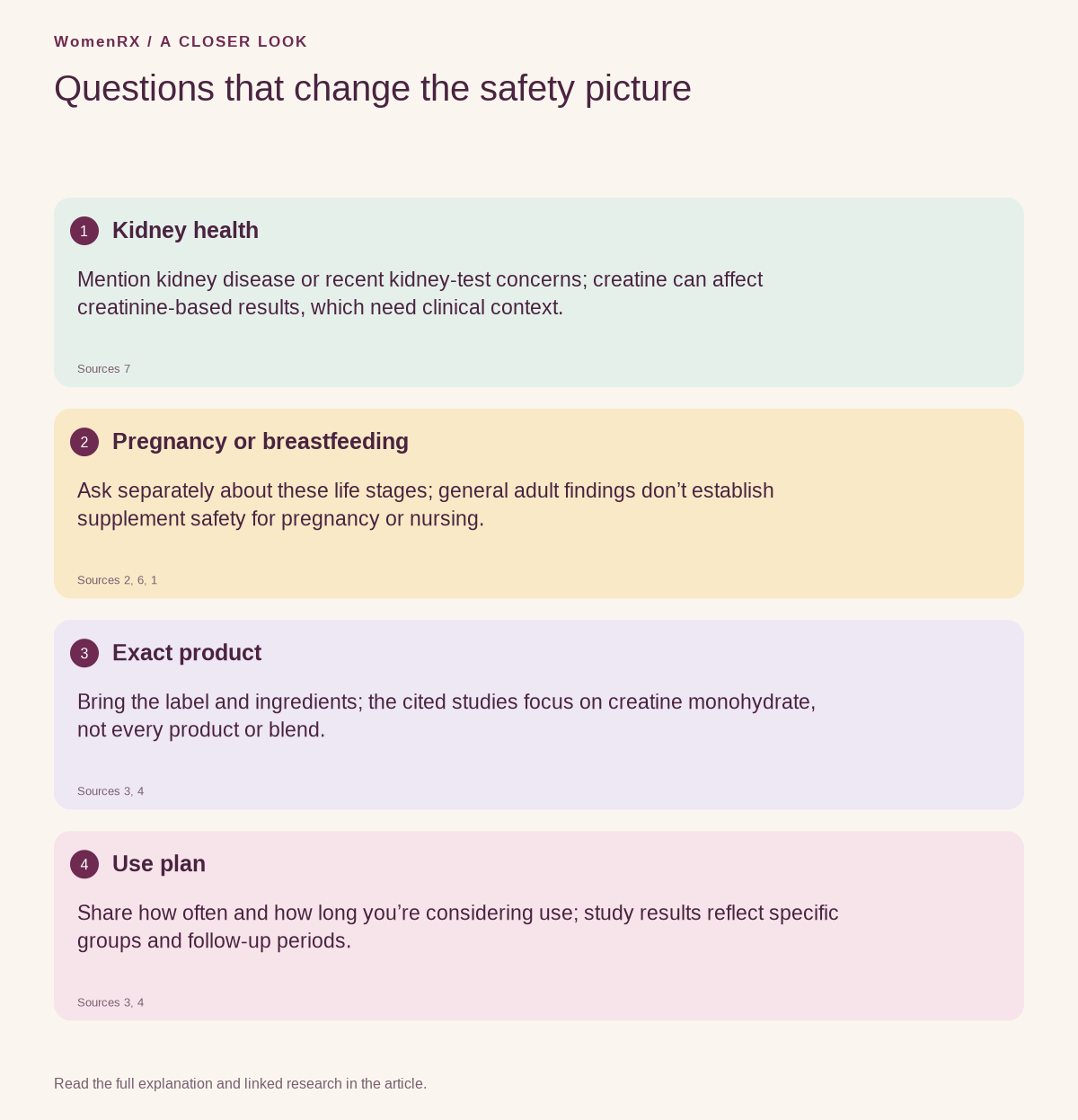
Questions that change the safety picture
Kidney health: Mention kidney disease or recent kidney-test concerns; creatine can affect creatinine-based results, which need clinical context.7
Pregnancy or breastfeeding: Ask separately about these life stages; general adult findings don’t establish supplement safety for pregnancy or nursing.261
Exact product: Bring the label and ingredients; the cited studies focus on creatine monohydrate, not every product or blend.34
Use plan: Share how often and how long you’re considering use; study results reflect specific groups and follow-up periods.34
Read the figure as text
Use these prompts to keep the discussion focused on the person, product, and study limits that matter for interpreting creatine evidence.- Kidney health: Mention kidney disease or recent kidney-test concerns; creatine can affect creatinine-based results, which need clinical context.7
- Pregnancy or breastfeeding: Ask separately about these life stages; general adult findings don’t establish supplement safety for pregnancy or nursing.261
- Exact product: Bring the label and ingredients; the cited studies focus on creatine monohydrate, not every product or blend.34
- Use plan: Share how often and how long you’re considering use; study results reflect specific groups and follow-up periods.34
Sources you can check
- Breastfeeding | Benefits of Breastfeeding | MedlinePlusAccessed 2026-09-25Return to first citation
- Pregnancy and Medicines | MedlinePlusAccessed 2026-09-25Return to first citation
- The CREST-E study of creatine for Huntington disease: A randomized controlled trial.Hersch SM, Schifitto G, Oakes D, Bredlau AL, Meyers CM, Nahin R, Rosas HD, Huntington Study Group CREST-E Investigators and Coordinators. · Neurology · 2017Return to first citation
- The Additive Effects of Creatine Supplementation and Exercise Training in an Aging Population: A Systematic Review of Randomized Controlled Trials.Stares A, Bains M. · Journal of geriatric physical therapy (2001) · 2020Return to first citation
- Creatine Supplementation in Women's Health: A Lifespan Perspective.Smith-Ryan AE, Cabre HE, Eckerson JM, Candow DG. · Nutrients · 2021Return to first citation
- Creatine Metabolism in Female Reproduction, Pregnancy and Newborn Health.Muccini AM, Tran NT, de Guingand DL, Philip M, Della Gatta PA, Galinsky R, Sherman LS, Kelleher MA, Palmer KR, Berry MJ, Walker DW, Snow RJ, Ellery SJ. · Nutrients · 2021Return to first citation
- Impact of creatine supplementation on kidney health: a systematic review and meta-analysis.de Souza Almeida A, da Silva LOD, Takahasi BNA, Terada BD, Gonçalves FGA, Porto BC, da Silva Sardenberg RA, Passerotti CC, Maia RS, Samaan F, Thoman M, Molina WR, Shiomi da Cruz JA... · International urology and nephrology · 2026Return to first citation