Already Getting Enough Protein? Where Creatine Fits
Creatine may be worth considering for strength-focused training, but studies comparing supplements separately cannot show what it adds to an already adequate protein intake.
Protein supplies the building blocks for muscle, while creatine helps fuel short, intense efforts. If your diet already meets your protein needs, creatine is a separate choice, not a reason to buy a protein powder too. Creatine research supports a possible benefit for strength-focused activity, but the comparisons described here don’t establish how much it adds specifically when protein intake is already adequate. 1 2 4
Two different jobs, with training at the center
Protein from foods such as dairy, meat, beans, nuts, and some grains helps your body build and maintain muscle. How much you need depends in part on your health and activity level. 1
Creatine does something else. It helps supply energy for short, intense muscle efforts. The NIH Office of Dietary Supplements reports that creatine may improve strength, power, and work during maximal-effort contractions, with much less value for endurance sports. That makes the kind of exercise you do relevant to the decision. Neither creatine nor extra protein replaces the work of resistance training. 2
For example, if you lift weights regularly and already get enough protein across your usual meals, another protein product may not fill a gap. Creatine could still be relevant to the short, demanding efforts in that training. That’s a reason to consider it separately, not evidence that buying both products produces an extra benefit. 1 2
What the supplement comparisons actually measured
A 2025 network meta-analysis brought together 19 randomized trials in healthy older adults. It compared nutritional supplementation strategies alongside resistance training. In its estimates against training alone, protein supplementation was associated with better strength and muscle-mass outcomes. Creatine did not show a statistically significant strength advantage against training alone, although the analysis reported a higher muscle-mass outcome. These are comparisons of different strategies, not a measurement of what happens when creatine is added to an already adequate protein intake. 4
That distinction matters. A result for training plus creatine and a separate result for training plus protein cannot be added together to predict the result of taking both. The review’s reported comparisons do not establish whether a creatine-and-protein combination outperforms either supplement alone, or whether starting protein intake changes creatine’s effect. 4
There’s also a difference between a muscle-mass measure and proven gains in muscle strength. Creatine can cause weight gain from water retention, according to the NIH summary. That doesn’t erase a reported mass finding, but it is another reason not to read it as a guarantee that you’ll lift more or build more muscle tissue. 2 4
Adequate protein is a separate question
The older-adult review does not establish that participants were already meeting their individual training-related protein needs before supplementation. Its protein comparison therefore cannot tell you how much benefit an additional shake would provide if your usual diet already supplies enough. 4
One short-term trial shows why the starting diet and the outcome matter. Among 27 healthy adults whose controlled diet provided habitual protein intake around 0.9 grams per kilogram of body weight per day, extra whey did not improve the measured muscle-protein synthesis or recovery outcomes during the 72 hours after a strenuous exercise session. The trial did not test creatine, follow long-term strength gains, or establish that this intake met each participant’s training needs. It should not be used as proof that extra protein never helps someone who exercises. 5
A useful way to make the choice is to keep three questions distinct: Are you doing resistance training that matches your strength goal? Does your overall diet provide enough protein for you, whether from food or a supplement? And does your activity include the short, high-intensity efforts for which creatine has the clearest performance rationale? Research on each component helps with those questions. It does not make the combination necessary. 1 2 3
What can you take from this if you’re a woman?
The older-adult review’s reported summary does not give a count of women or a women-specific analysis. The short-term whey trial’s findings are not presented as women-specific. More broadly, the NIH notes that exercise-supplement research has often included more men than women. The reported comparisons do not provide results by pregnancy, postpartum status, cycling years, perimenopause, or postmenopause. The findings can help frame a training and diet decision, but they cannot give a reliable estimate of the combination’s added effect for women at any particular life stage. 2 4 5
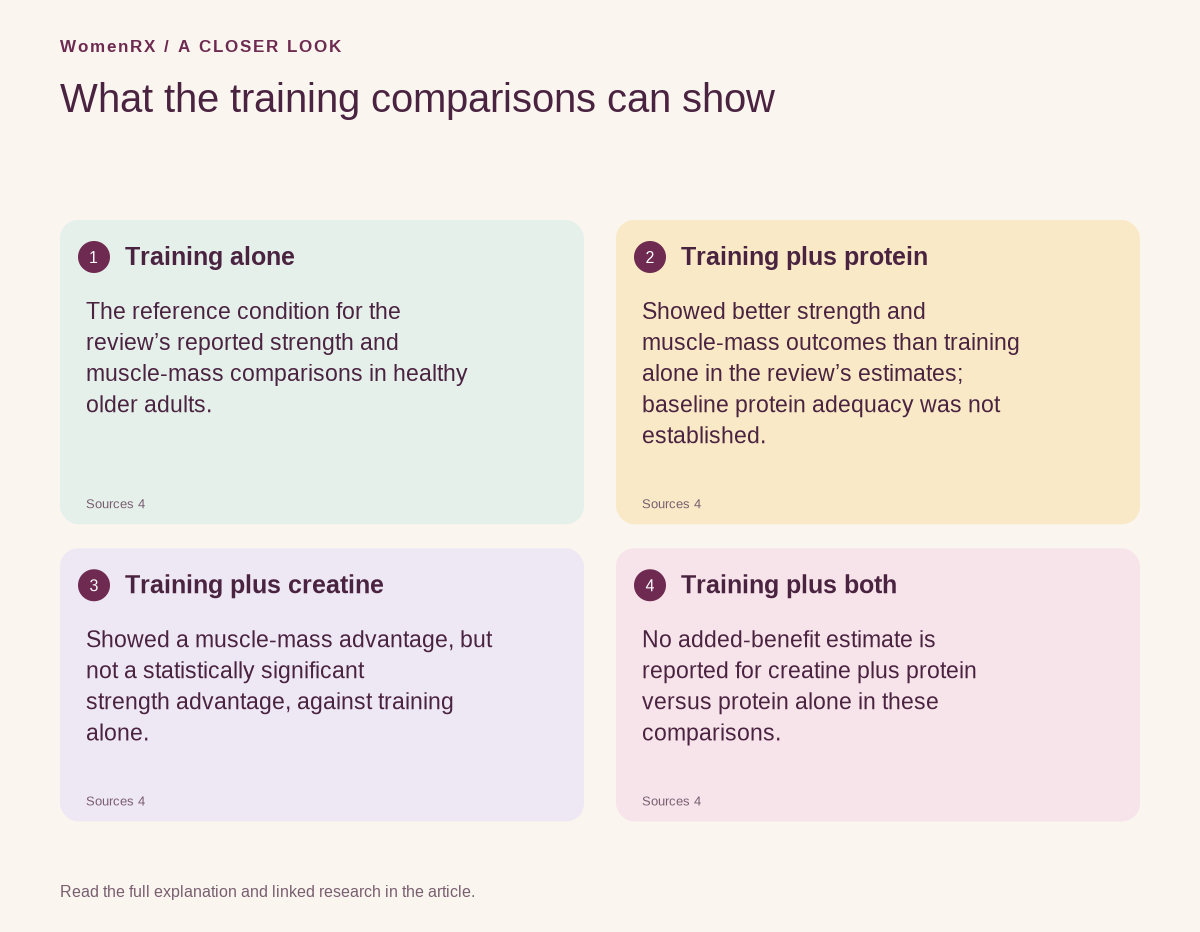
What the training comparisons can show
Training alone: The reference condition for the review’s reported strength and muscle-mass comparisons in healthy older adults.4
Training plus protein: Showed better strength and muscle-mass outcomes than training alone in the review’s estimates; baseline protein adequacy was not established.4
Training plus creatine: Showed a muscle-mass advantage, but not a statistically significant strength advantage, against training alone.4
Training plus both: No added-benefit estimate is reported for creatine plus protein versus protein alone in these comparisons.4
Read the figure as text
The older-adult review compares supplementation strategies against resistance training alone; it does not report the added effect of combining the supplements.- Training alone: The reference condition for the review’s reported strength and muscle-mass comparisons in healthy older adults.4
- Training plus protein: Showed better strength and muscle-mass outcomes than training alone in the review’s estimates; baseline protein adequacy was not established.4
- Training plus creatine: Showed a muscle-mass advantage, but not a statistically significant strength advantage, against training alone.4
- Training plus both: No added-benefit estimate is reported for creatine plus protein versus protein alone in these comparisons.4
Sources you can check
- Dietary Proteins: MedlinePlusAccessed 2026-09-25Return to first citation
- Dietary Supplements for Exercise and Athletic Performance - Health Professional Fact SheetAccessed 2026-09-25Return to first citation
- Benefits of Exercise: MedlinePlusAccessed 2026-09-25Return to first citation
- The impact of nutritional intervention and resistance training on muscle strength and mass in healthy older adults-a comparative analysis.Ma Y, Yan R, Li Y, Li D, Sun X, Chen T, Liu X. · Frontiers in nutrition · 2025Return to first citation
- Muscle Recovery and Myofibrillar Protein Synthesis after Damaging Exercise with Recombinant Bovine β-Lactoglobulin, Dairy-Derived Whey or Carbohydrate Supplementation in Young Healthy Adults.Rogers LM, Korzepa M, Belfield AE, Quinlan JI, Wallis GA, Breen L. · The Journal of nutrition · 2026Return to first citation