Creatine for Women: What to Weigh Before You Start
Creatine may help some postmenopausal women gain a little lean mass and strength, but a change on the scale or a kidney-related blood test needs context.
Creatine monohydrate has some supportive trial evidence in postmenopausal women, particularly in trials pairing at least 5 g/day with resistance training, but that doesn’t mean every woman will benefit. Weight can rise, and one short study found higher serum creatinine that could be misread as impaired kidney function. A safety review excluded pregnancy and breastfeeding, so its findings don’t establish safety in either situation. 4 3 2
Creatine is a supplement used in sports nutrition. Before trying it, weigh what you hope to get from it against what the research shows, what a scale change can tell you, and how a clinician might interpret a kidney-related test.
What the evidence says for women
The most directly relevant women-specific research is a 2026 systematic review and meta-analysis of seven randomized trials in 608 postmenopausal women. Across five trials, creatine was associated with a small average increase in lean mass compared with placebo: 0.37 kg. Across three trials, leg-press strength was higher by an average of 7.5 kg. The review reported that benefits were evident in trials combining at least 5 g/day of creatine with resistance training, while trials using 3 g/day or less without resistance training showed no measurable effect. It did not find an overall change in bone density. These results are specific to the women and outcomes studied, not a promise of noticeable results for any one person. The review also described some risk-of-bias concerns. 4
That gives you a practical reason to clarify your goal. If you’re considering creatine for strength or lean mass, the women-specific results are most relevant to postmenopausal women in trials pairing at least 5 g/day with resistance training. They don’t establish the same benefit for every woman, every exercise routine, or other reasons for taking it.
A higher scale reading doesn’t explain itself
Weight gain has been reported as an adverse effect in a review of creatine safety studies. But that review doesn’t establish how much of a creatine-related change is water, muscle, or another component. In general, body weight includes water, muscle, fat, and bone, so the scale alone can’t identify what changed. 2 1
The postmenopausal-women review found a small average increase in lean mass, but that result doesn’t show that any individual’s weight change is muscle gain, or explain how much water may contribute. If your goal is fat loss or a particular scale number, consider whether a possible scale increase would make creatine a poor fit for that goal. 4
Put a creatinine result in context
Creatinine is used in assessing kidney function, but a change in the blood result does not, by itself, prove kidney injury. In a randomized trial of 35 healthy, active-duty Army volunteers, including 15 women, participants took creatine or taurine for seven days. The creatine group had a significant increase in serum creatinine compared with the taurine group. The researchers warned that this result could be misinterpreted as impaired kidney function. The study was short and small, so it can’t settle long-term safety or establish what happens in people with kidney disease. 3
A separate review of trials in postmenopausal women reported that renal indices were unchanged in the included studies. That’s reassuring within those trials, but it doesn’t erase the need to interpret an individual test in context. If you have kidney-related test results coming up, or a known kidney condition, tell the person interpreting the results that you use creatine. Ask what the result means alongside your overall health and other available information, rather than treating one creatinine value as a diagnosis. 4 3
Choose based on what has been studied
Creatine monohydrate is the form examined in the postmenopausal-women review. A safety review of creatine products found limited data for several other marketed forms. If you’re comparing products, don’t assume a different form has the same evidence just because it contains the word creatine. Check the ingredient list and whether the product is a single ingredient or a blend; blends make it harder to know which ingredient you’re considering. The cited review assessed safety evidence, not the quality of individual products. 4 2
Pregnancy and breastfeeding need separate guidance
A creatine safety review focused on healthy adults and excluded pregnant and breastfeeding women. That exclusion is not proof of harm, but it means its conclusions can’t establish safety for pregnancy or breastfeeding. If you’re pregnant, breastfeeding, or planning to be, get guidance specific to that situation before starting rather than relying on studies in other adults. 2
Creatine: benefit, scale, and lab context
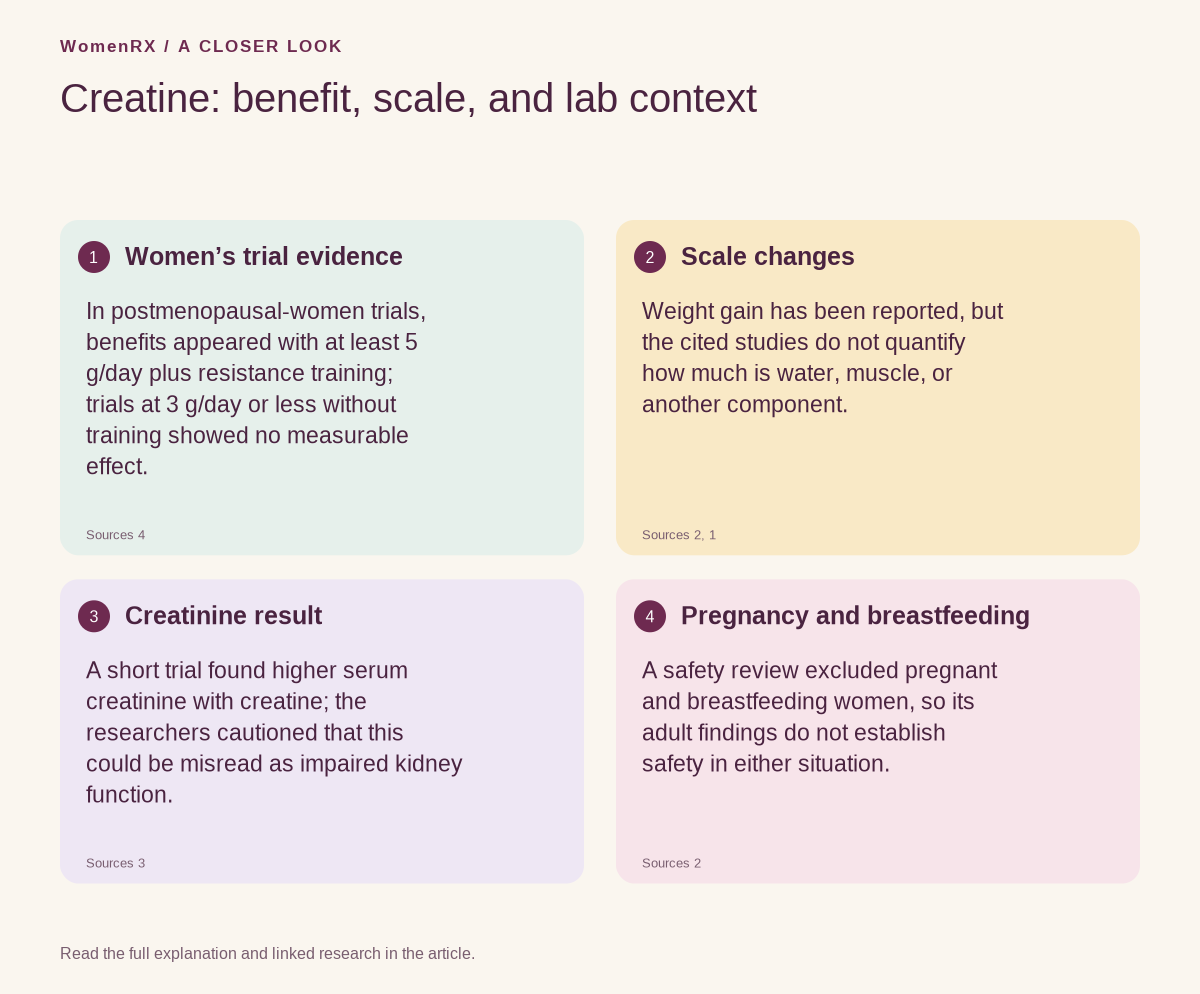
Women’s trial evidence: In postmenopausal-women trials, benefits appeared with at least 5 g/day plus resistance training; trials at 3 g/day or less without training showed no measurable effect.4
Scale changes: Weight gain has been reported, but the cited studies do not quantify how much is water, muscle, or another component.21
Creatinine result: A short trial found higher serum creatinine with creatine; the researchers cautioned that this could be misread as impaired kidney function.3
Pregnancy and breastfeeding: A safety review excluded pregnant and breastfeeding women, so its adult findings do not establish safety in either situation.2
Read the figure as text
These distinctions help separate findings in specific studies from what a scale reading or individual lab result can establish.- Women’s trial evidence: In postmenopausal-women trials, benefits appeared with at least 5 g/day plus resistance training; trials at 3 g/day or less without training showed no measurable effect.4
- Scale changes: Weight gain has been reported, but the cited studies do not quantify how much is water, muscle, or another component.21
- Creatinine result: A short trial found higher serum creatinine with creatine; the researchers cautioned that this could be misread as impaired kidney function.3
- Pregnancy and breastfeeding: A safety review excluded pregnant and breastfeeding women, so its adult findings do not establish safety in either situation.2
More questions, answered
Does a higher creatinine result mean creatine damaged my kidneys?
Not necessarily. A small, short trial found higher serum creatinine with creatine and cautioned that the change could be misinterpreted as impaired kidney function. A lab result needs interpretation in context; tell the person reviewing it that you take creatine. 3
Is creatine proven safe while breastfeeding?
A creatine safety review excluded breastfeeding women, so it cannot establish safety during breastfeeding. Its findings in healthy adults shouldn’t be treated as breastfeeding-specific guidance. 2
Sources you can check
- Body Weight: MedlinePlusAccessed 2026-09-25Return to first citation
- Creatine and creatine forms intended for sports nutrition.Andres S, Ziegenhagen R, Trefflich I, Pevny S, Schultrich K, Braun H, Schänzer W, Hirsch-Ernst KI, Schäfer B, Lampen A. · Molecular nutrition & food research · 2017Return to first citation
- The effect and safety of short-term creatine supplementation on performance of push-ups.Armentano MJ, Brenner AK, Hedman TL, Solomon ZT, Chavez J, Kemper GB, Salzberg D, Battafarano DF, Christie DS. · Military medicine · 2007Return to first citation
- Creatine monohydrate for lean mass, strength, and bone density in postmenopausal women: a systematic review and meta-analysis.Naddafha S, Antonio J, Kreider RB, Stout JR. · Journal of the International Society of Sports Nutrition · 2026Return to first citation