Creatine and Cognition: What the Human Trials Show
A few small trials report changes in specific thinking tests, but results differ by population and don’t yet establish a reliable cognitive benefit for women.
Creatine hasn’t been shown to reliably improve cognition in women. One small trial in perimenopausal and postmenopausal women reported a better reaction-time result and higher frontal-brain creatine after one formulation, while a separate trial in older women found no cognitive benefit. These findings concern different groups and tests, so they don’t establish a general effect on memory, focus, or cognitive health. 1 3
The findings depend on what was tested
“Cognition” covers different abilities, including reaction time, memory, attention, and mental control. A change on one test doesn’t show that all of these improve, or that someone will notice a difference in everyday life.
That distinction matters in the women-specific trials. In an eight-week randomized trial, 36 perimenopausal and postmenopausal women were assigned to one of four groups receiving different creatine formulations or placebo. The researchers reported a better reaction-time result and increased frontal-brain creatine in the medium-dose creatine hydrochloride group compared with placebo. This is a direct brain measurement, but it doesn’t by itself show that broader thinking skills improved. The trial was small, short, and tested several outcomes. 1
A separate 24-week randomized trial studied older women, with 14 participants in each of four groups. It assessed memory, selective attention, and inhibitory control. Researchers found no significant cognitive benefit from creatine alone or from adding creatine to strength training. Strength training improved muscle strength, but not cognitive performance in this study. 3
Taken together, the results aren’t simply “positive” or “negative.” One trial found a signal on reaction time in a specific group; another found no benefit across several cognitive tests in older women. Differences in age, formulation, study length, and the tests used make the findings hard to combine into a single conclusion.
A positive result in men doesn’t settle the question for women
A small crossover trial offers another example of why context matters. Twelve resistance-trained men took creatine nitrate, caffeine, the combination, or placebo for short periods. The combination improved scores on a Stroop test, which measures interference control, but the result can’t show that creatine alone caused the change: caffeine was taken at the same time. The study also used a different creatine form and included no women. 2
A larger 12-week trial included 40 women and 24 men aged 45 to 65. Its abstract reports favorable changes in selected cognitive and memory measures among participants taking creatine, with or without an exercise and diet program. The authors describe individual cognitive findings as exploratory, and the reported results don’t break them down by sex. So this study may add to the rationale for more research, but it doesn’t show whether women benefited differently from men. 4
What the brain measurement does, and doesn’t, tell you
The menopause-related trial is notable because it measured creatine in the frontal brain as well as a reaction-time outcome. Those are two distinct findings: a change in a brain measurement is not proof of a meaningful change in daily cognition. The available results don’t establish that the brain measurement explains the reaction-time result or predicts lasting cognitive benefit. 1
That’s a useful distinction when weighing claims about supplements and “brain health.” Muscle or exercise findings can’t stand in for cognitive outcomes, and a result on one short test isn’t evidence that creatine prevents cognitive decline or treats a brain condition.
What this means for women at different life stages
There is a small amount of direct trial evidence in perimenopausal and postmenopausal women, but it comes from one short, small study. The other women-only trial involved older women and did not find a cognitive benefit. A mixed-sex study included women but did not report a women-specific result in its abstract. 1 3 4
These studies don’t answer whether creatine affects cognition during the cycling years, pregnancy, or postpartum. Nor do they establish a dependable benefit for memory or everyday focus at any life stage. The practical takeaway is modest: a possible signal on a particular test deserves follow-up, but it isn’t yet a reason to expect creatine to improve cognition broadly.
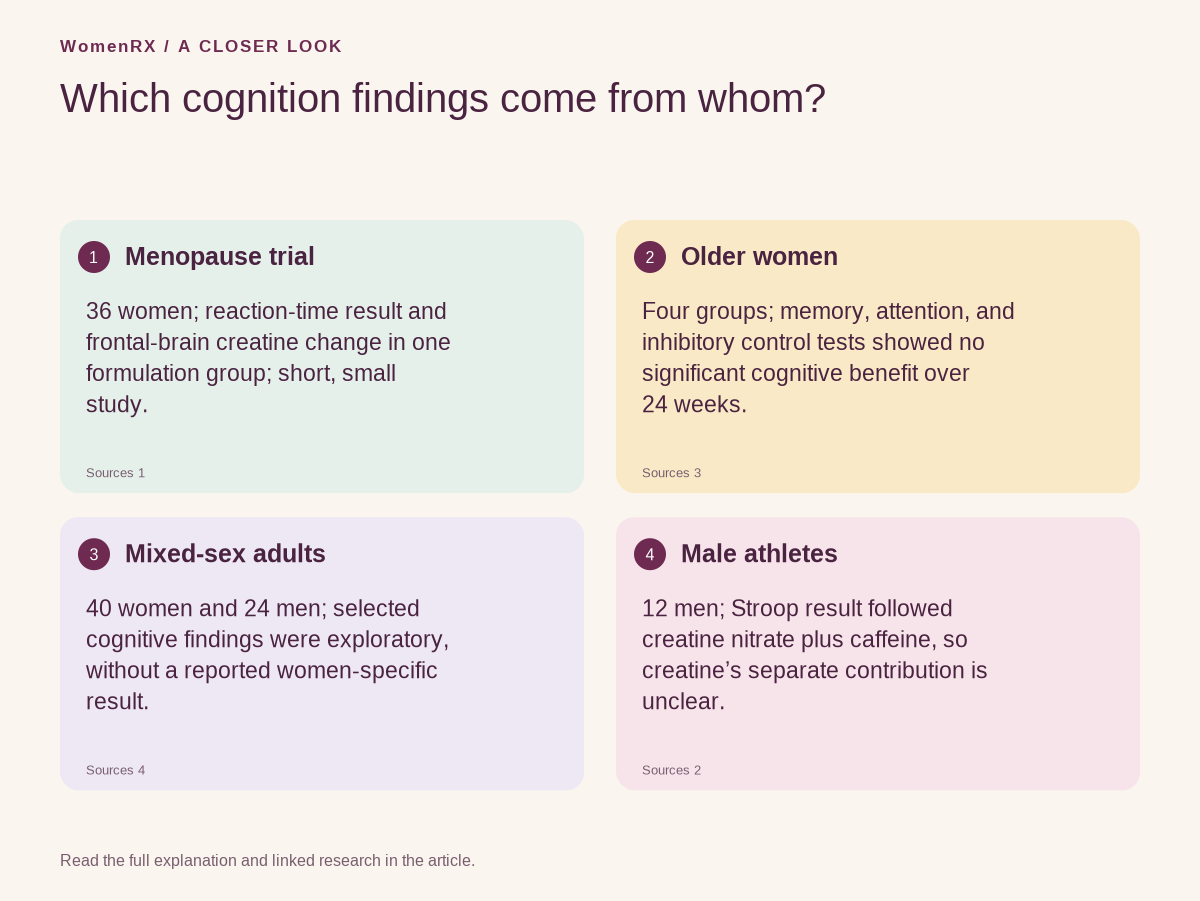
Which cognition findings come from whom?
Menopause trial: 36 women; reaction-time result and frontal-brain creatine change in one formulation group; short, small study.1
Older women: Four groups; memory, attention, and inhibitory control tests showed no significant cognitive benefit over 24 weeks.3
Mixed-sex adults: 40 women and 24 men; selected cognitive findings were exploratory, without a reported women-specific result.4
Male athletes: 12 men; Stroop result followed creatine nitrate plus caffeine, so creatine’s separate contribution is unclear.2
Read the figure as text
The trials differ in who participated, what cognitive outcome was tested, and how confidently the result applies to women.- Menopause trial: 36 women; reaction-time result and frontal-brain creatine change in one formulation group; short, small study.1
- Older women: Four groups; memory, attention, and inhibitory control tests showed no significant cognitive benefit over 24 weeks.3
- Mixed-sex adults: 40 women and 24 men; selected cognitive findings were exploratory, without a reported women-specific result.4
- Male athletes: 12 men; Stroop result followed creatine nitrate plus caffeine, so creatine’s separate contribution is unclear.2
More questions, answered
Does a higher brain creatine measurement mean better thinking?
Not on its own. The menopause-related trial reported both a change in frontal-brain creatine and a reaction-time result, but the reported findings don’t establish that the brain measurement caused or predicts a meaningful improvement in everyday cognition. 1
Have pregnancy or postpartum cognition been studied in these trials?
The trials described here studied perimenopausal and postmenopausal women, older women, or mixed-sex middle-aged and older adults. They don’t provide evidence about pregnancy or postpartum cognition. 1 3 4
Sources you can check
- The Effects of 8-Week Creatine Hydrochloride and Creatine Ethyl Ester Supplementation on Cognition, Clinical Outcomes, and Brain Creatine Levels in Perimenopausal and Menopausal Women (CONCRET-MENOPA): A Randomized Controlled Trial.Korovljev D, Ostojic J, Panic J, Ranisavljev M, Todorovic N, Nedeljkovic D, Kuzmanovic J, Vranes M, Stajer V, Ostojic SM. · Journal of the American Nutrition Association · 2026Return to first citation
- The Effect of Creatine Nitrate and Caffeine Individually or Combined on Exercise Performance and Cognitive Function: A Randomized, Crossover, Double-Blind, Placebo-Controlled Trial.Mabrey G, Koozehchian MS, Newton AT, Naderi A, Forbes SC, Haddad M. · Nutrients · 2024Return to first citation
- Creatine supplementation associated or not with strength training upon emotional and cognitive measures in older women: a randomized double-blind study.Alves CR, Merege Filho CA, Benatti FB, Brucki S, Pereira RM, de Sá Pinto AL, Lima FR, Roschel H, Gualano B. · PloS one · 2013Return to first citation
- Effects of creatine supplementation with and without exercise and diet intervention on body composition, cognitive function, and markers of health in middle-aged and older adults.Chun J, Liu Y, Kibler GL, Lee H, Babakhani K, Rhoades N, Bivins I, Ko J, Dickerson B, Gonzalez DE, Sowinski RJ, Rasmussen CJ, Kreider RB. · Journal of the International Society of Sports Nutrition · 2026Return to first citation