Creatine and Hair Loss: What the Human Evidence Shows
A small trial measured hair outcomes after creatine use, but it studied men, so it can’t settle the question for women.
The concern began with a short study in male athletes that reported a rise in DHT, a hormone linked to male-pattern hair loss. A later randomized trial directly measured hair outcomes and found no significant differences between creatine and placebo over 12 weeks, but it enrolled men only. That’s reassuring, not a definitive answer for women or longer-term use. 2
Why creatine became linked to hair loss
The concern centers on dihydrotestosterone, or DHT, a hormone involved in some forms of pattern hair loss. A 2009 study in male athletes reportedly found that creatine use was followed by an increase in DHT. That result raised a plausible question, but a change in a hormone marker is not the same as evidence that hair is thinning or shedding. The study did not directly measure hair outcomes, and the later trial authors describe that early result as unconfirmed by subsequent research at the time of their study. 2
That distinction matters: a proposed mechanism can be a reason to investigate a supplement, but it can’t by itself show that the supplement causes a visible change in hair.
What the hair-measuring trial found
In a randomized trial, 45 resistance-trained men aged 18 to 40 were assigned to creatine monohydrate or placebo for 12 weeks; 38 completed the study. Researchers measured testosterone and DHT, and used hair assessments that included follicle counts, density, and thickness. They found no significant difference between groups over time in DHT or the measured hair outcomes. 2
This is more useful than a hormone-only study because it looked at hair itself. Still, it was a small, short trial in men. It doesn’t establish what happens in women, answer whether effects might appear after longer use, or rule out every possible response in an individual. The practical takeaway is that current direct trial evidence doesn’t show creatine causing hair loss in the men studied, while the evidence doesn’t settle the question for women. 2
If the timing makes you suspect creatine
Hair shedding can have more than one explanation. Losing about 50 to 100 hairs a day can be normal, and hair loss can also be temporary after an illness or follow a familial pattern of thinning. 1 A change that happens after starting a supplement is worth noticing, but timing alone doesn’t show that the supplement caused it.
If you’re discussing a possible connection with a clinician, bring the supplement label and note when you started it and when you first noticed shedding or thinning. Also mention any recent illness and whether the change looks like diffuse shedding or a particular pattern. Those details can help put the timing in context; an examination may help identify the cause. 1
You can ask whether a change to your creatine use makes sense while the cause is being assessed, rather than making several changes at once and losing track of what happened. If the hair loss worries you, it’s reasonable to raise it even if the connection to creatine is uncertain. 1
What to take from the evidence
The strongest direct evidence here is a 12-week hair-outcome trial, and it found no significant creatine-related differences in its male participants. The earlier DHT finding explains why the question arose, but it doesn’t establish hair loss as an outcome. For women, this evidence can’t provide a direct answer. If you’re experiencing shedding, consider both the timing of supplement use and other possible explanations instead of treating one as proof of the other. 21
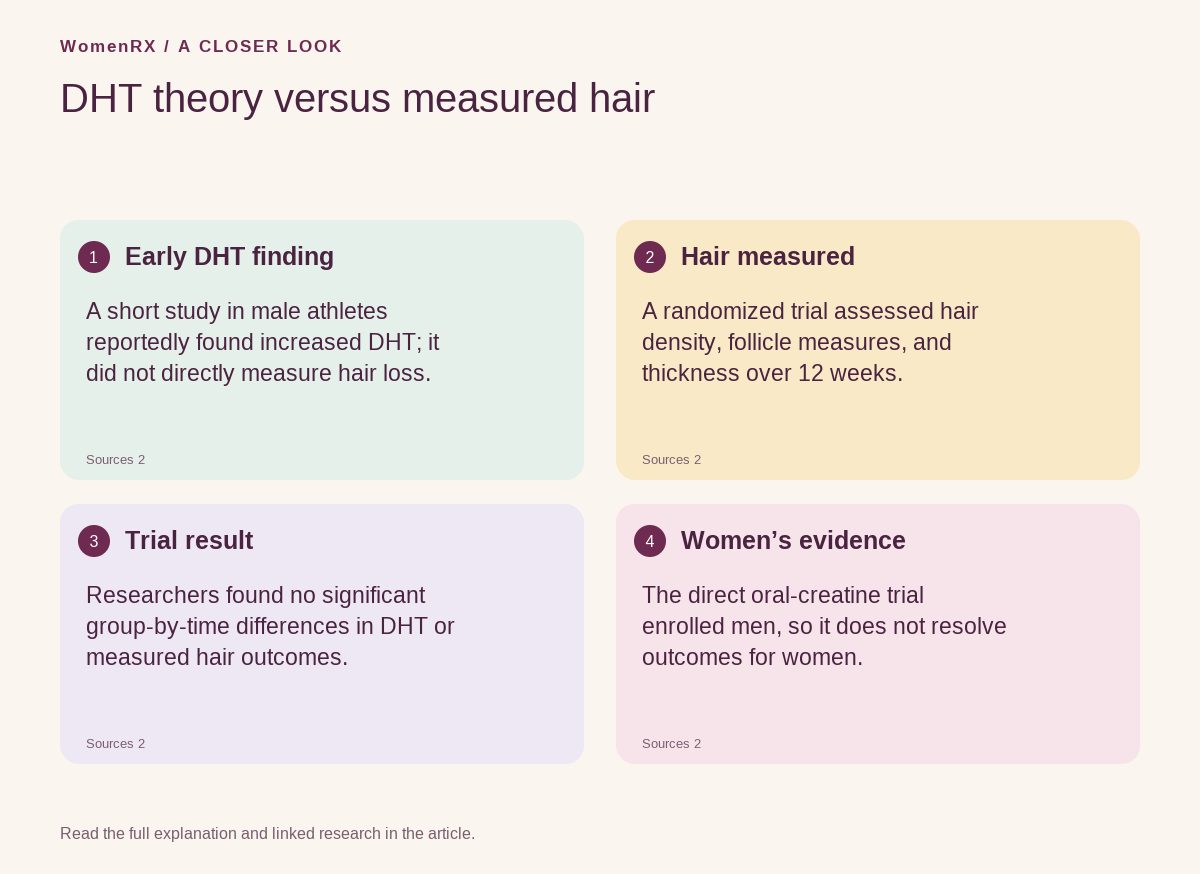
DHT theory versus measured hair
Early DHT finding: A short study in male athletes reportedly found increased DHT; it did not directly measure hair loss.2
Hair measured: A randomized trial assessed hair density, follicle measures, and thickness over 12 weeks.2
Trial result: Researchers found no significant group-by-time differences in DHT or measured hair outcomes.2
Women’s evidence: The direct oral-creatine trial enrolled men, so it does not resolve outcomes for women.2
Read the figure as text
The concern began with a hormone finding; a later trial also measured hair, but its participants were men.- Early DHT finding: A short study in male athletes reportedly found increased DHT; it did not directly measure hair loss.2
- Hair measured: A randomized trial assessed hair density, follicle measures, and thickness over 12 weeks.2
- Trial result: Researchers found no significant group-by-time differences in DHT or measured hair outcomes.2
- Women’s evidence: The direct oral-creatine trial enrolled men, so it does not resolve outcomes for women.2
More questions, answered
Does a rise in DHT prove creatine causes hair loss?
No. DHT is a proposed biological link, but a hormone change alone doesn’t demonstrate a change in hair. The randomized trial measured both DHT and hair outcomes and found no significant differences between creatine and placebo in the men studied. 2
Does the creatine hair study apply to women?
Not directly. The randomized trial enrolled resistance-trained men, so its findings don’t establish whether creatine affects hair outcomes in women. 2
Sources you can check
- Hair loss - NHSAccessed 2026-09-25Return to first citation
- Does creatine cause hair loss? A 12-week randomized controlled trial.Lak M, Forbes SC, Ashtary-Larky D, Dadkhahfar S, Robati RM, Nezakati F, Khajevandi M, Naseri S, Gerafiani A, Haghighat N, Antonio J, Tinsley GM. · Journal of the International Society of Sports Nutrition · 2025Return to first citation