Creatine and Cognition: What Have Studies Tested?
Human studies have tested reaction time, selected cognitive and memory measures, and broader test scores in specific groups, not brain health as a whole.
Creatine cognition studies have measured particular tasks and test scores. One small trial in perimenopausal and postmenopausal women reported a reaction-time advantage for one creatine regimen; mixed-sex adult studies examined selected cognitive measures, while an Alzheimer’s pilot tracked several scores without a control group. These findings don’t establish dementia prevention or a cognitive benefit for women generally. 1 3 5
“Brain health” isn’t one test
A faster response on a reaction-time task, performance on a memory measure, and a score on a broader cognitive battery are different outcomes. A result on one measure doesn’t automatically mean better everyday thinking, slower cognitive decline, or protection from dementia. The human studies below address specific questions in specific groups.
The outcomes studied, by population
Reaction time in women around menopause. An eight-week randomized, double-blind trial enrolled 36 apparently healthy perimenopausal and postmenopausal women, whose mean age was about 50. It compared placebo with three creatine regimens: two different doses of creatine hydrochloride and a combination of creatine hydrochloride with creatine ethyl ester. The medium-dose hydrochloride group had a better reaction-time result than placebo. That is a finding on one measure in a small trial, not proof of a general cognitive effect or of the same effect from creatine monohydrate. 1
Selected cognitive and memory measures in adults aged 45 to 65. A 12-week creatine monohydrate trial analyzed 64 adults, including 40 women and 24 men. Some participants also took part in an exercise and diet intervention. The researchers reported favorable changes in selected cognitive-function and memory markers, but described individual cognitive findings as exploratory. The results do not establish that women benefited specifically, or that the findings apply to every cognitive task. 3
Trail Making in an older-adult exercise study. A separate study included 103 community-dwelling older adults, 57 of them women, with an average age of about 68. It assessed cognition with the Trail Making Test while comparing resistance-training programs and creatine or placebo. The reported findings do not establish a separate creatine benefit on Trail Making. Because exercise was part of the trial, improvements associated with training also shouldn’t be attributed to creatine alone. 2
Several test scores in people with Alzheimer’s disease. An eight-week, single-arm pilot followed 20 people with Alzheimer’s disease. It measured cognition using the NIH Toolbox and Mini-Mental State Examination, including global and fluid cognition composites and tasks such as List Sorting, Oral Reading, and Flanker. Scores improved on several measures, but without a comparison group, the study can’t show that creatine caused those changes. 5
What the findings say about women
The menopause-stage trial is the most directly relevant evidence for women, but it is small and tested specific creatine regimens. The two mixed-sex adult studies included women, yet their reported findings don’t establish a women-specific cognitive benefit. They also don’t tell us whether results differ between women and men. 1 2 3
These studies focus on menopause or middle and older age. They don’t answer whether creatine affects cognition during pregnancy, postpartum, or the cycling years. Nor can a result in one age group or on one test be assumed to apply to another.
Test scores are not dementia prevention
The Alzheimer’s pilot studied people who already had the disease. It was not a prevention trial, and its uncontrolled design means the score changes can’t be attributed to creatine. A scoping review of creatine and dementia-related cognitive outcomes identified one human pilot trial and no relevant randomized controlled trials in its search. Taken together, this is preliminary evidence, not proof that creatine prevents dementia or treats Alzheimer’s disease. 4 5
When you see a cognitive claim, look for the exact measure, who took part, and whether the study had a comparison group. “Reaction time in women around menopause” is a much narrower claim than “better brain health,” and the evidence should be read at that narrower scale.
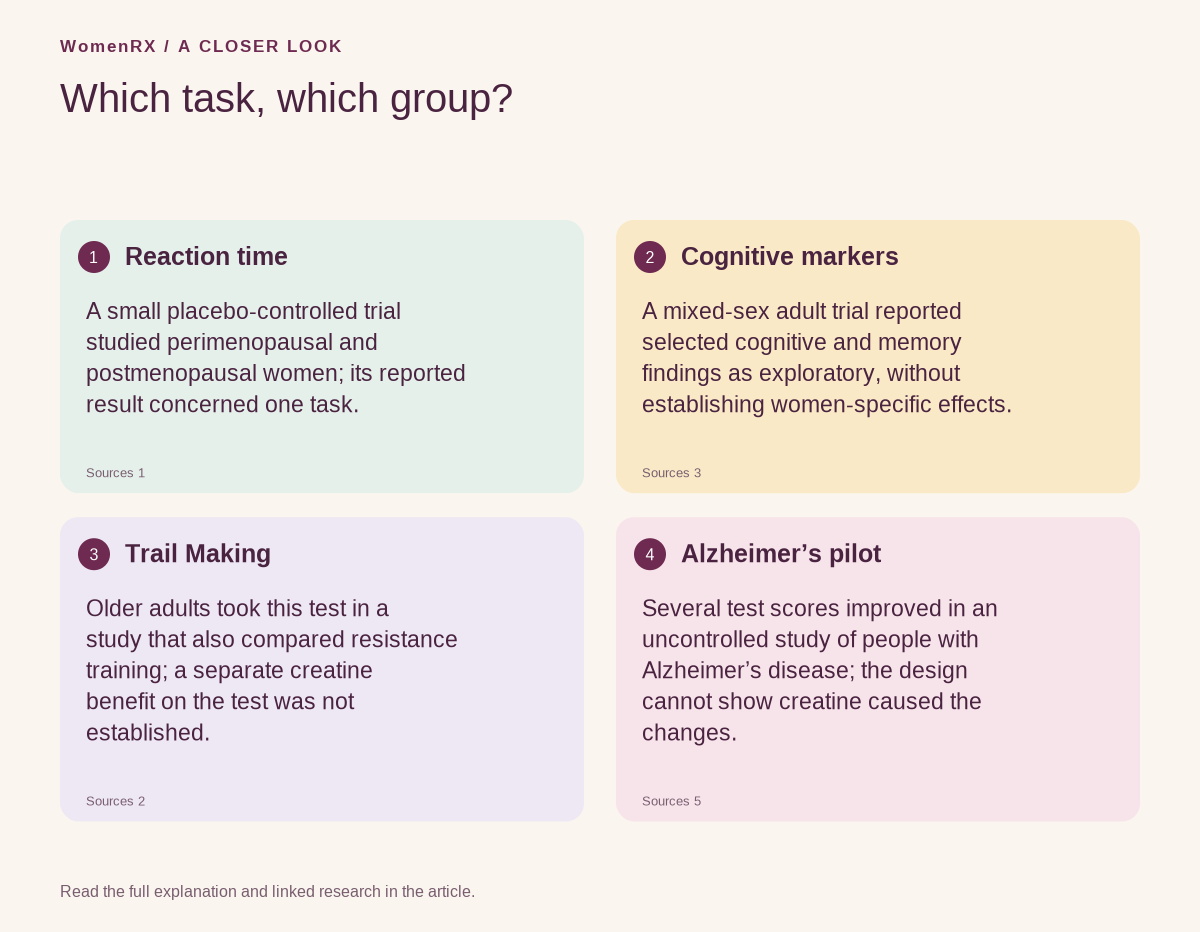
Which task, which group?
Reaction time: A small placebo-controlled trial studied perimenopausal and postmenopausal women; its reported result concerned one task.1
Cognitive markers: A mixed-sex adult trial reported selected cognitive and memory findings as exploratory, without establishing women-specific effects.3
Trail Making: Older adults took this test in a study that also compared resistance training; a separate creatine benefit on the test was not established.2
Alzheimer’s pilot: Several test scores improved in an uncontrolled study of people with Alzheimer’s disease; the design cannot show creatine caused the changes.5
Read the figure as text
These studies tested different cognitive outcomes in different populations. The design and study group shape what each result can tell you.- Reaction time: A small placebo-controlled trial studied perimenopausal and postmenopausal women; its reported result concerned one task.1
- Cognitive markers: A mixed-sex adult trial reported selected cognitive and memory findings as exploratory, without establishing women-specific effects.3
- Trail Making: Older adults took this test in a study that also compared resistance training; a separate creatine benefit on the test was not established.2
- Alzheimer’s pilot: Several test scores improved in an uncontrolled study of people with Alzheimer’s disease; the design cannot show creatine caused the changes.5
More questions, answered
Does creatine prevent Alzheimer’s disease or dementia?
These studies don’t establish prevention. The Alzheimer’s study was a small, uncontrolled pilot in people who already had the disease, and a scoping review identified no relevant randomized controlled trials in its search. 4 5
Do the studies show that women respond differently from men?
No. One small trial enrolled only perimenopausal and postmenopausal women, while the mixed-sex studies did not establish women-specific cognitive effects or differences by sex. 1 2 3
Sources you can check
- The Effects of 8-Week Creatine Hydrochloride and Creatine Ethyl Ester Supplementation on Cognition, Clinical Outcomes, and Brain Creatine Levels in Perimenopausal and Menopausal Women (CONCRET-MENOPA): A Randomized Controlled Trial.Korovljev D, Ostojic J, Panic J, Ranisavljev M, Todorovic N, Nedeljkovic D, Kuzmanovic J, Vranes M, Stajer V, Ostojic SM. · Journal of the American Nutrition Association · 2026Return to first citation
- Effects of high-load, velocity-intentional variable resistance training combined with creatine supplementation on neuroplasticity, oxidative stress, inflammation, physical function, cognitive performance and quality of life in older adults: A randomized, double-blind, placebo-controlled trial.Fernandez-Garrido J, Martin EG, Saez-Berlanga A, Gargallo-Bayo P, Gene-Morales J, Alix-Fages C, Jiménez-Martínez P, Caballero O, Salvador-Palmer R, Colado JC. · Experimental gerontology · 2026Return to first citation
- Effects of creatine supplementation with and without exercise and diet intervention on body composition, cognitive function, and markers of health in middle-aged and older adults.Chun J, Liu Y, Kibler GL, Lee H, Babakhani K, Rhoades N, Bivins I, Ko J, Dickerson B, Gonzalez DE, Sowinski RJ, Rasmussen CJ, Kreider RB. · Journal of the International Society of Sports Nutrition · 2026Return to first citation
- The cognitive effects of creatine supplementation in older adults and preclinical models of dementia: A scoping review.Whitford T, Donlon C, Pech A, Goldberg C, Whiteson H, Etienne M. · Ageing research reviews · 2026Return to first citation
- Creatine monohydrate pilot in Alzheimer's: Feasibility, brain creatine, and cognition.Smith AN, Choi IY, Lee P, Sullivan DK, Burns JM, Swerdlow RH, Kelly E, Taylor MK. · Alzheimer's & dementia (New York, N. Y.) · 2025Return to first citation