How Does Estrogen Relate to Bone Loss During Menopause?
Falling estrogen can shift bone remodeling toward loss, but it can’t tell you your bone density or whether you have osteoporosis.
Bone is continually renewed: cells called osteoclasts break it down, while osteoblasts build it. Estrogen helps regulate this process, and lower estrogen around and after menopause can tip the balance toward bone loss. That change can affect fracture risk, but it isn’t an osteoporosis diagnosis. A clinician can help decide whether a fracture-risk assessment, a bone-density measurement, or neither makes sense for you. 3 1
Estrogen helps keep bone renewal in balance
Bone is living tissue. As part of normal remodeling, osteoclasts remove old or damaged bone and osteoblasts build replacement tissue. Estrogen helps regulate the cells involved in this cycle, including by limiting osteoclast activity. 3
As estrogen levels change during the menopause transition and remain low after menopause, remodeling can shift toward more breakdown than rebuilding. That can contribute to bone loss. Estrogen is one part of the picture, not a measurement of how much bone an individual has lost. 3
Bone loss isn’t the same as an osteoporosis diagnosis
Osteoporosis involves reduced bone mass and changes in bone structure that raise the risk of fracture. A menopause-related hormone change can help explain a possible route to bone loss, but it doesn’t establish that you have osteoporosis or show your personal fracture risk. 3
That distinction matters in everyday terms: how you feel during menopause isn’t a bone-density measurement. Bone health is worth bringing up even if you feel well. NICE recommends discussing bone health with people experiencing menopause and returning to it at review appointments. 1
What to ask about at an appointment
A bone-density measurement and a fracture-risk assessment answer related but different questions. A bone-density measurement looks at bone mass; a fracture-risk assessment considers the chance of a fracture. Your clinician can help decide whether one, both, or neither is useful given your circumstances. 1 3
You could ask: “Given where I am in menopause and my health history, should we assess my fracture risk or measure my bone density?” You can also ask what the result would change about your care. If you’ve had a fracture, mention it and ask whether it changes the assessment you need. The right next step is individual; menopause alone doesn’t establish a need for a particular test. 1 3
Where hormone therapy fits
Menopausal hormone therapy has been shown to prevent bone loss and fractures. That doesn’t make it the automatic choice for everyone whose estrogen is declining. The North American Menopause Society says the balance of benefits and risks depends on factors including age, timing, treatment type, and individual circumstances, and recommends individual decisions with periodic review. 2
The useful distinction is this: estrogen helps explain how bone remodeling may change around menopause, while an assessment helps answer what that change means for you.
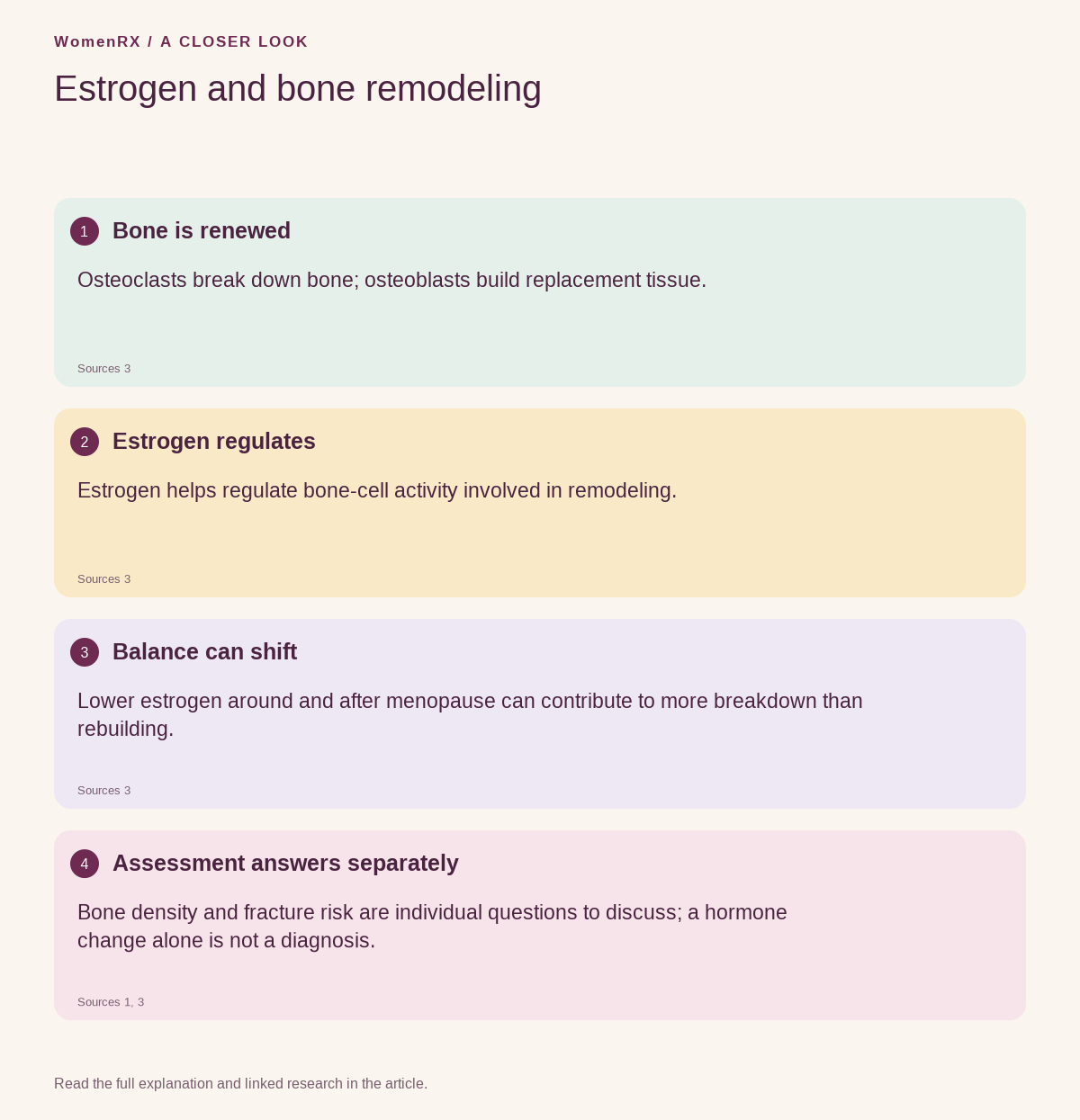
Estrogen and bone remodeling
Bone is renewed: Osteoclasts break down bone; osteoblasts build replacement tissue.3
Estrogen regulates: Estrogen helps regulate bone-cell activity involved in remodeling.3
Balance can shift: Lower estrogen around and after menopause can contribute to more breakdown than rebuilding.3
Assessment answers separately: Bone density and fracture risk are individual questions to discuss; a hormone change alone is not a diagnosis.13
Read the figure as text
This simplified mechanism shows how estrogen relates to bone renewal, and why a change in remodeling is separate from an osteoporosis diagnosis.- Bone is renewed: Osteoclasts break down bone; osteoblasts build replacement tissue.3
- Estrogen regulates: Estrogen helps regulate bone-cell activity involved in remodeling.3
- Balance can shift: Lower estrogen around and after menopause can contribute to more breakdown than rebuilding.3
- Assessment answers separately: Bone density and fracture risk are individual questions to discuss; a hormone change alone is not a diagnosis.13
More questions, answered
Does menopause by itself mean I have osteoporosis?
No. Lower estrogen can contribute to bone loss, but osteoporosis involves reduced bone mass and structural changes associated with fracture risk. Menopause alone doesn’t establish a diagnosis. 3
Can hormone therapy help protect bone?
It has been shown to prevent bone loss and fractures, but whether its benefits outweigh its risks depends on individual circumstances and treatment details. 2
Sources you can check
- Recommendations | Menopause: identification and management | Guidance | NICEAccessed 2026-09-25Return to first citation
- The 2022 hormone therapy position statement of The North American Menopause Society.“The 2022 Hormone Therapy Position Statement of The North American Menopause Society” Advisory Panel. · Menopause (New York, N.Y.) · 2022Return to first citation
- Mathematical modeling of bone remodeling after surgical menopause.Nelson AC, Yeo EF, Zhang Y, Cook CV, Fischer-Holzhausen S, Keeler Bruce L, Dutta P, Gholami S, Smith BJ, Ford Versypt AN. · Frontiers in systems biology · 2026Return to first citation