Can Menopause Hormone Therapy Prevent Bone Loss?
Hormone therapy can help preserve bone and reduce fractures, but whether it makes sense for you depends on more than a bone-density result.
Yes. Menopause hormone therapy has been shown to prevent bone loss and fractures. The case for using it is generally more favorable for healthy women younger than 60 or within 10 years of menopause who also have bothersome menopause symptoms. It isn’t the right choice for everyone, and a bone-density result and your overall fracture risk matter when weighing it against bone-specific treatments. 4 2
Bone density and fractures tell related, different stories
Bone density is one part of bone strength; a fracture is the outcome treatment aims to help prevent. A bone-density scan can help identify low bone mass or osteoporosis, while fracture-risk assessment considers the chance of breaking a bone. So, preserving bone density is relevant, but a density result by itself doesn’t tell the whole story about whether treatment will prevent fractures for you. 2 3
The North American Menopause Society’s 2022 position statement says hormone therapy has been shown to prevent both bone loss and fracture. That supports a real bone benefit, not a promise that every fracture can be prevented. The statement doesn’t give a single fracture-risk reduction that can be applied to every woman, so it’s better to weigh the benefit against your own starting risk than to assume a particular amount of protection. 4
When the balance may be more favorable
For women younger than 60 or within 10 years of menopause onset who have no contraindications, the position statement describes the benefit-risk balance as favorable for treating bothersome hot flashes and other vasomotor symptoms, and for preventing bone loss. That makes bone protection a meaningful added benefit when you’re considering hormone therapy for symptoms. 4
If bone health is your only reason for considering hormones, say so directly. The decision should take into account your age, how long it’s been since menopause, symptoms, bone density and fracture risk, as well as the type and route of hormone therapy and whether a progestogen is used. The position statement says hormone-therapy risks vary with these factors and calls for individualized decisions and periodic reevaluation. 4 3
Timing matters. For women starting more than 10 years after menopause or after age 60, the position statement describes a less favorable balance, in part because the absolute risks of coronary heart disease, stroke, blood clots in veins and dementia are greater. Those are population-level considerations, not a personal prediction. Your health history and reasons for considering treatment still matter. 4
Put hormones alongside your bone-health options
Hormone therapy isn’t the only way to address osteoporosis risk. Osteoporosis treatment may include medicines that slow bone loss or help rebuild bone; the choice depends on clinical circumstances and fracture risk. A bone-density scan and an assessment of your risk can help clarify whether you have low bone mass or osteoporosis and what kind of treatment discussion is appropriate. 2 3
Weight-bearing and resistance exercise are practical parts of bone health. A balanced diet that includes calcium and vitamin D, not smoking, and limiting alcohol are also recommended in the NHS osteoporosis-prevention guidance. These steps can support bone health, but they don’t replace an individualized assessment if you may have osteoporosis or a high fracture risk. 1 2
Questions that make the tradeoff clearer
You might ask: What does my bone-density result say, and what is my estimated fracture risk? Am I considering hormones mainly for menopause symptoms, bone protection, or both? How do my age, time since menopause, medical history and personal risk factors affect the balance? If hormone therapy isn’t a good fit, what bone-specific options should we consider?
Those questions keep the decision focused on what matters: not just whether hormones can help protect bone, but whether their potential benefits fit your symptoms and risk profile better than other options.
Bone benefit and treatment fit
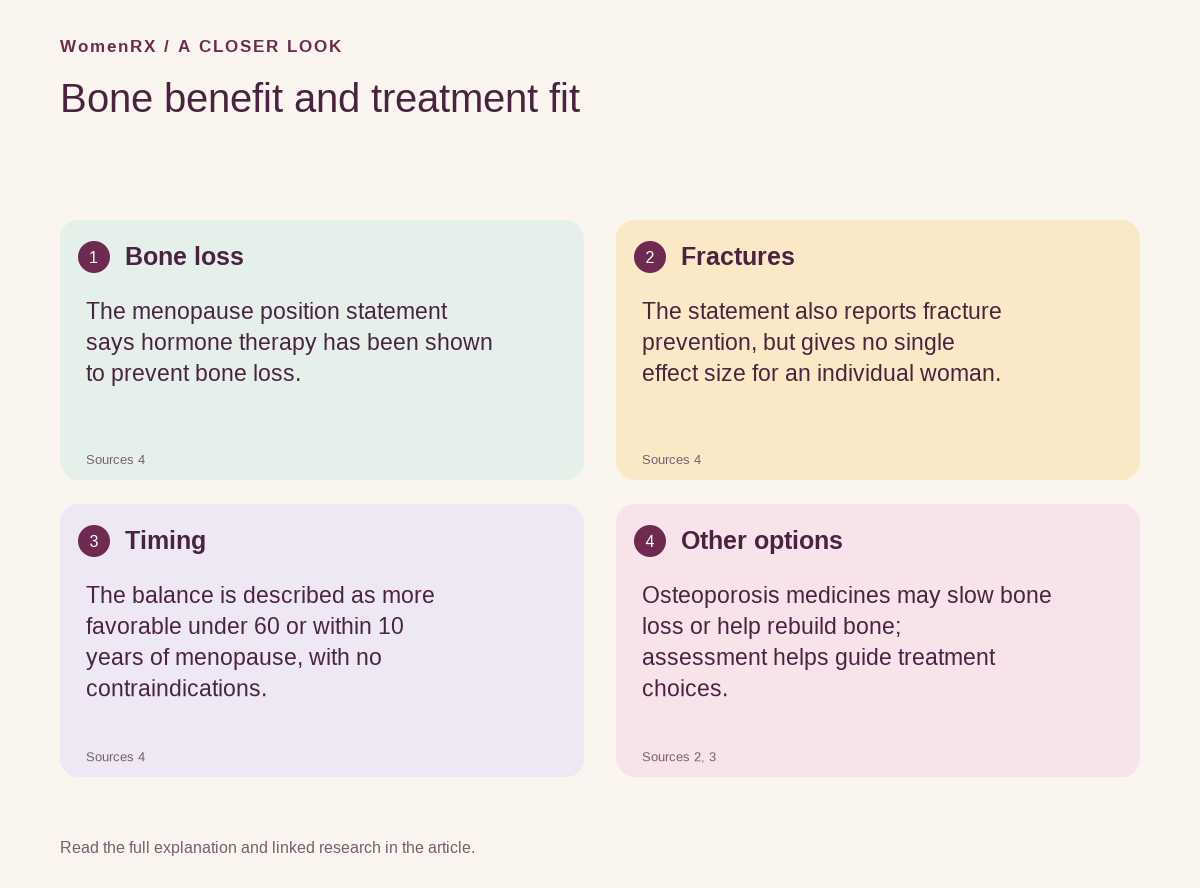
Bone loss: The menopause position statement says hormone therapy has been shown to prevent bone loss.4
Fractures: The statement also reports fracture prevention, but gives no single effect size for an individual woman.4
Timing: The balance is described as more favorable under 60 or within 10 years of menopause, with no contraindications.4
Other options: Osteoporosis medicines may slow bone loss or help rebuild bone; assessment helps guide treatment choices.23
Read the figure as text
Hormone therapy’s bone effects are one part of the decision; timing, symptoms, personal risks, and other bone treatments also matter.- Bone loss: The menopause position statement says hormone therapy has been shown to prevent bone loss.4
- Fractures: The statement also reports fracture prevention, but gives no single effect size for an individual woman.4
- Timing: The balance is described as more favorable under 60 or within 10 years of menopause, with no contraindications.4
- Other options: Osteoporosis medicines may slow bone loss or help rebuild bone; assessment helps guide treatment choices.23
Sources you can check
- Osteoporosis - Prevention - NHSAccessed 2026-09-25Return to first citation
- Osteoporosis | MedlinePlusAccessed 2026-09-25Return to first citation
- Updated practice guideline for dual-energy X-ray absorptiometry (DXA).Slart RHJA, Punda M, Ali DS, Bazzocchi A, Bock O, Camacho P, Carey JJ, Colquhoun A, Compston J, Engelke K, Erba PA, Harvey NC, Krueger D, Lems WF, Lewiecki EM, Morgan S, Moseley KF... · European journal of nuclear medicine and molecular imaging · 2025Return to first citation
- The 2022 hormone therapy position statement of The North American Menopause Society.“The 2022 Hormone Therapy Position Statement of The North American Menopause Society” Advisory Panel. · Menopause (New York, N.Y.) · 2022Return to first citation