Does Hormone Therapy Replace an Osteoporosis Assessment?
Menopause hormone therapy can protect bones, but it can’t tell you whether you already have osteoporosis or need a different treatment plan.
Menopause hormone therapy can prevent bone loss and has been shown to reduce fractures. That benefit doesn’t tell you your own bone density or whether you have osteoporosis. If you’re considering hormone therapy for menopause symptoms, the decision about whether it fits you and the decision about whether your bones need assessment or additional treatment are connected, but separate. 1 4
A stronger scan result isn’t the same as a prevented fracture
As estrogen declines around menopause, bone can be broken down faster than it’s replaced. Menopause hormone therapy (MHT) helps prevent that bone loss. Bone mineral density, or BMD, measures the minerals in bone; denser bones tend to be stronger and less likely to break. 1 5
But the outcome you ultimately care about is a fracture, not just a scan result. The North American Menopause Society’s 2022 position statement says MHT has been shown to prevent both bone loss and fractures. That’s a meaningful benefit. It doesn’t mean an improved BMD result guarantees you won’t break a bone. 1 4
The evidence also isn’t identical for every type of MHT. A 2023 review describes oral synthetic estrogens as the most extensively studied form for fracture prevention. The broader finding that MHT protects bones shouldn’t be read as proof that every dose, formulation, and route has the same fracture-prevention evidence. 6
Bone benefit is one part of the hormone-therapy decision
If you’re considering MHT for bothersome hot flashes or night sweats, bone protection can be an added benefit. The overall decision still depends on more than bone health. For women younger than 60 or within 10 years of menopause onset who have no contraindications, the 2022 position statement describes the benefit-risk balance as favorable for treating bothersome symptoms and preventing bone loss. For women starting after 60 or more than 10 years after menopause, it appears less favorable because the absolute risks of several serious conditions are greater. 4
So timing changes the conversation. Someone close to menopause who wants relief from symptoms is weighing a different overall decision from someone much further past menopause who is considering MHT mainly for bones. In neither case does the bone benefit, by itself, settle whether to start or continue treatment. 4
Your own fracture risk still needs its own look
MHT can protect bone without revealing where you started. A bone-density scan can identify low BMD or osteoporosis, help assess fracture risk, and help show whether osteoporosis treatment is working. A past fracture matters too: low bone density and osteoporosis make a break more likely. 1 3
For example, if you’re choosing MHT for hot flashes, you can also ask whether your bone health calls for a density scan or another assessment. If you’ve already been told you have osteoporosis, or you’ve had a fracture that raises concern about weak bones, ask how that finding affects your bone-treatment plan. Taking MHT doesn’t answer those questions automatically. Assessment might show that no additional medicine is needed, or it might lead to a discussion of osteoporosis-specific treatment. 1 3 4
The same distinction matters when you stop MHT. A 2024 systematic review found only two eligible studies of osteoporosis medicines used after MHT discontinuation, so it could not establish the best follow-on approach. If bone protection was part of why you used MHT, stopping is a sensible point to revisit your fracture risk rather than assuming you do, or don’t, need another treatment. 7
Weight-bearing and resistance exercise remain useful parts of caring for your bones alongside these treatment decisions. They support bone health, but they don’t establish whether you have osteoporosis or make an assessment unnecessary. 1 2
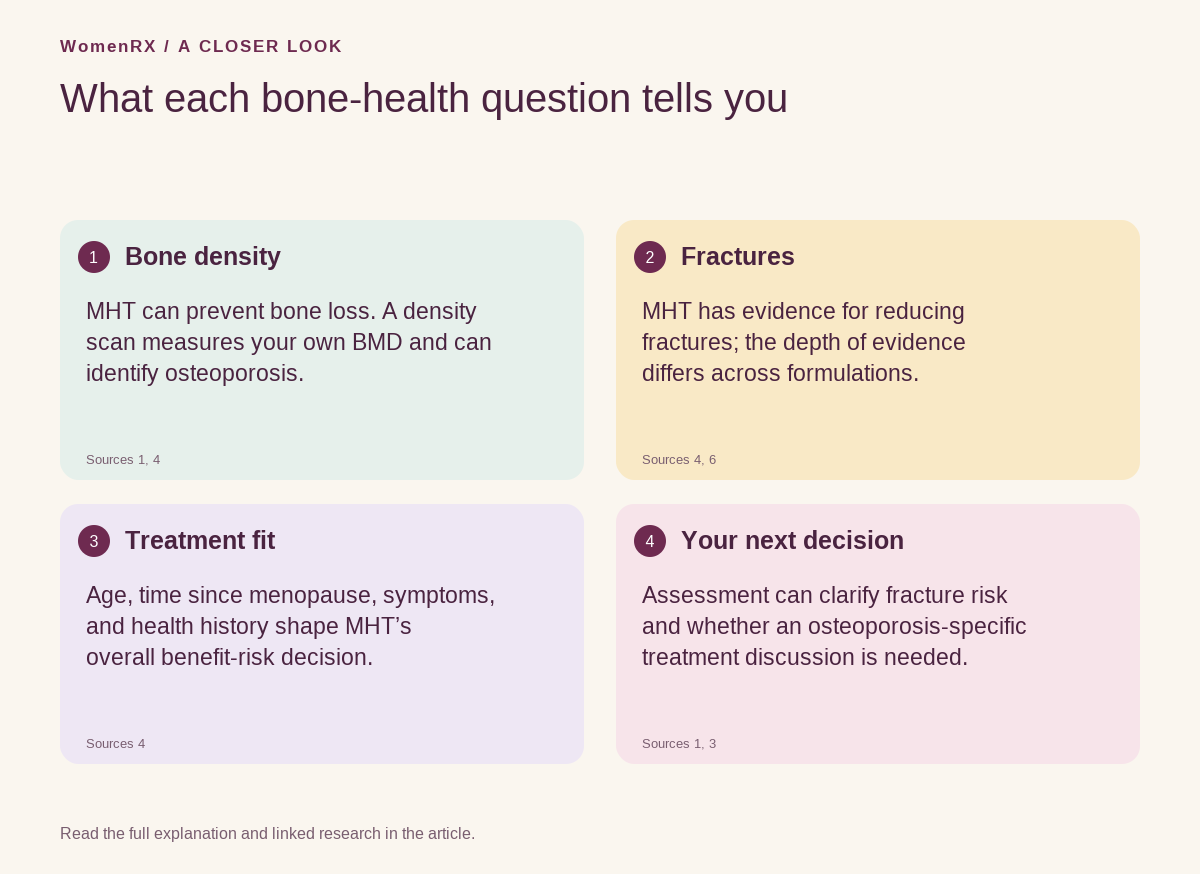
What each bone-health question tells you
Bone density: MHT can prevent bone loss. A density scan measures your own BMD and can identify osteoporosis.14
Fractures: MHT has evidence for reducing fractures; the depth of evidence differs across formulations.46
Treatment fit: Age, time since menopause, symptoms, and health history shape MHT’s overall benefit-risk decision.4
Your next decision: Assessment can clarify fracture risk and whether an osteoporosis-specific treatment discussion is needed.13
Read the figure as text
MHT’s measured bone effects and your need for an osteoporosis assessment are related, but they aren’t the same question.- Bone density: MHT can prevent bone loss. A density scan measures your own BMD and can identify osteoporosis.14
- Fractures: MHT has evidence for reducing fractures; the depth of evidence differs across formulations.46
- Treatment fit: Age, time since menopause, symptoms, and health history shape MHT’s overall benefit-risk decision.4
- Your next decision: Assessment can clarify fracture risk and whether an osteoporosis-specific treatment discussion is needed.13
More questions, answered
Do hot flashes tell me whether I have osteoporosis?
No. A 2024 review of observational studies found an association between vasomotor symptoms and low bone density, but it did not find a difference in fractures between women with and without those symptoms. Hot flashes aren’t a substitute for assessing your own bone health. 5
Sources you can check
- Bone Density | Bone Mineral Density | BMD | MedlinePlusAccessed 2026-09-25Return to first citation
- Osteoporosis - Prevention - NHSAccessed 2026-09-25Return to first citation
- Fracture | MedlinePlusAccessed 2026-09-25Return to first citation
- The 2022 hormone therapy position statement of The North American Menopause Society.“The 2022 Hormone Therapy Position Statement of The North American Menopause Society” Advisory Panel. · Menopause (New York, N.Y.) · 2022Return to first citation
- The association of vasomotor symptoms with fracture risk and bone mineral density in postmenopausal women: a systematic review and meta-analysis of observational studies.Anagnostis P, Lallas K, Pappa A, Avgeris G, Beta K, Damakis D, Fountoukidou E, Zidrou M, Lambrinoudaki I, Goulis DG. · Osteoporosis international : a journal established as result of cooperation between the European Foundation for Osteoporosis and the National Osteoporosis Foundation of the USA · 2024Return to first citation
- The role of menopausal hormone therapy in the prevention and treatment of low bone density in perimenopausal and postmenopausal women.Shah N, Ariel D. · Current opinion in obstetrics & gynecology · 2023Return to first citation
- Antiosteoporosis therapy after discontinuation of menopausal hormone therapy: a systematic review.Anagnostis P, Divaris E, Bosdou JΚ, Tournis S, Stathopoulos K, Goulis DG. · Hormones (Athens, Greece) · 2024Return to first citation