When Menopause Anxiety Needs More Than Waiting It Out
If anxiety is disrupting your life, the next step depends on whether worry, poor sleep, or hot flashes are causing the most trouble.
Anxiety that’s persistent, worsening, or interfering with daily life is worth addressing, whether you’re in perimenopause or past menopause. Note when it happens, how it affects you, and whether sleep problems or hot flashes are part of the picture. That can help you seek support for anxiety itself while also addressing symptoms that may be adding to the strain. 1 5 7
Start with what the anxiety is doing
An anxious spell can be a normal response to stress. But worry or physical symptoms that keep returning, get worse, or interfere with work, relationships, or everyday tasks are a reason to seek support rather than wait for the menopause transition to pass. Menopause may be part of the picture, but the timing alone can’t tell you what’s causing anxiety. 1 7
Anxiety can bring hard-to-control thoughts along with a pounding heartbeat, dizziness, or shortness of breath. Hot flashes and night sweats can also interrupt sleep, leaving you tired and distressed the next day. These experiences may overlap. Notice whether anxiety tends to follow a rough night or a hot flash, appears in other situations too, or has begun to limit what you do. 1 5
Match support to the problem you want to address
If anxiety itself is the main concern: Psychotherapy is a treatment option. Cognitive behavioral therapy (CBT) helps you work with thoughts and behaviors that shape your response to fear and worry. For an anxiety disorder, medication or a combination of medication and therapy may also be considered, depending on the type of anxiety and your circumstances. 1
Menopause-specific CBT research offers some encouragement, though the trials are small. In a pilot randomized trial of 40 Korean perimenopausal women, anxiety scores differed between the CBT and standard-care groups; the authors interpreted the findings as suggesting CBT may have prevented symptoms from worsening. In a separate randomized study of 53 Indian women attending a gynecology clinic, the CBT group had a greater reduction in anxiety scores than a group given a menopause-education pamphlet after six weeks. Neither trial tells us which approach will work best for every woman, particularly after menopause. 4 5
If sleep disruption is leading the way: Describe what happens at night and how you feel during the day. Menopause-focused CBT can address sleep problems, including anxious thoughts about not sleeping. That’s a different treatment focus from working primarily on worry that persists throughout the day, though you may need help with both. 5 6
If hot flashes or night sweats are driving the disruption: Ask about treating those symptoms alongside anxiety. Hormone therapy is the most effective treatment for bothersome hot flashes and night sweats, but its benefits and risks vary with factors including age, timing, treatment type, and health history. Evidence-supported nonhormonal options for these symptoms include CBT and certain prescription medicines. Treating hot flashes may ease one source of disruption; it shouldn’t be assumed to treat anxiety itself. 2 3
If it’s hard to separate them: You don’t have to settle the cause before asking for help. You can explain that worry, lost sleep, and menopause symptoms are happening together, then discuss which problem needs attention first. Mental health support is appropriate when anxiety is persistent or affecting daily life, even if hot flashes are also present. 1 7
Bring a short note, not a perfect diary
Before an appointment, jot down a few examples of what’s changed:
- When anxiety shows up and what it feels like, including physical sensations.
- Whether hot flashes, night sweats, or a poor night’s sleep happened around the same time.
- What anxiety is making harder, such as concentrating at work or going to an event.
- Which problem you most want help with first.
For example, “I woke after night sweats, felt tense at work, and avoided a meeting” tells more than “I’ve been anxious lately.” If worry also appears on well-rested days, include that. These details can help you describe the pattern without having to decide for yourself whether menopause explains it.
A primary care clinician, mental health professional, or clinician who provides menopause care can be a starting point. If anxiety is interfering with your life, you don’t need to wait until it becomes unbearable to bring it up. 1 7
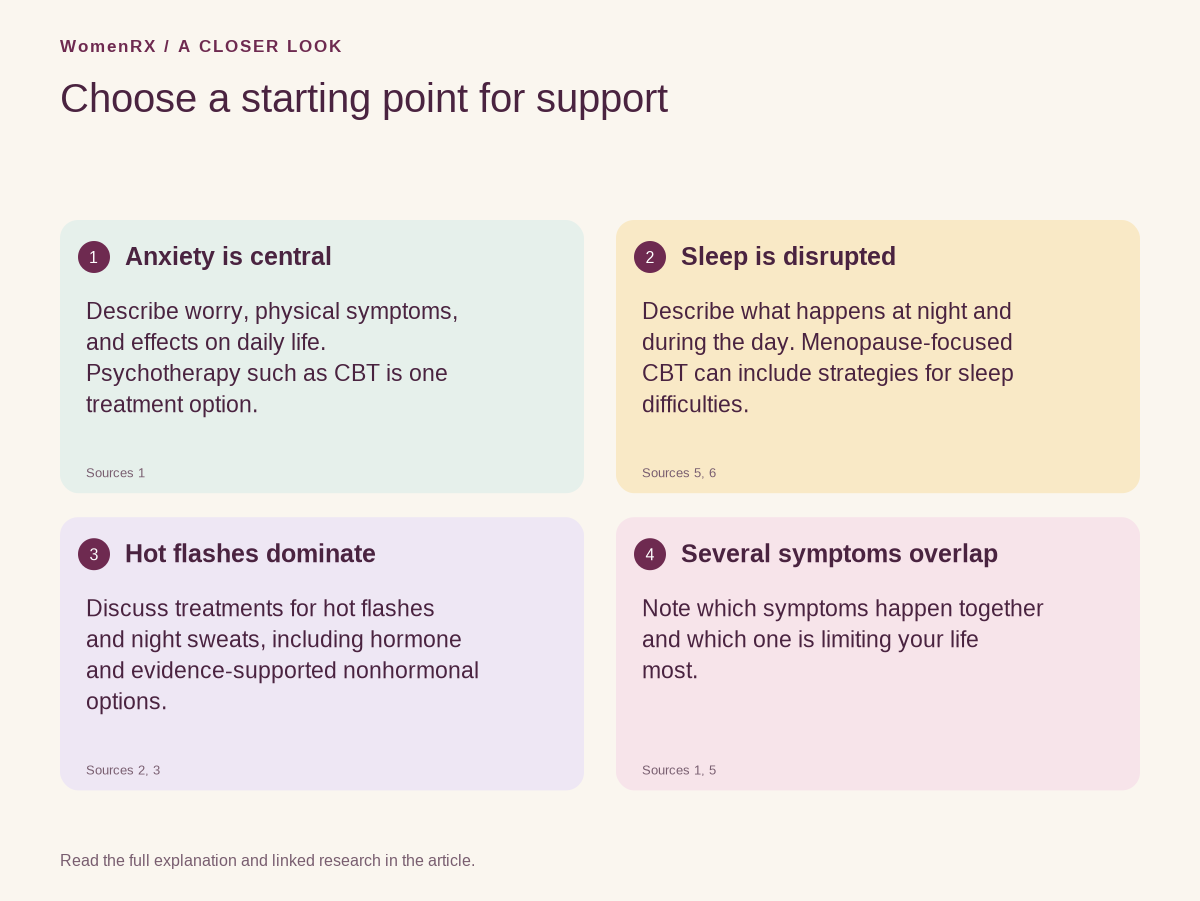
Choose a starting point for support
Anxiety is central: Describe worry, physical symptoms, and effects on daily life. Psychotherapy such as CBT is one treatment option.1
Sleep is disrupted: Describe what happens at night and during the day. Menopause-focused CBT can include strategies for sleep difficulties.56
Hot flashes dominate: Discuss treatments for hot flashes and night sweats, including hormone and evidence-supported nonhormonal options.23
Several symptoms overlap: Note which symptoms happen together and which one is limiting your life most.15
Read the figure as text
Anxiety, sleep disruption, and hot flashes can overlap, but each suggests a different focus for care.- Anxiety is central: Describe worry, physical symptoms, and effects on daily life. Psychotherapy such as CBT is one treatment option.1
- Sleep is disrupted: Describe what happens at night and during the day. Menopause-focused CBT can include strategies for sleep difficulties.56
- Hot flashes dominate: Discuss treatments for hot flashes and night sweats, including hormone and evidence-supported nonhormonal options.23
- Several symptoms overlap: Note which symptoms happen together and which one is limiting your life most.15
More questions, answered
Is CBT for hot flashes the same as CBT for anxiety?
Both use cognitive and behavioral strategies, but the focus matters. Menopause-focused CBT often addresses how you respond to hot flashes and their effect on sleep, while CBT for anxiety focuses on the thoughts and behaviors tied to your particular fears or worries. Ask what symptoms a proposed course of therapy is designed to address. 1 6
Sources you can check
- Anxiety: MedlinePlusAccessed 2026-09-25Return to first citation
- The 2022 hormone therapy position statement of The North American Menopause Society.“The 2022 Hormone Therapy Position Statement of The North American Menopause Society” Advisory Panel. · Menopause (New York, N.Y.) · 2022Return to first citation
- The 2023 nonhormone therapy position statement of The North American Menopause Society.Menopause (New York, N.Y.) · 2023Return to first citation
- Efficacy of cognitive behavioral therapy for menopausal symptoms and quality of life in Korean perimenopausal women: A pilot randomized controlled trial.Kim DS, Kim NY, Han DH, Kim HJ, Yu ES, Kim SM. · Maturitas · 2024Return to first citation
- Effectiveness of Cognitive Behavioral Therapy in Managing Physical and Psychological Distress in Women during the Perimenopausal Phase.Bassi R, Bajaj MK, Goel B. · Journal of mid-life health · 2025Return to first citation
- Cognitive behavioral therapy for menopausal symptoms.Hunter MS. · Climacteric : the journal of the International Menopause Society · 2021Return to first citation
- FIGO best practice recommendations for the mental health of women at menopausal age.Khadilkar S, Divakar H, Benedetto C, Genazzani A, Ramos D, Argale E, Deshpande G, Hicky M, Filho ALDS, Herrera E, Balkrishnan M. · International journal of gynaecology and obstetrics: the official organ of the International Federation of Gynaecology and Obstetrics · 2026Return to first citation