Menopause Anxiety: Comparing Nonhormonal Ways to Find Relief
Anxiety during the menopause transition can overlap with hot flashes and sleep problems, but it deserves attention in its own right.
Therapy, medication, and practical steps can all have a role, depending on what’s driving the distress. Cognitive behavioral therapy (CBT) is a treatment for anxiety; CBT and certain prescription medicines are also recommended for menopause-related hot flashes, which can be closely linked with mood symptoms. Persistent anxiety, disrupted daily life, or new physical symptoms are reasons to seek an assessment rather than assume menopause explains everything. 4 5 6
First, notice what the anxiety is doing
Anxiety can include hard-to-control worry that interferes with daily life, as well as physical sensations such as a rapid heartbeat, tension, dizziness, or shortness of breath. Those sensations alone don’t tell you what’s causing them. Anxiety can be a response to stress, but persistent or worsening symptoms may need assessment. 4
During perimenopause and early menopause, anxiety symptoms and bothersome hot flashes can occur together. In a 10-year prospective study of 430 midlife Chinese women, greater bother from vasomotor symptoms was associated with anxiety and depression symptoms. In time-lagged analyses, hot-flash bother predicted a higher risk of mood symptoms the following year, while anxiety symptoms also predicted greater hot-flash bother. That’s a meaningful connection, but it doesn’t show that hot flashes cause anxiety, or that anxiety is always menopause-related. 5
Anxiety after menopause deserves the same attention as anxiety during the transition. The hot-flash study followed women through perimenopause and early menopause; it doesn’t establish what explains anxiety later in postmenopause. If you already had an anxiety disorder, symptoms now might reflect that ongoing condition, menopausal symptoms, a stressful period of life, or more than one of these. You don’t need to settle on a single explanation before seeking help. 4 5
It may help to notice whether worry continues between hot flashes, whether it is affecting work or relationships, and whether sleep disruption or a major stressor is part of the picture. Those details can help distinguish anxiety that needs its own treatment from distress that rises around particular symptoms. They aren’t a diagnosis.
Match the approach to the main problem
When worry itself is the main issue: Psychotherapy is a standard treatment for anxiety disorders. CBT helps you recognize and change patterns of thinking and behavior, and practice responding differently to situations that trigger fear or anxiety. A therapist can focus the work on your particular concerns and how they affect daily life. 4
When hot flashes are a major part of the distress: A menopause-focused CBT approach may help with vasomotor symptoms and their impact. The North American Menopause Society also lists clinical hypnosis and several prescription nonhormonal treatments as evidence-based options for vasomotor symptoms. That evidence concerns hot flashes, not proof that each option treats an anxiety disorder. 6
When symptoms call for medication: Medication and psychotherapy are both main treatment options for anxiety disorders, and some people use both. Therapy offers a way to work directly on anxious thoughts, behaviors, and responses; medication is another treatment option to discuss if anxiety is persistent or disruptive. The choice depends on the symptoms and health history. Separately, selective serotonin reuptake inhibitors (SSRIs) and serotonin-norepinephrine reuptake inhibitors (SNRIs) are among the prescription options recommended for menopause-related vasomotor symptoms. That hot-flash recommendation doesn’t, by itself, tell you which medicine is right for your anxiety. If both anxiety and hot flashes are concerns, ask what symptoms a proposed medicine is intended to treat and what benefits to expect. 4 6
When you want something to try day to day: If a racing heartbeat is part of the distress, pay attention to whether poor sleep, caffeine, alcohol, or stress seems to precede it. These can contribute to palpitations, and addressing a trigger may help when the palpitations aren’t caused by a health condition. This is a practical step for that symptom, not a substitute for treating persistent anxiety or assessing recurring palpitations. 1 4
When you’re considering supplements: Don’t assume that a product studied for general stress has been shown to treat menopause-related anxiety. For example, studies of ashwagandha for stress or anxiety have included adults in India, used varied preparations, and do not establish a menopause-specific effect. Short-term studies do not settle long-term safety; the NIH Office of Dietary Supplements notes possible liver and thyroid effects and interactions with some medicines. 3
Don’t write off new physical symptoms as anxiety
Palpitations can happen with stress or anxiety and may occur around menopause, but they can also have other causes, including iron-deficiency anemia, an overactive thyroid, or a heart rhythm problem. If they keep returning or become more frequent, seek medical assessment. Palpitations that do not stop, or occur with chest pain or fainting, need urgent medical attention. 1
An assessment for anxiety may include questions about your symptoms and medical history, a physical exam, and sometimes tests to check whether another health problem could be contributing. You don’t have to decide in advance whether the cause is hormonal, emotional, or medical. 4
If anxiety is hard to control, getting worse, or interfering with everyday life, reaching out to a mental-health professional or a medical clinician is a reasonable next step. If you’re thinking about suicide or may harm yourself, call or text 988 in the United States for immediate crisis support. 2 4
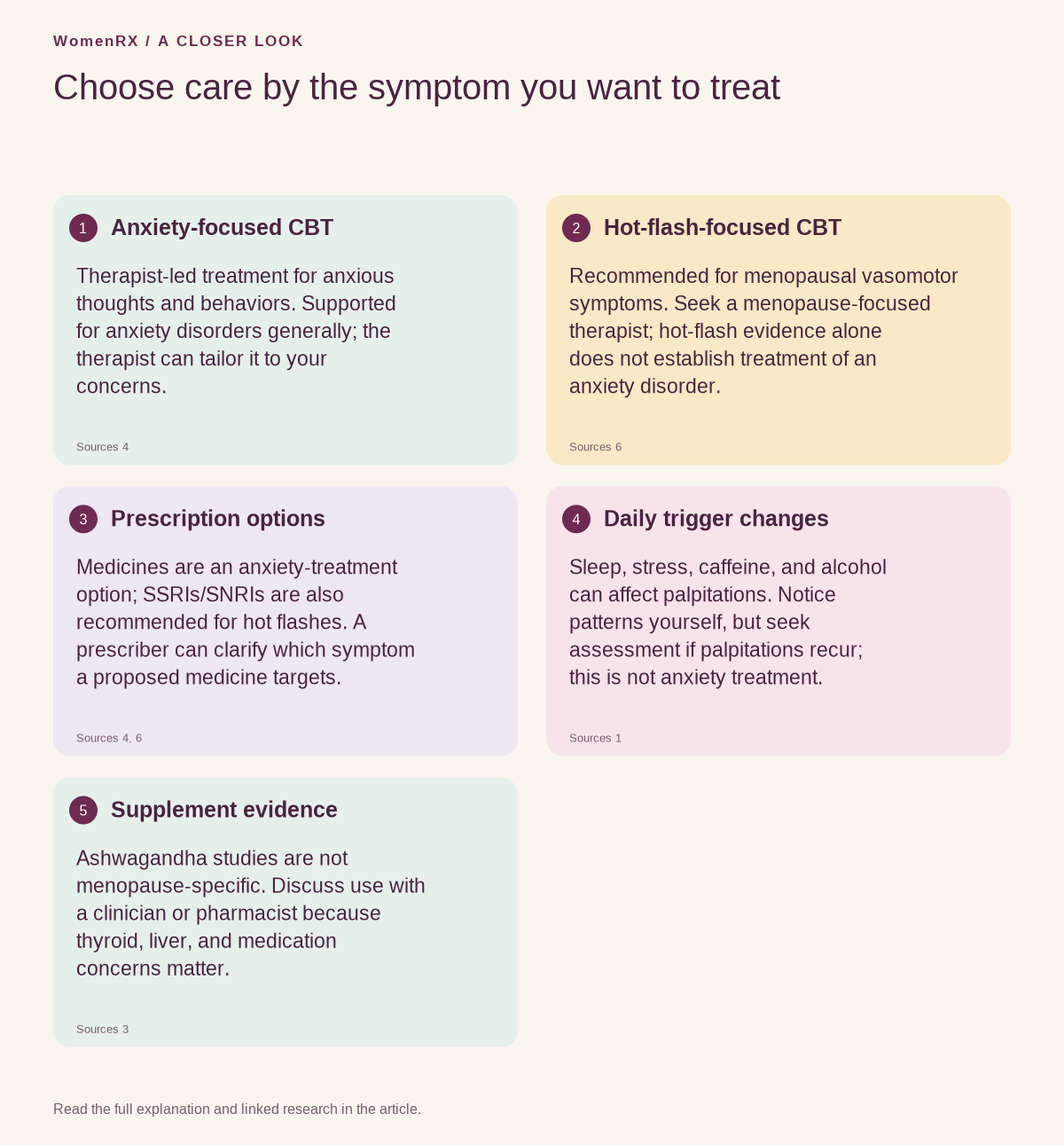
Choose care by the symptom you want to treat
Anxiety-focused CBT: Therapist-led treatment for anxious thoughts and behaviors. Supported for anxiety disorders generally; the therapist can tailor it to your concerns.4
Hot-flash-focused CBT: Recommended for menopausal vasomotor symptoms. Seek a menopause-focused therapist; hot-flash evidence alone does not establish treatment of an anxiety disorder.6
Prescription options: Medicines are an anxiety-treatment option; SSRIs/SNRIs are also recommended for hot flashes. A prescriber can clarify which symptom a proposed medicine targets.46
Daily trigger changes: Sleep, stress, caffeine, and alcohol can affect palpitations. Notice patterns yourself, but seek assessment if palpitations recur; this is not anxiety treatment.1
Supplement evidence: Ashwagandha studies are not menopause-specific. Discuss use with a clinician or pharmacist because thyroid, liver, and medication concerns matter.3
Read the figure as text
These options differ in what they address, what the evidence supports, and whether you need professional help to use them.- Anxiety-focused CBT: Therapist-led treatment for anxious thoughts and behaviors. Supported for anxiety disorders generally; the therapist can tailor it to your concerns.4
- Hot-flash-focused CBT: Recommended for menopausal vasomotor symptoms. Seek a menopause-focused therapist; hot-flash evidence alone does not establish treatment of an anxiety disorder.6
- Prescription options: Medicines are an anxiety-treatment option; SSRIs/SNRIs are also recommended for hot flashes. A prescriber can clarify which symptom a proposed medicine targets.46
- Daily trigger changes: Sleep, stress, caffeine, and alcohol can affect palpitations. Notice patterns yourself, but seek assessment if palpitations recur; this is not anxiety treatment.1
- Supplement evidence: Ashwagandha studies are not menopause-specific. Discuss use with a clinician or pharmacist because thyroid, liver, and medication concerns matter.3
More questions, answered
Does a hot flash mean my anxiety is caused by menopause?
No. Hot-flash bother and anxiety symptoms were linked in a prospective study of midlife Chinese women, and each predicted the other in time-lagged analyses. That supports a connection, not proof of cause. Anxiety can have more than one contributor, so persistent or disruptive symptoms deserve assessment. 5 4
Can I try a supplement instead of therapy or medication?
Evidence from studies of supplements for general stress does not establish that they treat menopause-related anxiety. Ashwagandha studies used varied products, and possible liver or thyroid effects and medication interactions are relevant safety concerns. It’s sensible to discuss a supplement with a clinician or pharmacist, especially if you take medicines or have a thyroid condition. 3
Sources you can check
- Heart palpitations - NHSAccessed 2026-09-25Return to first citation
- Suicide: MedlinePlusAccessed 2026-09-25Return to first citation
- Ashwagandha: Is it helpful for stress, anxiety, or sleep? - Health Professional Fact SheetAccessed 2026-09-25Return to first citation
- Anxiety: MedlinePlusAccessed 2026-09-25Return to first citation
- Relationships Between Vasomotor Symptoms and Mood in Midlife Urban Chinese Women: Observations in a Prospective Study.Tang R, Luo M, Li J, Peng Y, Wang Y, Liu B, Liu G, Wang Y, Lin S, Chen R. · The Journal of clinical endocrinology and metabolism · 2020Return to first citation
- The 2023 nonhormone therapy position statement of The North American Menopause Society.Menopause (New York, N.Y.) · 2023Return to first citation