What Helps Menopause Night Sweats Without Hormones?
If sudden heat keeps waking you, treatments for menopausal hot flashes can do more than changing the bedding.
If your night sweats are menopausal hot flashes, evidence-supported nonhormonal options include certain SSRIs or SNRIs, gabapentin, fezolinetant, cognitive behavioral therapy, and clinical hypnosis. 6 Lighter bedding can help when you’re too warm, but cooling isn’t a proven treatment for the hot flashes themselves. 16 Regularly disruptive or unexplained sweats deserve assessment, especially with feverish symptoms or unexplained weight loss. 1
First, notice how the sweating starts
Hot flashes can bring sudden warmth to the face, neck, and chest and may cause sweating. When they happen at night with sweating, they are called night sweats. 11 Vasomotor symptoms affect women during perimenopause as well as after menopause, so you don’t have to wait until your periods have stopped to take a recurring pattern seriously. 7
Being too warm under a heavy comforter is different. A hot room or bedding can make anyone sweat at night; repeatedly soaking your nightclothes or sheets even when the room is cool is a pattern worth getting checked. Neither description proves the cause by itself. 1
For example, if you wake up warm under thick covers, switching to lighter bedding addresses a possible source of overheating. If a sudden wave of heat keeps waking you in a comfortable room, lighter covers may make the aftermath easier without preventing the episode. The Menopause Society’s 2023 evidence review does not recommend cooling techniques as a treatment for menopausal vasomotor symptoms. 16
Match the option to the problem that’s waking you
The Menopause Society recommends several nonhormonal approaches for vasomotor symptoms: certain selective serotonin reuptake inhibitors (SSRIs) and serotonin-norepinephrine reuptake inhibitors (SNRIs), gabapentin, fezolinetant, cognitive behavioral therapy (CBT), and clinical hypnosis. It also lists oxybutynin as an option. These are recommendations for menopausal vasomotor symptoms overall; the cited guidance does not separately establish effects on nighttime episodes or name a best choice for them. 6
SSRIs and SNRIs are prescription medicines that can reduce the frequency of vasomotor symptoms. In a pooled analysis of three randomized trials involving 899 perimenopausal and postmenopausal women with at least 14 bothersome episodes a week, venlafaxine reduced overall symptom frequency by 1.8 episodes per day more than placebo at eight weeks; escitalopram’s placebo-relative reduction was 1.4 episodes per day. Those figures count vasomotor symptoms overall, not night sweats alone. 7 Your other medicines matter here: the review advises caution with paroxetine and fluoxetine in people taking tamoxifen. 8
Gabapentin is another recommended prescription option for vasomotor symptoms. Sleepiness, tiredness, and dizziness are possible side effects, so a medicine considered for nighttime symptoms may also affect how you feel the next day. If you’re already taking gabapentin, don’t stop it abruptly; stopping may require a gradual reduction. 634
Fezolinetant is a nonhormonal prescription medicine for moderate to severe menopausal vasomotor symptoms. One concrete medication check is whether you take a CYP1A2 inhibitor: the US prescribing information says fezolinetant must not be used with medicines in that group. It also lists cirrhosis, severe kidney impairment, or end-stage kidney disease as reasons not to use it. The label warns about serious liver problems and calls for liver blood tests before treatment, monthly for the first three months, and at months six and nine. 2
CBT and clinical hypnosis are recommended nonmedication approaches for vasomotor symptoms. That’s a different claim from saying either will treat insomnia that continues on nights without sweating. If you’re awake even when no heat or sweating occurs, describe that as a separate sleep problem rather than assuming fewer hot flashes will resolve all of it. 6
Nonhormonal options differ in side effects, medication interactions, and whether they involve medicine or a behavioral approach. Those differences can help you compare choices. 23468
Hormone therapy is the most effective treatment for menopausal vasomotor symptoms. Its balance of benefits and risks depends on your health, when treatment begins, and the type, route, and duration used. The Menopause Society finds that balance generally more favorable for women younger than 60 or within 10 years of menopause onset who have no contraindications; starting later can carry greater absolute health risks. 5
Be selective about supplements and bedroom fixes
You can make your sleep space comfortable without expecting it to function as treatment. The same distinction applies to products marketed as natural remedies. A 2024 review found improvements in pooled measures of menopausal symptoms, including hot-flash frequency, across varied plant-derived supplements. Its authors also identified substantial differences among products and limitations in study quality. The Menopause Society does not recommend supplements or herbal remedies for treating vasomotor symptoms, so a pooled result is not a reliable promise for a particular bottle. 96
When the pattern calls for a closer look
Menopause is a common reason for night sweats, not the only one. Anxiety, alcohol or drug use, excessive-sweating conditions, and sometimes medicines can contribute. If the pattern began after a medication change, mention the timing rather than assuming menopause or the medicine is definitely responsible. 1
Arrange an assessment if sweats regularly wake you, soak your clothes or sheets, or worry you. Sweating alongside a very high temperature or feeling hot, cold, or shivery; a cough; diarrhea; or unexplained weight loss also needs checking. These signs don’t identify a single cause, but they’re good reasons not to treat the sweating as just another hot flash. 1
If sleep loss is the main reason you’re seeking relief, the most useful distinction is simple: are sudden heat-and-sweating episodes waking you, or is sleep difficult even without them? That answer helps separate a conversation about treating vasomotor symptoms from one about sleep itself.
If sleep stays difficult even without sweating, seek an assessment when changing sleep habits has not helped, the problem has lasted for months, or it makes daily life hard to cope with. Insomnia may need its own treatment; CBT for insomnia addresses thoughts and habits that keep you awake. 10
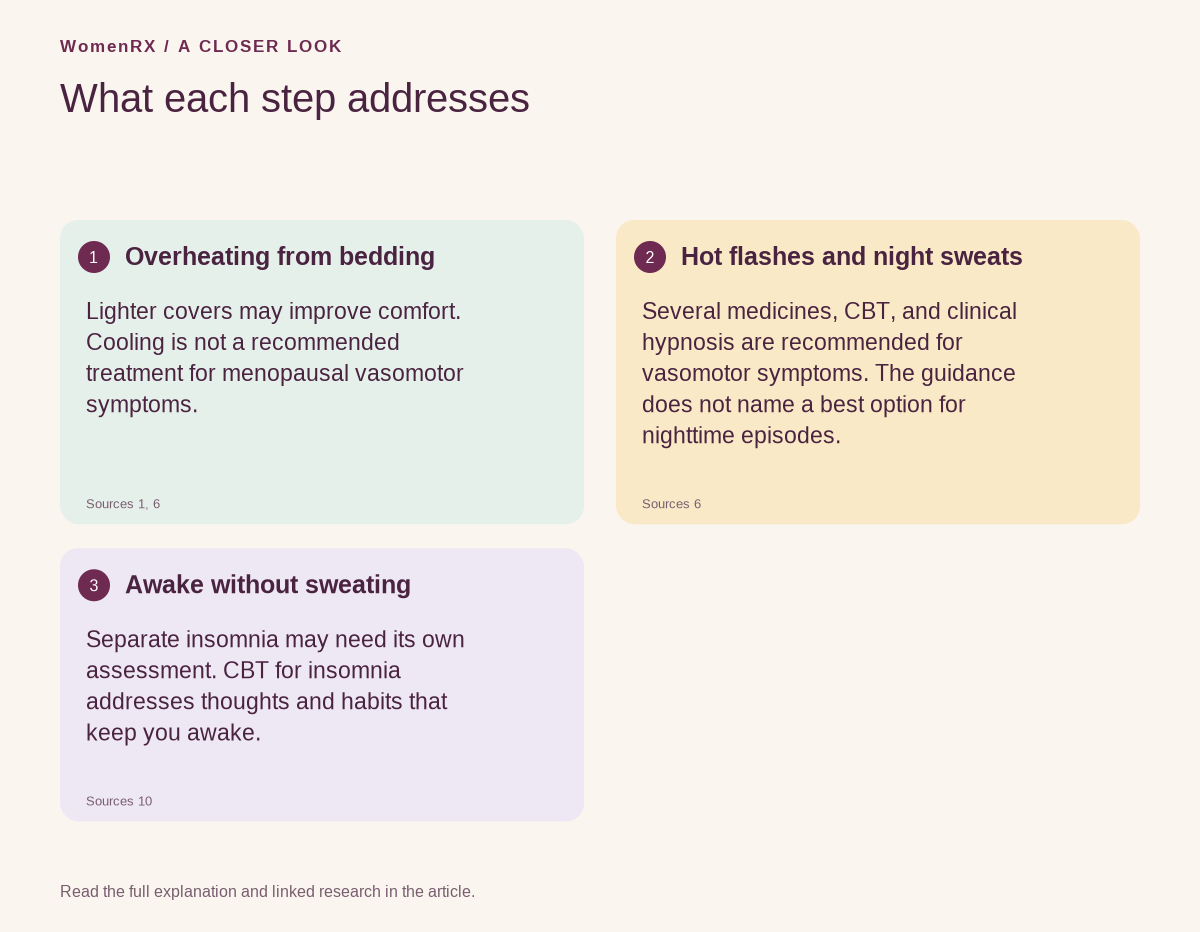
What each step addresses
Overheating from bedding: Lighter covers may improve comfort. Cooling is not a recommended treatment for menopausal vasomotor symptoms.16
Hot flashes and night sweats: Several medicines, CBT, and clinical hypnosis are recommended for vasomotor symptoms. The guidance does not name a best option for nighttime episodes.6
Awake without sweating: Separate insomnia may need its own assessment. CBT for insomnia addresses thoughts and habits that keep you awake.10
Read the figure as text
A comfortable bedroom, treatment for hot flashes, and attention to separate sleep difficulty solve different problems.- Overheating from bedding: Lighter covers may improve comfort. Cooling is not a recommended treatment for menopausal vasomotor symptoms.16
- Hot flashes and night sweats: Several medicines, CBT, and clinical hypnosis are recommended for vasomotor symptoms. The guidance does not name a best option for nighttime episodes.6
- Awake without sweating: Separate insomnia may need its own assessment. CBT for insomnia addresses thoughts and habits that keep you awake.10
Sources you can check
- Night sweats - NHSAccessed 2026-09-25Return to first citation
- VEOZAH (FEZOLINETANT) TABLET, FILM COATED [ASTELLAS PHARMA US, INC.] | US prescribing information and patient instructionsAccessed 2026-09-25Return to first citation
- About gabapentin - NHSAccessed 2026-09-25Return to first citation
- Side effects of gabapentin - NHSAccessed 2026-09-25Return to first citation
- The 2022 hormone therapy position statement of The North American Menopause Society.“The 2022 Hormone Therapy Position Statement of The North American Menopause Society” Advisory Panel. · Menopause (New York, N.Y.) · 2022Return to first citation
- The 2023 nonhormone therapy position statement of The North American Menopause Society.Menopause (New York, N.Y.) · 2023Return to first citation
- Pooled Analysis of Six Pharmacologic and Nonpharmacologic Interventions for Vasomotor Symptoms.Guthrie KA, LaCroix AZ, Ensrud KE, Joffe H, Newton KM, Reed SD, Caan B, Carpenter JS, Cohen LS, Freeman EW, Larson JC, Manson JE, Rexrode K, Skaar TC, Sternfeld B, Anderson GL. · Obstetrics and gynecology · 2015Return to first citation
- Serotonergic agents as an alternative to hormonal therapy for the treatment of menopausal vasomotor symptoms.Stearns V. · Treatments in endocrinology · 2006Return to first citation
- Efficacy of plant-derived dietary supplements in improving overall menopausal symptoms in women: An updated systematic review and meta-analysis.Oh MR, Park JH, Park SK, Park SH. · Phytotherapy research : PTR · 2024Return to first citation
- InsomniaAccessed 2026-09-25Return to first citation
- MenopauseAccessed 2026-09-25Return to first citation