Could Thyroid Symptoms Overlap With Perimenopause?
Fatigue, mood changes, and temperature sensitivity can have more than one explanation, and menopause and thyroid dysfunction can occur at the same time.
Yes. Some symptoms discussed around menopause also occur with thyroid dysfunction, including fatigue, mood or concentration changes, and temperature sensitivity. These symptoms can help frame a conversation, but they can’t identify the cause on their own. If changes are persistent, or you also notice palpitations or pronounced heat intolerance, ask whether thyroid evaluation, such as a TSH blood test, makes sense alongside a discussion of perimenopause. 12
The overlap is real, but the clues aren’t a diagnosis
Fatigue, changes in mood or concentration, and feeling unusually sensitive to temperature can raise questions about both perimenopause and thyroid function. A review focused on peri- and postmenopausal women notes that hyperthyroidism can have symptoms similar to menopause, and that thyroid problems may be harder to recognize as people get older. 1
The useful distinction isn’t a symptom checklist. In one cross-sectional study of 150 women over 40 at a clinic in India, somatic symptoms did not differ significantly across thyroid-function groups. Depressive mood was more prevalent among participants with hypothyroidism or hyperthyroidism, but that finding doesn’t make mood changes a reliable way to identify a thyroid problem. 2
What may be worth mentioning
The pattern and context of symptoms can still help you explain what’s changed. The study report describes heat intolerance, palpitations, and insomnia in connection with hyperthyroidism. It also discusses fatigue, slowed thinking, mood problems, and cold sensitivity with thyroid dysfunction. These are reasons to include those experiences in a conversation, not proof of a particular diagnosis. 2
If your cycles have become irregular, include that change too. A cycle change alone can’t establish whether thyroid function is involved. Menopause and thyroid dysfunction don’t have to be competing explanations: a thyroid condition may be present during the same life stage. 1
When a thyroid check may be part of the conversation
If symptoms persist, feel different from your usual pattern, or include palpitations or pronounced heat intolerance, it’s reasonable to ask whether thyroid evaluation belongs in the discussion. A 2023 review recommends keeping the reasons to measure TSH broad in perimenopausal women. That’s the review’s recommendation, not a universal rule that everyone going through perimenopause needs testing. 1
A practical question is: “Could checking my thyroid be useful alongside considering perimenopause?” TSH is a thyroid blood test clinicians may consider when evaluating thyroid function. If you already take thyroid medication, mention that as part of the discussion; thyroid follow-up remains relevant during the peri- and postmenopausal years. 13
The point isn’t to decide which condition you have before asking. It’s to bring together your symptoms, cycle changes, and relevant health history so both possibilities can be considered.
Shared symptoms and useful context
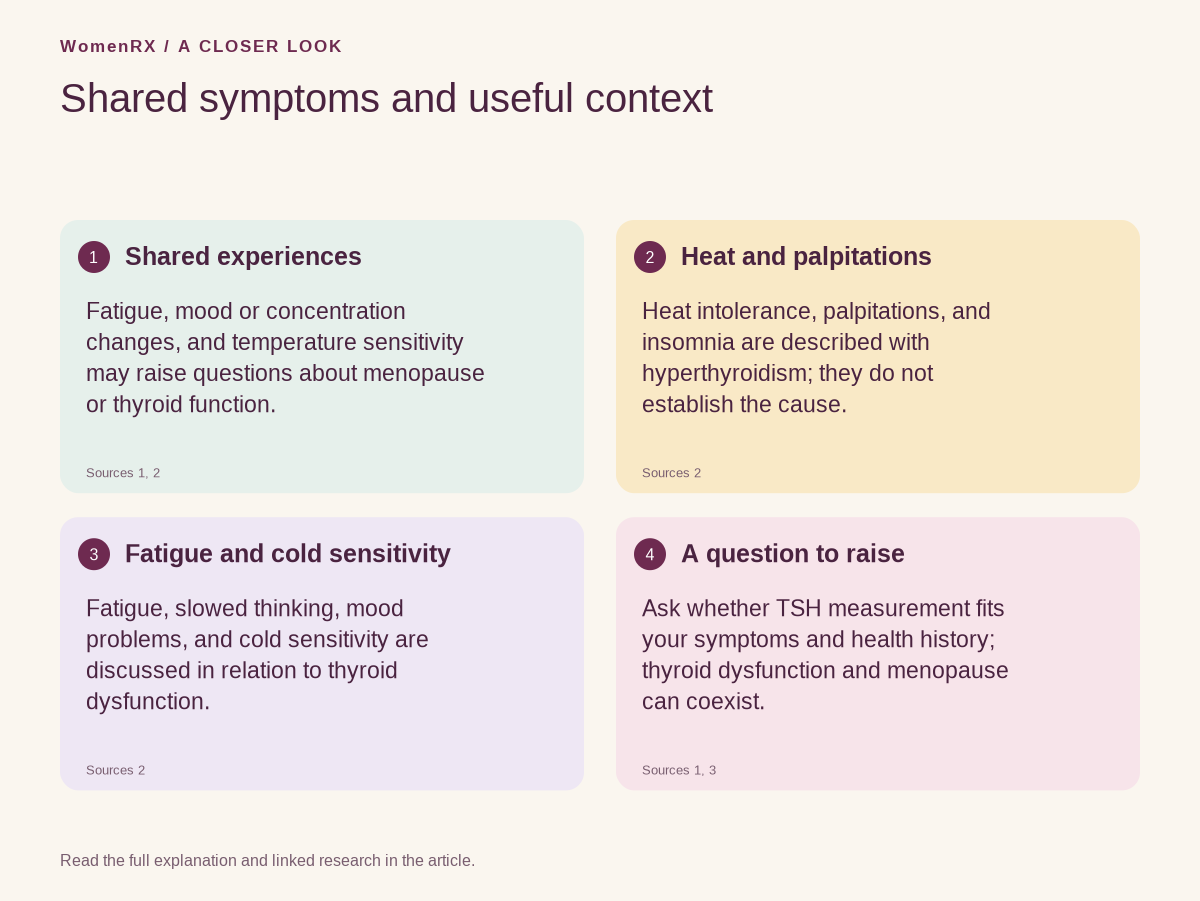
Shared experiences: Fatigue, mood or concentration changes, and temperature sensitivity may raise questions about menopause or thyroid function.12
Heat and palpitations: Heat intolerance, palpitations, and insomnia are described with hyperthyroidism; they do not establish the cause.2
Fatigue and cold sensitivity: Fatigue, slowed thinking, mood problems, and cold sensitivity are discussed in relation to thyroid dysfunction.2
A question to raise: Ask whether TSH measurement fits your symptoms and health history; thyroid dysfunction and menopause can coexist.13
Read the figure as text
Symptoms can help you describe what has changed, while the distinctions here show what may be useful to raise when discussing thyroid evaluation.- Shared experiences: Fatigue, mood or concentration changes, and temperature sensitivity may raise questions about menopause or thyroid function.12
- Heat and palpitations: Heat intolerance, palpitations, and insomnia are described with hyperthyroidism; they do not establish the cause.2
- Fatigue and cold sensitivity: Fatigue, slowed thinking, mood problems, and cold sensitivity are discussed in relation to thyroid dysfunction.2
- A question to raise: Ask whether TSH measurement fits your symptoms and health history; thyroid dysfunction and menopause can coexist.13
More questions, answered
Can thyroid dysfunction and perimenopause happen at the same time?
Yes. Thyroid dysfunction is considered in peri- and postmenopausal women, so the two explanations aren’t mutually exclusive. 1
Does a symptom like fatigue mean I need a thyroid test?
Fatigue alone doesn’t establish the cause. If it persists or comes with other changes, ask whether thyroid evaluation, including TSH measurement, fits your situation. A 2023 review argues for broad consideration of TSH testing in perimenopausal women, rather than saying everyone should be tested. 12
Sources you can check
- Thyroid Dysfunction in Periand Postmenopausal Women-Cumulative Risks.Frank-Raue K, Raue F. · Deutsches Arzteblatt international · 2023Return to first citation
- Frequency of Thyroid Disorder in Pre- and Postmenopausal Women and Its Association With Menopausal Symptoms.Yadav M, Kose V, Bhalerao A. · Cureus · 2023Return to first citation
- Analyzing Thyroid Dysfunction in the Climacteric.Panda S, Das A. · Journal of mid-life health · 2018Return to first citation