Menopause, Hormone Changes, and Fatigue: What’s the Link?
Fatigue can happen around menopause, but it doesn’t tell you whether hormones are the cause.
Fatigue may occur during the menopause transition, but its timing doesn’t show that changing hormones directly caused it. There’s a possible indirect link: if hot flashes or night sweats interrupt your sleep, too little sleep can leave you tired. Fatigue has many other possible causes, so it isn’t a reliable measure of hormone status. 1 2 4
Feeling worn out during perimenopause or after your periods have stopped can make hormone changes seem like the obvious explanation. But fatigue alone can’t tell you what’s behind it. The useful distinction is between a direct hormone effect, which symptom reports don’t establish, and an indirect effect through something you can notice, such as disrupted sleep.
Fatigue can accompany menopause without measuring hormones
Fatigue is reported alongside other symptoms in women experiencing changes in ovarian function. In a clinic-based study of 293 Chinese women with premature ovarian insufficiency, 57.3% reported fatigue and 58.7% reported insomnia. Premature ovarian insufficiency is distinct from typical-age perimenopause or postmenopause, so those percentages shouldn’t be treated as rates for all women around menopause. The study also measured symptoms at one point in time; it can’t show that hormone changes caused the fatigue. 4
That’s why feeling tired isn’t a specific sign of low estrogen or another particular hormone level. It’s a real symptom, but not a hormone test. 1 4
Sleep is a possible indirect link
Hot flashes and night sweats are menopause symptoms. Too little sleep is also a recognized cause of fatigue. Put together, those facts suggest a possible pathway: nighttime symptoms interrupt sleep, and lost sleep contributes to next-day tiredness. They don’t prove that this is the cause for any one person. 1 2
For example, if you feel most drained after nights when you wake up sweaty, sleep disruption might be part of the picture. If you’re tired even after nights when you sleep well, that pattern is a reason to look beyond nighttime symptoms. Neither pattern can diagnose the cause on its own.
Treatment choices depend on the symptom you’re trying to relieve. The North American Menopause Society’s 2022 guidance identifies hormone therapy as the most effective treatment for hot flashes and night sweats. That finding shouldn’t be turned into a promise that hormone therapy will reliably relieve fatigue itself. 3
Don’t overlook other causes
Fatigue can also be related to sleep disorders, anemia, thyroid disease, diabetes, infections, depression, anxiety, ongoing pain, stress, and other factors. The fact that it began around perimenopause or postmenopause is useful context, not a diagnosis. 1
If fatigue hasn’t improved after several weeks, MedlinePlus advises contacting a health care provider to help find the cause. Questions about sleep and daily activities, a physical exam, and sometimes lab tests can be part of that evaluation. 1
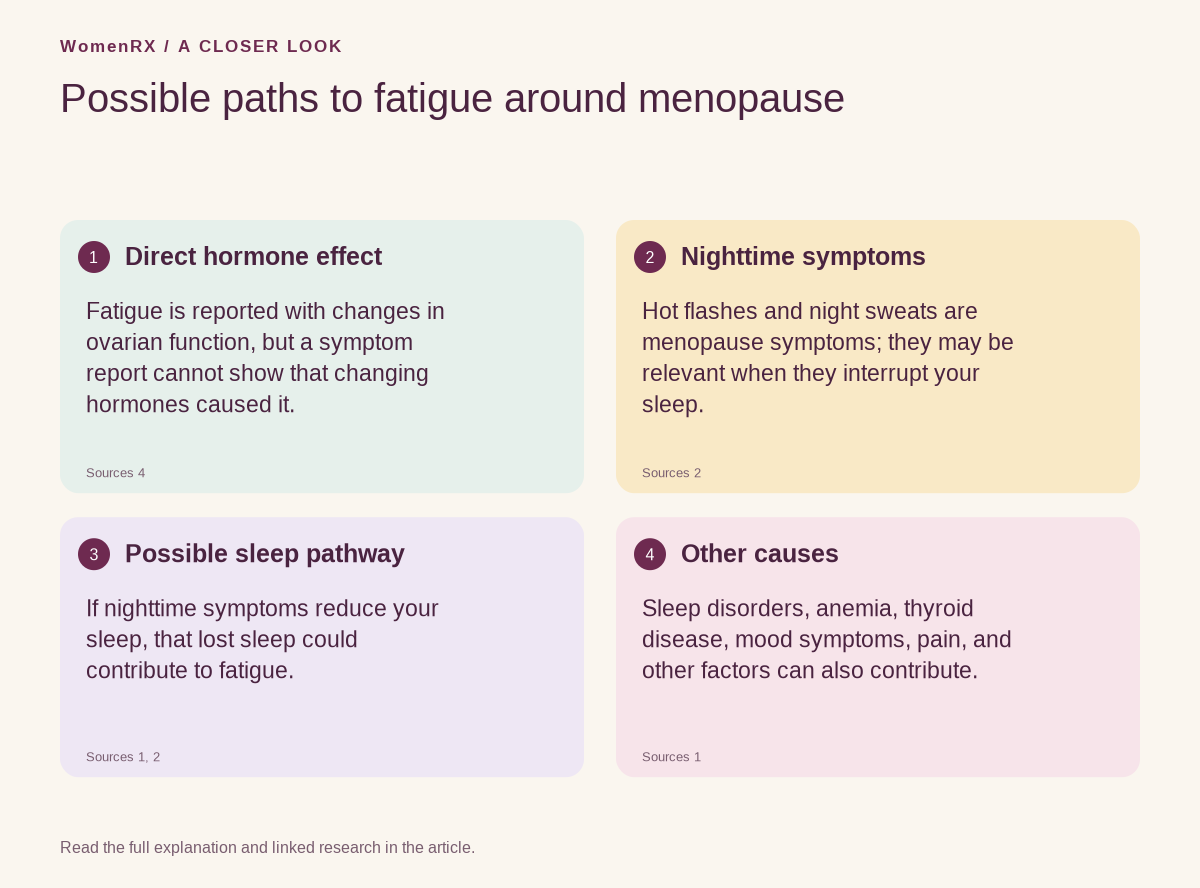
Possible paths to fatigue around menopause
Direct hormone effect: Fatigue is reported with changes in ovarian function, but a symptom report cannot show that changing hormones caused it.4
Nighttime symptoms: Hot flashes and night sweats are menopause symptoms; they may be relevant when they interrupt your sleep.2
Possible sleep pathway: If nighttime symptoms reduce your sleep, that lost sleep could contribute to fatigue.12
Other causes: Sleep disorders, anemia, thyroid disease, mood symptoms, pain, and other factors can also contribute.1
Read the figure as text
This map distinguishes a possible sleep-related pathway from a direct hormone effect that symptom reports cannot establish.- Direct hormone effect: Fatigue is reported with changes in ovarian function, but a symptom report cannot show that changing hormones caused it.4
- Nighttime symptoms: Hot flashes and night sweats are menopause symptoms; they may be relevant when they interrupt your sleep.2
- Possible sleep pathway: If nighttime symptoms reduce your sleep, that lost sleep could contribute to fatigue.12
- Other causes: Sleep disorders, anemia, thyroid disease, mood symptoms, pain, and other factors can also contribute.1
More questions, answered
Does hormone therapy reliably improve fatigue?
The 2022 North American Menopause Society guidance identifies hormone therapy as the most effective treatment for hot flashes and night sweats. It does not establish that hormone therapy reliably treats fatigue itself. 3
Sources you can check
- Fatigue: MedlinePlusAccessed 2026-09-25Return to first citation
- Other medicines for menopause symptoms - NHSAccessed 2026-09-25Return to first citation
- The 2022 hormone therapy position statement of The North American Menopause Society.“The 2022 Hormone Therapy Position Statement of The North American Menopause Society” Advisory Panel. · Menopause (New York, N.Y.) · 2022Return to first citation
- Menopausal symptoms in women with premature ovarian insufficiency: prevalence, severity, and associated factors.Huang Y, Qi T, Ma L, Li D, Li C, Lan Y, Chu K, Chen P, Xu W, Cao Y, Ying Q, Xu L, Zhou J. · Menopause (New York, N.Y.) · 2021Return to first citation