Could These Symptoms Be Menopause? Look for the Pattern
Hot flashes and disrupted sleep can occur around menopause. Note changes in periods as context, and know when a symptom needs checking.
A sudden wave of heat and sweating can be a hot flash around menopause. If your periods are changing, record when that began as context, not proof of the cause. Nighttime waking may come with hot flashes, though sleep problems can happen without them. If you’re over 45 and have gone more than a year without a period, new vaginal bleeding needs to be checked rather than counted as another menopause symptom. 372
Start with what happens, and when
A hot flash may feel like a sudden rush of heat in your face, neck, or chest, sometimes with intense sweating. As estrogen levels decline around menopause, some women have mild hot flashes while others find them very uncomfortable. If both ovaries are removed before natural menopause, the drop in estrogen is sudden rather than gradual. 3
The context matters. If you’re still having periods, record when symptoms occur and whether your menstrual pattern has changed. Menopause is usually identified in women over 45 after more than a year without a period. Before that point, neither a symptom list nor a single sweaty night tells you where you are in the transition. 23
After the final period, hot flashes can still be relevant. A clinical trial of a treatment for vasomotor symptoms enrolled postmenopausal women with moderate to severe hot flashes. The final period isn’t necessarily the end of those symptoms. 3
Night sweats and poor sleep aren’t the same clue
Waking hot because your room or bedding is warm is different from repeatedly soaking your nightclothes and sheets while the room is cool. Menopause-related hot flashes are one common reason for night sweats, but anxiety, alcohol or drug use, and excessive sweating can also be involved. A medicine may be another possibility worth considering. 1
Sleep deserves its own attention, even if you suspect menopause. In a longitudinal study of 1,285 women going through natural menopause, frequent vasomotor symptoms, such as hot flashes and night sweats, were strongly associated with waking several times a night. Sleep problems also occurred without vasomotor symptoms, and women’s patterns differed over time. If you wake up, ask yourself whether a rush of heat woke you or whether you were already awake when you noticed feeling warm. That distinction can make a conversation about sleep more useful, though it won’t establish a diagnosis. 7
Notice what doesn’t fit neatly
Vaginal dryness and joint symptoms are also studied in connection with menopause, but neither identifies menopause on its own. Mood changes need similar care: they’re real and worth addressing without assuming hormones are the sole cause. In a long-term study of 1,178 Korean women undergoing natural menopause, most maintained low depressive-symptom scores; a smaller group’s symptoms worsened. Poor sleep and moderate to severe hot flashes were associated with that worsening pattern, but the study cannot show that menopause caused an individual woman’s depression. 46
A useful next move is to separate symptoms that occur together from those that don’t. For example, if poor sleep follows repeated hot flashes, discussing both may help. If sleep or mood has changed substantially without hot flashes, it deserves attention in its own right rather than being dismissed as ‘just menopause.’ 67
Know when to seek a separate explanation
Bleeding after menopause is one clear dividing line. If you’re over 45 and have gone more than a year without a period, arrange a medical assessment for any new vaginal bleeding, even if it happens only once or you aren’t sure it’s blood. It often has a cause other than cancer, but it needs checking. 2
Regular night sweats that wake or worry you also deserve an assessment, particularly if they come with a high temperature, cough, diarrhea, or unexplained weight loss. These accompanying features are a reason not to assume the sweating is hormonal. 1
If hot flashes are disrupting your days or nights, you don’t have to wait for certainty about your final period to talk about relief. Cognitive and behavioral therapies have shown modest benefits for menopausal symptoms, including hot flashes and night sweats, across randomized trials. A care conversation can focus on the symptom that is affecting you now while also checking whether something else needs attention. 5
Bring a short pattern, not a perfect diary
For a few examples of recent episodes, write down what happened: sudden heat or sweating, waking without feeling hot, or another symptom; whether you were still having periods; and what the episode interrupted. Include any new bleeding after a full year without a period. If you’ve had both ovaries removed, mention when the surgery happened, since that changes the hormonal context. The aim isn’t to prove menopause. It’s to make the distinction between a possible menopause pattern and a separate problem easier to see. 1237
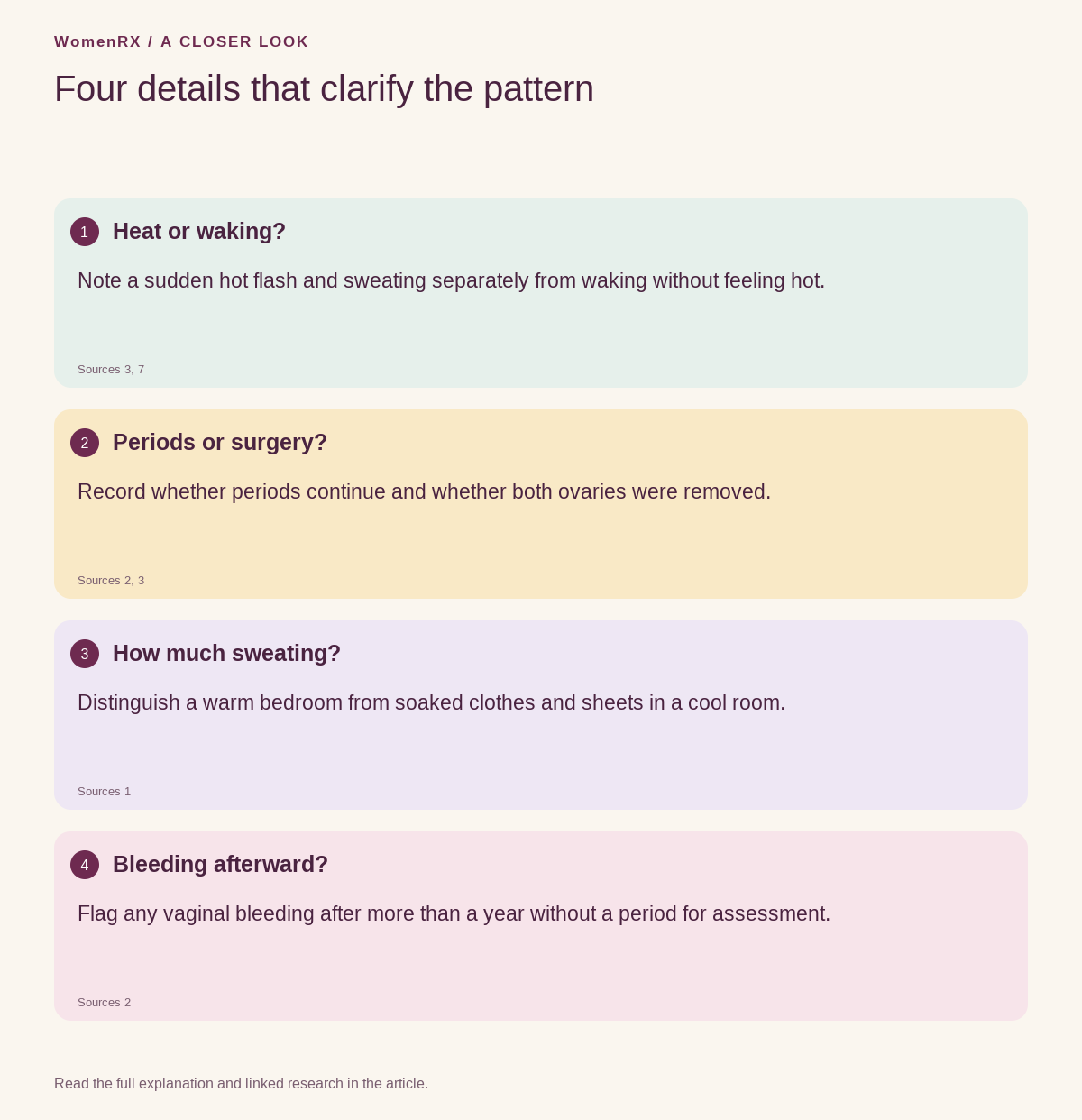
Four details that clarify the pattern
Heat or waking?: Note a sudden hot flash and sweating separately from waking without feeling hot.37
Periods or surgery?: Record whether periods continue and whether both ovaries were removed.23
How much sweating?: Distinguish a warm bedroom from soaked clothes and sheets in a cool room.1
Bleeding afterward?: Flag any vaginal bleeding after more than a year without a period for assessment.2
Read the figure as text
Use these prompts to describe symptoms and context, not to score or diagnose menopause.- Heat or waking?: Note a sudden hot flash and sweating separately from waking without feeling hot.37
- Periods or surgery?: Record whether periods continue and whether both ovaries were removed.23
- How much sweating?: Distinguish a warm bedroom from soaked clothes and sheets in a cool room.1
- Bleeding afterward?: Flag any vaginal bleeding after more than a year without a period for assessment.2
More questions, answered
Can I still have hot flashes after my periods have stopped?
Yes. Hot flashes can affect postmenopausal women; the final period doesn’t necessarily mark the end of them. 3
Sources you can check
- Night sweats - NHSAccessed 2026-09-25Return to first citation
- Postmenopausal bleeding - NHSAccessed 2026-09-25Return to first citation
- CLIMARA PRO (ESTRADIOL AND LEVONORGESTREL) PATCH [BAYER HEALTHCARE PHARMACEUTICALS INC.] | US prescribing information and patient instructionsAccessed 2026-09-25Return to first citation
- Factors Associated With Menopause Symptoms: A Systematic Review and Meta-Analysis.Hoang J, Halliday K, Allen D, Mtika WM, Tranter E, Glover G, Tatnell L, Hippisley-Cox J, Coupland C, Hillman S, Hirst J. · BJOG : an international journal of obstetrics and gynaecology · 2026Return to first citation
- Efficacy of cognitive therapy and behavior therapy for menopausal symptoms: a systematic review and meta-analysis.Ye M, Shou M, Zhang J, Hu B, Liu C, Bi C, Lv T, Luo F, Zhang Z, Liang S, Feng H, Qian C, Cao S, Liu Z. · Psychological medicine · 2022Return to first citation
- Longitudinal patterns and group heterogeneity of depressive symptoms during menopausal transition in middle-aged Korean women.Jang Y, Chang Y, Park J, Jeon SW, Seo B, Park JH, Kang J, Kwon R, Lim GY, Kim KH, Kim H, Hong YS, Park J, Zhao D, Cho J, Guallar E, Ryu S. · Epidemiology and psychiatric sciences · 2025Return to first citation
- Sleep Trajectories Before and After the Final Menstrual Period in The Study of Women's Health Across the Nation (SWAN).Kravitz HM, Janssen I, Bromberger JT, Matthews KA, Hall MH, Ruppert K, Joffe H. · Current sleep medicine reports · 2017Return to first citation