How Metformin Changes PCOS: Metabolism, Cycles, and More
Metformin targets glucose handling, while research in PCOS has also measured menstrual cycles and hormone levels, with results that don’t guarantee ovulation or pregnancy.
Metformin helps the body use insulin more effectively and reduces the amount of glucose made by the liver. In PCOS, researchers have studied metabolic measures such as blood glucose and insulin, as well as menstrual regularity and hormone levels. Some short trials report cycle changes, but those findings don’t establish that metformin reliably restores ovulation or improves the chance of pregnancy. 2 5 6
One medicine, several possible goals
PCOS can involve irregular or absent ovulation, higher androgen levels, and insulin resistance, but those features don’t look the same for everyone. A clinician might discuss metformin when metabolic health is a goal, or when cycle and hormone concerns are part of the treatment picture. The reason for considering it matters: improving a glucose-related measure is a different outcome from regulating periods or treating infertility. 1 4
Metformin is an insulin-sensitizing medicine. It reduces glucose production by the liver, decreases glucose absorption in the intestine, and helps tissues take up and use glucose. In other words, it changes how the body handles glucose; it doesn’t work by making the pancreas release more insulin. 2 3
How that metabolic action might connect to PCOS
In PCOS, insulin resistance can be accompanied by higher insulin levels. A review describes how insulin can contribute to increased ovarian androgen production and lower production of sex hormone-binding globulin, which can raise free testosterone. That offers a possible link between insulin-related metabolism and some hormone or ovulation features of PCOS. It doesn’t mean that insulin resistance explains every person’s PCOS, or that changing glucose measures will necessarily resolve reproductive symptoms. 4
A small randomized trial illustrates why it helps to look at the specific outcome. It enrolled 55 normal-weight women with PCOS and compared metformin with another active medicine for 12 weeks. The study measured blood glucose and insulin during a glucose-and-insulin test, as well as menstrual cycles and hormone levels. Both groups had menstrual and hormone changes; the other medicine showed greater improvement than metformin on several timed glucose and insulin measures. Because this was a short, small trial with an active comparator, it doesn’t establish how metformin performs against no treatment or for all people with PCOS. 6
Periods, ovulation, and fertility aren’t interchangeable
A more regular period can be useful, but it isn’t the same as documented ovulation, and neither result alone establishes a higher chance of pregnancy. In a separate 12-week trial with several treatment groups, menstrual regularity improved in each group; 39.6% of participants in the metformin-only group reported cycle regularization. The combination group had a higher reported proportion, but that group also received other interventions, so its result can’t be credited to metformin alone. 5
These trials measured short-term changes. They don’t answer whether metformin reliably helps someone ovulate, become pregnant, or sustain a pregnancy. PCOS can involve ovulation problems, but many people with PCOS can still become pregnant. If pregnancy is the goal, it’s useful to say so clearly when discussing treatment, because cycle management and fertility treatment are not the same task. 1
Match the discussion to your goal
If the main concern is metabolic health, ask which glucose or insulin-related measure is being targeted and how progress will be assessed. If the main concern is irregular periods, ask what change would count as success and whether the goal is cycle management or confirming ovulation. If you’re trying to conceive, ask how the plan addresses fertility specifically rather than assuming that a more regular cycle means pregnancy is more likely.
These short trials included adult women, with one restricted to normal-weight participants. They don’t establish that metformin is appropriate for everyone with PCOS or describe how benefits differ across later reproductive stages. The useful takeaway is to keep the treatment goal and the outcome being measured distinct.
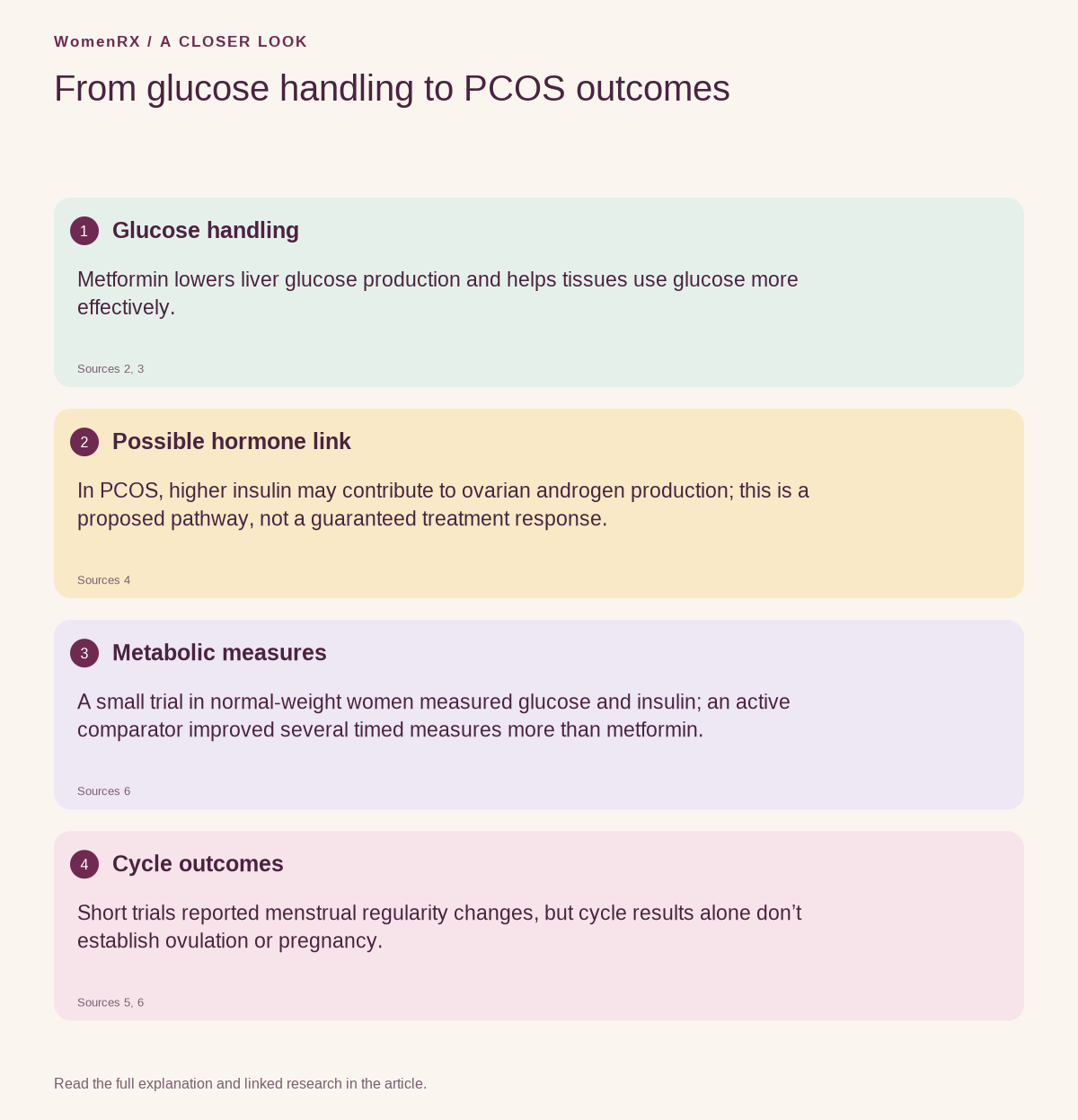
From glucose handling to PCOS outcomes
Glucose handling: Metformin lowers liver glucose production and helps tissues use glucose more effectively.23
Possible hormone link: In PCOS, higher insulin may contribute to ovarian androgen production; this is a proposed pathway, not a guaranteed treatment response.4
Metabolic measures: A small trial in normal-weight women measured glucose and insulin; an active comparator improved several timed measures more than metformin.6
Cycle outcomes: Short trials reported menstrual regularity changes, but cycle results alone don’t establish ovulation or pregnancy.56
Read the figure as text
Metformin’s metabolic action and the outcomes studied in PCOS are related questions, but evidence for one outcome does not prove another.- Glucose handling: Metformin lowers liver glucose production and helps tissues use glucose more effectively.23
- Possible hormone link: In PCOS, higher insulin may contribute to ovarian androgen production; this is a proposed pathway, not a guaranteed treatment response.4
- Metabolic measures: A small trial in normal-weight women measured glucose and insulin; an active comparator improved several timed measures more than metformin.6
- Cycle outcomes: Short trials reported menstrual regularity changes, but cycle results alone don’t establish ovulation or pregnancy.56
More questions, answered
Does a more regular period on metformin mean I’m ovulating?
Not necessarily. The cited trials reported menstrual regularity, but those results don’t by themselves confirm ovulation. Ask what outcome is being assessed if confirming ovulation matters to your goal. 5 6
Does PCOS automatically mean I have insulin resistance?
A group-level link between PCOS and insulin resistance can’t tell you whether a particular person has it. The reason metformin is being considered should be tied to your own metabolic or reproductive goals and the measures being followed. 1 4
Sources you can check
- PCOS | Polycystic Ovary Syndrome | MedlinePlusAccessed 2026-09-25Return to first citation
- GLIPIZIDE AND METFORMIN HYDROCHLORIDE TABLET, FILM COATED [REMEDYREPACK INC.] | US prescribing information and patient instructionsAccessed 2026-09-25Return to first citation
- DAPAGLIFLOZIN AND METFORMIN HYDROCHLORIDE TABLET, FILM COATED, EXTENDED RELEASE [SUN PHARMACEUTICAL INDUSTRIES, INC.] | US prescribing information and patient instructionsAccessed 2026-09-25Return to first citation
- The impact of gut microbiota on insulin resistance in polycystic ovary syndrome: mechanisms and therapeutic prospects.Gao Y, Liu C, He X. · Frontiers in cellular and infection microbiology · 2026Return to first citation
- Multimodal Therapy With Metformin, Inositol and Dietary Restriction Improves Insulin Resistance and Endocrine Outcomes in Women With Polyendocrine Metabolic Ovarian Syndrome: A Randomized Controlled Trial.Irfan NU, Saleem S, Irfan A. · Clinical endocrinology · 2026Return to first citation
- The effects of chiglitazar and metformin on insulin resistance in women with a normal BMI and polycystic ovary syndrome: a randomized controlled study.Yang Y, Han Y, Xu J, Gao Y, He B. · BMC endocrine disorders · 2025Return to first citation