What to Check Before Taking Fish Oil Long Term
Long-term fish oil can be reasonable when it has a clear purpose, but food, retail supplements, and prescription omega-3s aren’t interchangeable.
Taking fish oil long term isn’t automatically necessary. Trials of omega-3 interventions using capsules or a margarine spread in cognitively healthy adults aged 60 and older found mostly mild reported side effects over six to 40 months. They don’t establish long-term fish-oil safety across products, doses, and health conditions. A review also found a possible atrial-fibrillation signal with long-term oral use in people with cardiovascular disease. Before continuing, check your goal, the EPA and DHA amount, and your medicines and health conditions. 53
Start with the reason you’re taking it
If you’re taking fish oil without a specific health goal, it’s worth asking whether you still need it. Omega-3 supplements come in different formulations and amounts, and evidence for one product or purpose doesn’t automatically apply to another. For example, a prescription product used for certain adults with elevated triglycerides and cardiovascular risk isn’t interchangeable with an over-the-counter fish oil capsule. 12
Food is another option, not simply a lower-dose version of a supplement. Fatty fish such as salmon, herring, sardines, and mackerel provide EPA and DHA, while flaxseed, chia, walnuts, and some oils provide ALA, a different omega-3 fatty acid. ALA is essential, but US reference intakes do not set a specific recommended intake for EPA or DHA for adults. 1
Read the EPA and DHA, not just “fish oil”
The front of a bottle may highlight the total amount of fish oil. Look at the Supplement Facts panel for the actual EPA and DHA amounts. NIH’s Office of Dietary Supplements describes a typical 1,000 mg fish-oil supplement as containing about 180 mg EPA and 120 mg DHA, but formulations vary widely. That example is not a recommended dose. 1
Also check what else is in the product. Cod liver oil contains vitamins A and D as well as omega-3s, so it isn’t the same as a fish-oil-only supplement. Algal oil is a non-fish source that usually provides DHA and may also contain EPA. 1
Product quality deserves a separate check from dose. The ODS reference reports that mercury is removed during processing and purification of omega-3 supplements. That statement is about mercury; it doesn’t verify every product’s overall quality or establish that every contaminant is assessed in the same way. 1
If you’re pregnant or breastfeeding, treat seafood and supplements as separate questions. Seafood species vary in EPA and DHA content and can contain methylmercury, so omega-3 content alone isn’t enough to choose which fish to eat. For a supplement, check its EPA and DHA content and whether it’s cod liver oil. Those details don’t establish an appropriate amount for you or verify contaminant testing of that particular product. US reference intakes give ALA values for pregnancy and lactation, not a specific EPA/DHA supplement amount. 1 For pregnancy- or breastfeeding-specific seafood choices, ask your prenatal clinician for current US guidance. To assess a particular supplement for contaminants, ask its manufacturer for product-specific test results and review them with your clinician; the EPA and DHA label alone does not establish that testing was done.
Prescription omega-3s serve a different purpose
Prescription products shouldn’t be treated as stronger versions of retail supplements. One example is icosapent ethyl, a prescription product made from purified EPA. The review describes its use alongside statin therapy for certain adults with elevated triglycerides who have established cardiovascular disease, or diabetes plus additional cardiovascular risk factors; it also describes use to lower very high triglycerides. Those are specific treatment settings, not a reason to take any fish-oil product for general prevention. The review does not establish that ordinary retail supplements provide the same outcome. 2
Prescription omega-3 products can also have different compositions. The review distinguishes purified EPA from products combining EPA and DHA. Its reported cardiovascular-outcome evidence is about icosapent ethyl, so don’t transfer that finding to other prescription formulations or to an over-the-counter bottle. 2
What long-term safety evidence can tell you
There’s no single finding that proves every fish-oil product is safe for indefinite use. A Cochrane review of three omega-3 intervention trials in cognitively healthy adults aged 60 and older followed participants for six, 24, or 40 months. Two trials used capsules; the 40-month trial used a margarine spread containing omega-3s. The review found no cognitive benefit from the interventions; mild gastrointestinal problems were the most commonly reported side effect, and minor adverse events were reported by fewer than 15% of participants, with similar reporting in intervention and comparison groups. These results offer some reassurance about those trial settings, not a guarantee of long-term fish-oil safety for every dose, product, or person. 5
For cardiovascular safety, a 2025 review of analyses of long-term oral fish-oil treatment in people with cardiovascular disease found that the analyses consistently suggested a higher risk of atrial fibrillation. The review also highlighted possible biases and conflicting results from trials that made atrial fibrillation a primary outcome. This is a reason to review long-term use with extra care if you have cardiovascular disease or a history of atrial fibrillation, not proof that every fish-oil supplement causes the condition. 3
If you take warfarin, don’t stop or change it based on a general warning about fish oil. In a retrospective study of 573 people receiving long-term warfarin, the 145 people taking fish or krill oil did not have significantly different warfarin control or bleeding incidence from the comparison group. Because this was an observational study, it can’t rule out every interaction or answer questions about every anticoagulant. Tell the clinician managing your warfarin what supplement and amount you use. 4
A practical review before you continue
Use the bottle and your health goal to make the decision specific:
- Purpose: What health goal are you aiming for, and is this the product studied for that goal?
- Amount: How much EPA and DHA does the label list? Don’t infer it from the total fish-oil amount.
- Product: Is it fish oil, cod liver oil, algal oil, or a prescription product? What else does it contain?
- Personal context: Are you pregnant or breastfeeding, living with cardiovascular disease or atrial fibrillation, or taking warfarin?
- Duration: Is there a reason to keep taking it, and when will you review that decision?
A clear purpose and label are more useful than the phrase “omega-3” on the front of a bottle. If the product is prescribed, keep the decision tied to the condition it was prescribed for; if it’s a retail supplement, don’t assume that prescription findings apply.
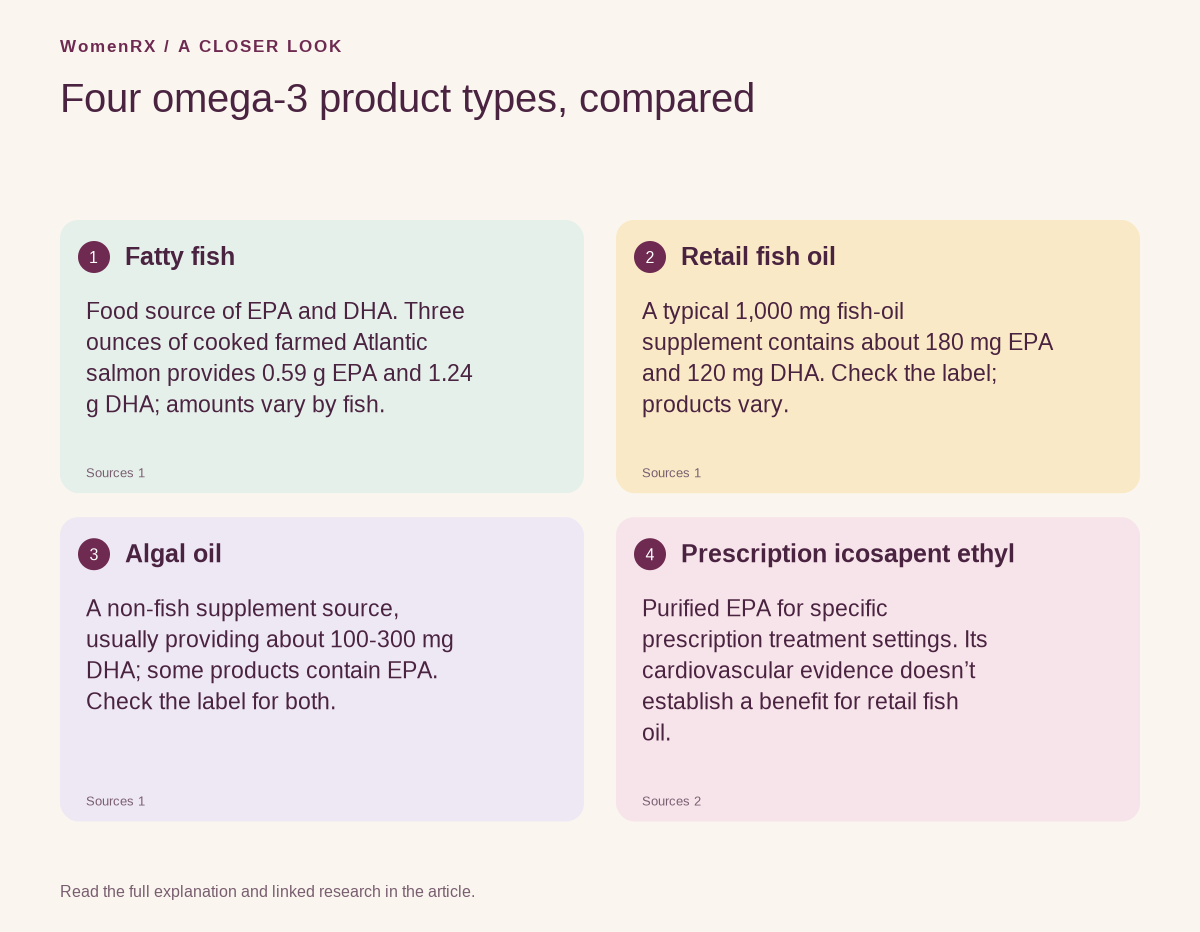
Four omega-3 product types, compared
Fatty fish: Food source of EPA and DHA. Three ounces of cooked farmed Atlantic salmon provides 0.59 g EPA and 1.24 g DHA; amounts vary by fish.1
Retail fish oil: A typical 1,000 mg fish-oil supplement contains about 180 mg EPA and 120 mg DHA. Check the label; products vary.1
Algal oil: A non-fish supplement source, usually providing about 100-300 mg DHA; some products contain EPA. Check the label for both.1
Prescription icosapent ethyl: Purified EPA for specific prescription treatment settings. Its cardiovascular evidence doesn’t establish a benefit for retail fish oil.2
Read the figure as text
These examples show why the source, EPA and DHA amounts, and intended purpose matter more than the words “omega-3” alone.- Fatty fish: Food source of EPA and DHA. Three ounces of cooked farmed Atlantic salmon provides 0.59 g EPA and 1.24 g DHA; amounts vary by fish.1
- Retail fish oil: A typical 1,000 mg fish-oil supplement contains about 180 mg EPA and 120 mg DHA. Check the label; products vary.1
- Algal oil: A non-fish supplement source, usually providing about 100-300 mg DHA; some products contain EPA. Check the label for both.1
- Prescription icosapent ethyl: Purified EPA for specific prescription treatment settings. Its cardiovascular evidence doesn’t establish a benefit for retail fish oil.2
More questions, answered
Does taking fish oil with warfarin always cause bleeding?
A retrospective study of 573 long-term warfarin users found no significant difference in warfarin control or bleeding incidence among the 145 people taking fish or krill oil. That finding is reassuring but doesn’t prove there can never be an interaction; share the exact supplement and amount with the clinician managing your warfarin. 4
Is a prescription omega-3 the same as store-bought fish oil?
No. The prescription product icosapent ethyl is purified EPA and has evidence for specific treatment settings. Retail fish oils vary in their EPA and DHA content, and the evidence for that prescription product shouldn’t be assumed to apply to them. 12
Sources you can check
- Omega-3 Fatty Acids - Health Professional Fact SheetAccessed 2026-09-25Return to first citation
- A Critical Review of Icosapent Ethyl in Cardiovascular Risk Reduction.Huston J, Schaffner H, Cox A, Sperry A, Mcgee S, Lor P, Langley L, Skrable B, Ashchi M, Bisharat M, Gore A, Jones T, Sutton D, Sheikh-Ali M, Berner J, Goldfaden R. · American journal of cardiovascular drugs : drugs, devices, and other interventions · 2023Return to first citation
- Does parenteral Omega-3 fatty acid administration increase the risk of atrial fibrillation? An analysis of the current evidence.Hartl WH, Meybohm P, Pirlich M, Mayer K, Elke G, Stoppe C, von Loeffelholz C. · Clinical nutrition (Edinburgh, Scotland) · 2025Return to first citation
- The Use of Fish Oil with Warfarin Does Not Significantly Affect either the International Normalised Ratio or Incidence of Adverse Events in Patients with Atrial Fibrillation and Deep Vein Thrombosis: A Retrospective Study.Pryce R, Bernaitis N, Davey AK, Badrick T, Anoopkumar-Dukie S. · Nutrients · 2016Return to first citation
- Omega 3 fatty acid for the prevention of cognitive decline and dementia.Sydenham E, Dangour AD, Lim WS. · The Cochrane database of systematic reviews · 2012Return to first citation