Berberine for Blood Sugar or PCOS? Start With Your Goal
Berberine has been studied for several metabolic outcomes, but the result you want and the medicines you take change the decision.
Berberine isn’t an all-purpose blood-sugar or PCOS supplement. Reviews report promising metabolic findings, but many are methodologically weak. PCOS fertility trials studied berberine added to other treatment, not berberine on its own. Before considering it, match the research to your goal and check your medications, especially drugs that lower blood sugar or cyclosporine. 3 6 7
What are you hoping berberine will change?
“Better metabolic health” can mean a lower blood-glucose reading, improved insulin resistance, a change in cholesterol, or weight loss. Those are different outcomes. If you have PCOS, you might instead be thinking about ovulation, pregnancy, or symptoms such as acne. Evidence for one result doesn’t establish the others. PCOS can involve insulin resistance, but not everyone with PCOS has the same symptoms or related health concerns. 1 7
That distinction gives you a practical first question: What result would make taking berberine worthwhile to me? Once you can name it, it’s easier to see whether a study measured that result in people like you, rather than a loosely related laboratory marker.
For blood sugar, promising findings come with a quality problem
A 2025 overview examined 54 systematic reviews of berberine across several conditions, including type 2 diabetes and PCOS. Many reviews reported favorable outcomes. But when the overview’s authors assessed the reviews themselves, they rated 45 very low quality, eight low quality, and one high quality. Reviews of PCOS studies also substantially overlapped, so counting every favorable review as independent confirmation would be misleading. 7
This doesn’t mean berberine has no effect on blood sugar. It means a positive finding needs to be read alongside the study population, the outcome measured, and the limitations of the research. If you have diabetes, readings and A1C help assess how your treatment is working; your glucose targets depend on your circumstances. A supplement finding about glucose does not establish that berberine can replace your treatment plan or prevent diabetes complications. 2 7
The same caution applies to weight-loss claims. An improvement in a metabolic marker, or a result in a particular study group, isn’t proof of reliable weight loss for women generally. 5 7
PCOS research asks a narrower question
The clearest fertility-related result here comes from a 2024 meta-analysis of 10 randomized trials involving 713 women with PCOS. It compared berberine added to other medical treatment with that treatment alone. The researchers reported higher ovulation and clinical pregnancy rates in the add-on groups and said further trials were needed. The analysis does not establish that berberine works as a stand-alone fertility treatment, and it does not report whether it increases live births. 6
That’s a meaningful difference if you’re deciding what to do next. For example, if your goal is more regular ovulation, the add-on trials are more relevant than a study of cholesterol. But their results still don’t tell you whether berberine would help with your particular PCOS symptoms, whether it fits your current treatment, or whether taking it while trying to conceive is safe. PCOS care varies with the symptom being treated and whether pregnancy is a goal. 1 6
Check the medication combination before the supplement label
Berberine can affect the way other drugs act in the body. A 2026 narrative review found that only a few specific interactions had been documented in people; most proposed interactions were based on mechanisms rather than direct clinical evidence. Its clearest human example was increased exposure to cyclosporine in kidney-transplant recipients. That result shouldn’t be generalized to every medicine, but it makes cyclosporine a concrete reason to avoid treating berberine as an inert add-on. 3
The review also identifies a potential additive effect on blood-sugar lowering. If you use a medicine that lowers glucose, ask a pharmacist or prescribing clinician to check the specific combination before you add berberine. Low blood sugar can cause symptoms that come on quickly, and the level considered low for you may depend on your situation. 2 3
Bring the exact product label, along with your prescription medicines, over-the-counter medicines, and other supplements. The useful question isn’t simply “Does berberine interact with medications?” It’s “Is there a known human interaction with mine, or a plausible one that needs a plan?” Product variability adds another uncertainty: a review of interactions notes that unstandardized products can change how much berberine a person is exposed to. 3
If pregnancy or breastfeeding is possible
A toxicology review covering Berberis plants and several related alkaloids identifies pregnancy status and effects on embryonic development as safety considerations. Because it covers multiple plants and compounds, it cannot give a reliable risk estimate for a particular berberine supplement in pregnancy. It also doesn’t settle whether berberine is safe while breastfeeding. 4
If you’re pregnant, trying to conceive, or breastfeeding, make that part of the discussion before taking berberine. The PCOS trials’ clinical pregnancy finding is not a safety finding for use during pregnancy, and plant-derived doesn’t automatically mean suitable for a baby. 4 6
The decision comes down to a match: a clearly defined goal, evidence that actually measures it, and a safety check that reflects your medicines and reproductive circumstances. If one of those pieces is missing, a “best berberine” label can’t fill it in. 3 6 7
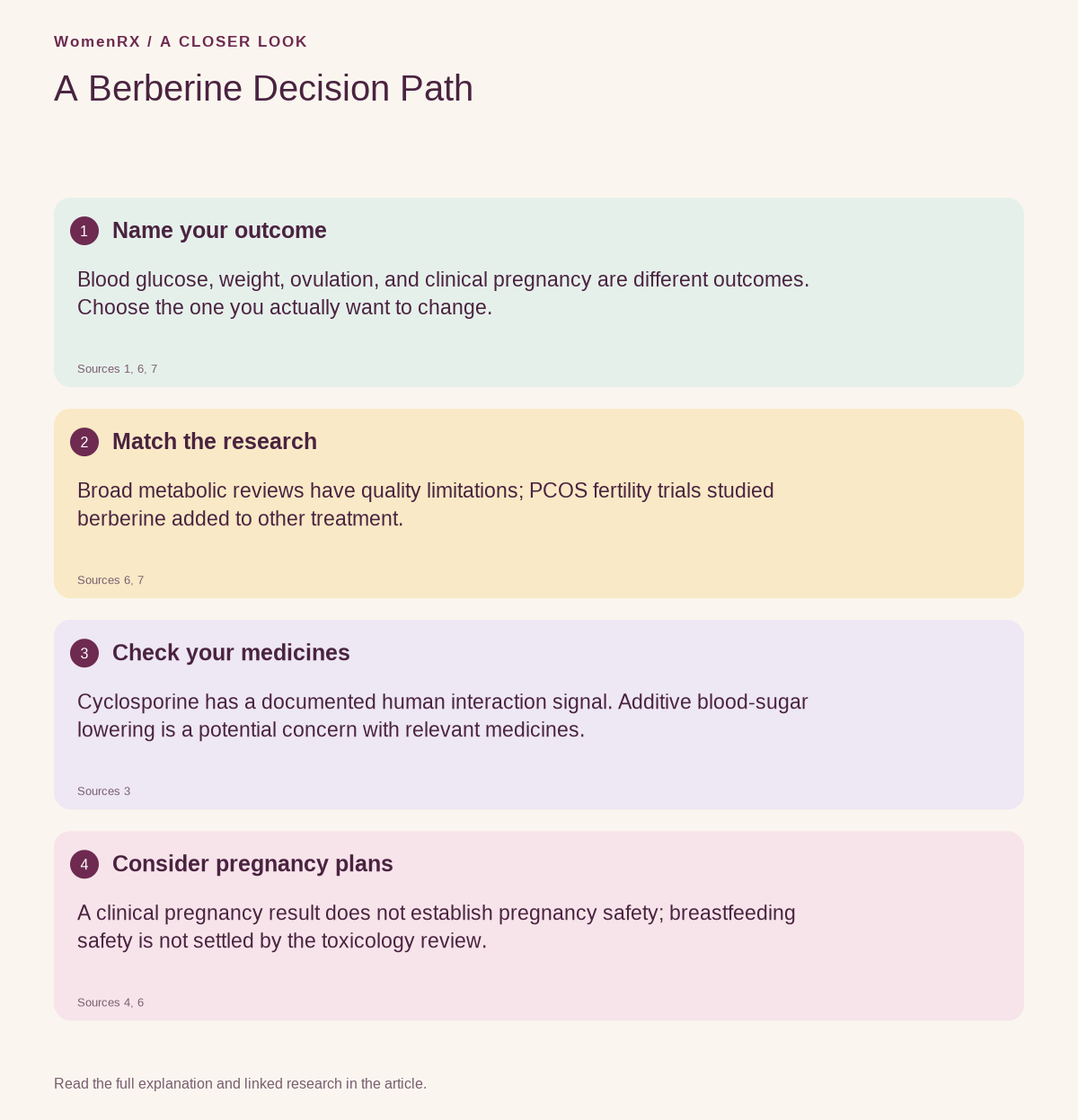
A Berberine Decision Path
Name your outcome: Blood glucose, weight, ovulation, and clinical pregnancy are different outcomes. Choose the one you actually want to change.167
Match the research: Broad metabolic reviews have quality limitations; PCOS fertility trials studied berberine added to other treatment.67
Check your medicines: Cyclosporine has a documented human interaction signal. Additive blood-sugar lowering is a potential concern with relevant medicines.3
Consider pregnancy plans: A clinical pregnancy result does not establish pregnancy safety; breastfeeding safety is not settled by the toxicology review.46
Read the figure as text
Follow the question that matches your goal, then check the safety factors that apply regardless of goal.- Name your outcome: Blood glucose, weight, ovulation, and clinical pregnancy are different outcomes. Choose the one you actually want to change.167
- Match the research: Broad metabolic reviews have quality limitations; PCOS fertility trials studied berberine added to other treatment.67
- Check your medicines: Cyclosporine has a documented human interaction signal. Additive blood-sugar lowering is a potential concern with relevant medicines.3
- Consider pregnancy plans: A clinical pregnancy result does not establish pregnancy safety; breastfeeding safety is not settled by the toxicology review.46
Sources you can check
- PCOS | Polycystic Ovary Syndrome | MedlinePlusAccessed 2026-09-25Return to first citation
- Blood Glucose | Blood Sugar | Diabetes | MedlinePlusAccessed 2026-09-25Return to first citation
- Berberine-Drug Interactions: Mechanisms, Clinical Relevance and Risk Stratification-A Narrative Review.Dumitru CN, Marcu T, Dumitru AO, Tudor SS, Ferțu ID, Elisei AM, Goroftei L. · Pharmaceuticals (Basel, Switzerland) · 2026Return to first citation
- Balancing efficacy and risk: A toxicological review and safety transformation of Berberis plants and their alkaloids.Ma J, Lan X, Luo X, Jing Y, Yin Y, Du H, Li Q, Fan G. · Phytomedicine : international journal of phytotherapy and phytopharmacology · 2026Return to first citation
- Berberine as a Bioactive Alkaloid: Multi-Omics Perspectives on Its Role in Obesity Management.Zieniuk B, Pawełkowicz M. · Metabolites · 2025Return to first citation
- Berberine as adjuvant therapy for treating reduced fertility potential in women with polycystic ovary syndrome: A meta-analysis of randomized controlled trials.Ha S, Song X. · Explore (New York, N.Y.) · 2024Return to first citation
- Berberine and health outcomes: an overview of systematic reviews.Shi L, Wang W, Jing C, Hu J, Liao X. · BMC complementary medicine and therapies · 2025Return to first citation