What Has Alpha-Lipoic Acid Actually Been Studied For?
The clearest human research is in diabetic nerve symptoms, not blood sugar control or a broad range of women’s health concerns.
Alpha-lipoic acid (ALA) has been studied most directly for symptoms of diabetic peripheral neuropathy, including pain, burning, tingling, and numbness. Some reviews report improvements in symptom scores, but findings on nerve-function tests and HbA1c, a measure of longer-term blood sugar, are less convincing. A small observational study also examined restless legs symptoms in people with diabetic neuropathy. The research doesn’t establish different effects by sex or life stage. 352

The strongest research is about diabetic nerve symptoms
Diabetic peripheral neuropathy is nerve damage associated with diabetes. It can cause pain, burning or tingling, numbness, and other changes in sensation. ALA has been studied as a possible way to ease some of these symptoms, rather than as a general treatment for nerve problems with many possible causes. 13
A 2026 systematic review and meta-analysis included 15 studies of people with diabetic peripheral neuropathy; 12 contributed to the analysis of outcomes. It reported improvements in several symptom measures, including tingling, numbness, and pain, compared with placebo or other treatments. But the results weren’t positive for every outcome, and an earlier evidence review judged the evidence for ALA and diabetic nerve pain to be low strength. Taken together, the findings offer a reason for interest, not a guarantee that ALA will relieve symptoms for a particular person. 36
That distinction matters: a change in a symptom score is not the same as showing that nerve damage has been reversed or that foot complications are prevented. The newer review found no significant changes in some measures, including sural sensory nerve response and peroneal motor nerve conduction velocity. It also concluded that longer-term effects remain uncertain. 3
Blood sugar is a different question
Because diabetes-related nerve damage is linked to high blood glucose over time, it may seem natural to assume a supplement studied for neuropathy also improves glucose control. The evidence doesn’t support treating those as interchangeable claims.
In the meta-analysis, ALA did not significantly change HbA1c, a measure of average blood sugar over time. One small 12-week randomized trial compared ALA with another medicine in 58 people with type 2 diabetes and neuropathy. HbA1c fell in both groups, but the other medicine produced a larger decrease; because there was no group receiving neither treatment, the trial can’t establish that ALA itself reliably lowers blood sugar. 34
So, if a product claim is about glucose control, look for evidence on glucose outcomes specifically. Possible improvement in neuropathy symptoms doesn’t prove better diabetes control or fewer long-term diabetes complications.
Restless legs: a much earlier research question
ALA has also been examined for restless legs symptoms in people who had diabetic neuropathy. In one observational study, researchers assessed 65 volunteers who had already been taking ALA for diabetic neuropathy. Among the 29 participants diagnosed with restless legs syndrome, symptom severity was lower after treatment than before. Because this wasn’t a randomized comparison, it can’t show that ALA caused the change. The researchers themselves called for randomized studies to test the finding. This is an early lead in a specific group, not evidence that ALA treats restless legs generally. 2
What women can take from these findings
The studies summarized here focus on people with diabetes or diabetic neuropathy. They don’t establish whether ALA’s effects differ for women and men, or whether menstrual cycling, pregnancy, postpartum recovery, perimenopause, or postmenopause changes its effects. That means the neuropathy findings may be relevant to a woman with diabetes and nerve symptoms, but they don’t amount to a women-specific benefit claim.
A practical way to assess a claim is to ask what outcome was actually measured: symptom relief, a nerve test, HbA1c, or something else. ALA has its most direct clinical evidence for diabetic neuropathy symptoms. Evidence for nerve-function changes and blood sugar improvement is less settled, while the restless legs finding is preliminary. 235
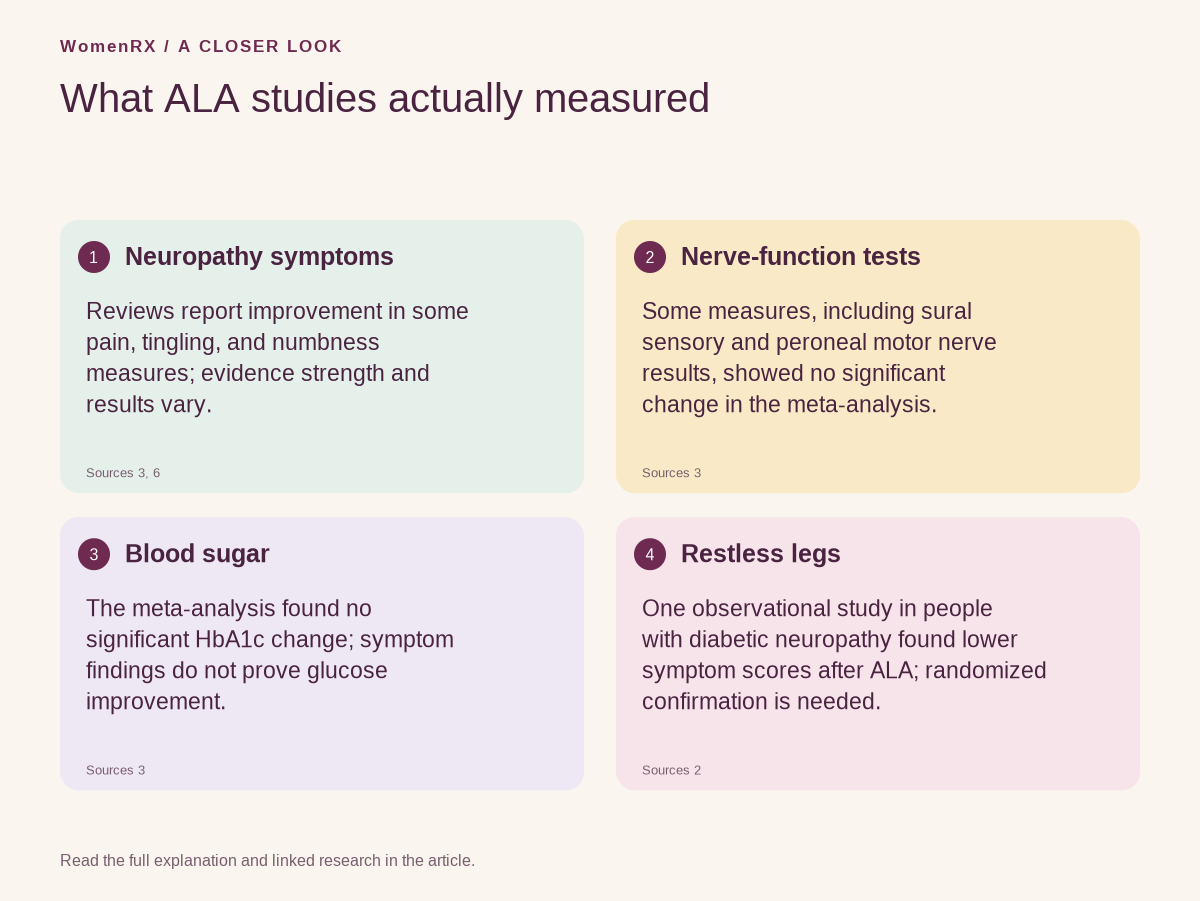
What ALA studies actually measured
Neuropathy symptoms: Reviews report improvement in some pain, tingling, and numbness measures; evidence strength and results vary.36
Nerve-function tests: Some measures, including sural sensory and peroneal motor nerve results, showed no significant change in the meta-analysis.3
Blood sugar: The meta-analysis found no significant HbA1c change; symptom findings do not prove glucose improvement.3
Restless legs: One observational study in people with diabetic neuropathy found lower symptom scores after ALA; randomized confirmation is needed.2
Read the figure as text
These outcomes are related, but evidence for one does not establish a benefit in another.- Neuropathy symptoms: Reviews report improvement in some pain, tingling, and numbness measures; evidence strength and results vary.36
- Nerve-function tests: Some measures, including sural sensory and peroneal motor nerve results, showed no significant change in the meta-analysis.3
- Blood sugar: The meta-analysis found no significant HbA1c change; symptom findings do not prove glucose improvement.3
- Restless legs: One observational study in people with diabetic neuropathy found lower symptom scores after ALA; randomized confirmation is needed.2
More questions, answered
Does research show that alpha-lipoic acid reverses diabetic nerve damage?
No clear reversal has been established. Some studies report better neuropathy symptom scores, but the meta-analysis found no significant change in certain nerve-conduction measures. Symptom relief and repairing nerve damage are different outcomes. 3
Has alpha-lipoic acid been shown to lower HbA1c?
The systematic review and meta-analysis found no significant change in HbA1c. A small trial comparing ALA with another medicine isn’t proof that ALA lowers HbA1c versus no treatment. 34
Sources you can check
- Diabetic Neuropathy | MedlinePlusAccessed 2026-09-25Return to first citation
- Alpha-Lipoic acid in the management of restless legs syndrome in patients with diabetic neuropathy: A possible novel therapeutic approach.Tutan D, Ulfberg J, Uzeli ÜŞ, Kayır T, Kaya AE, Akpinar NB, Bilgin H, Tutan MB. · Endocrine · 2025Return to first citation
- Effectiveness of alpha lipoic acid supplementation on biochemical, clinical, and inflammatory parameters in patients with diabetic polyneuropathy: A systematic review and meta-analysis.Salinas AV, Caroca TM, Santibáñez FP, González JR, López-Chaparro M, Barahona-Vásquez M, Loaiza-Giraldo JP, Gómez-Valdovinos C, Valenzuela-Fuenzalida JJ, Nova-Baeza P, Orellana-Don... · Diabetes & metabolic syndrome · 2026Return to first citation
- Efficacy and Safety of Roflumilast versus Alpha-Lipoic Acid in Type 2 Diabetes with Neuropathy: A Comparative Clinical Study.Elsharab A, Nooh MZ, Matard RS, Mostafa TM, El-Afify DR. · Diabetes, metabolic syndrome and obesity : targets and therapy · 2025Return to first citation
- Diabetic Peripheral Neuropathy: Prevention and Treatment.Bragg S, Marrison ST, Haley S. · American family physician · 2024Return to first citation
- Preventing Complications and Treating Symptoms of Diabetic Peripheral NeuropathyDy SM, Bennett WL, Sharma R, Zhang A, Waldfogel JM, Nesbit SA, Yeh HC, Chelladurai Y, Feldman D, Wilson LM, Robinson KA. · 2017Return to first citation