What Glucomannan Has Actually Been Studied For
Human trials have examined glucomannan for cholesterol, blood sugar, constipation, and appetite, but the evidence differs sharply by outcome and study population.
Glucomannan has been tested in people for several distinct outcomes, not just weight-related ones. Small trials report possible changes in cholesterol and blood sugar in people with type 2 diabetes, and one trial found improved constipation symptoms in male athletes. 43 A short study also examined hunger and waist size. 7 These findings don’t establish the same benefits in women generally, or show that one outcome predicts another.
One fiber, separate questions
Glucomannan, also called konjac glucomannan, has been studied for several possible effects. But “studied” doesn’t mean proven, and a result for one outcome doesn’t establish benefits for another. The trials also vary in who took part and what they consumed: some tested glucomannan itself, while others used it in a blend or food.
Cholesterol: a promising but narrow trial
A randomized crossover trial tested glucomannan in 22 people with type 2 diabetes and elevated cholesterol who weren’t taking cholesterol-lowering medication. Over two 28-day periods, participants received glucomannan or placebo. Compared with placebo, the glucomannan period was associated with lower total cholesterol and LDL cholesterol. The study also found higher fecal excretion of neutral sterols and bile acids. It was a small, short study in a specific group, so it doesn’t establish how well glucomannan lowers cholesterol more broadly or whether the result applies to women without diabetes. 4
The trial measured cholesterol and glucose, not heart attacks, so it can’t establish whether glucomannan prevents heart attacks. 4 A cholesterol result needs to be interpreted in the context of your overall health and risk; some people need cholesterol medicines as well as lifestyle changes. 12
Blood sugar: results depend on the product and group
The same small trial reported lower fasting glucose in its glucomannan period, but it did not find a significant change in post-meal glucose after its statistical adjustment. That distinction matters: one blood-sugar measure improving doesn’t mean all measures do. 4
Other trials tested combinations rather than glucomannan alone. In a crossover trial involving people with type 2 diabetes, a konjac-based fiber blend was taken with American ginseng. Thirty participants completed the study, including 12 women. The combined intervention produced a lower HbA1c than a wheat-bran-based control after 12 weeks, but the result can’t be attributed to glucomannan by itself. 5
Another trial tested yogurt containing both glucomannan and inulin in people with type 2 diabetes. Because two fibers were included together, its findings don’t isolate glucomannan’s effect either. 6
Taken together, these studies make blood-sugar effects worth investigating, especially in people with diabetes, but they don’t show that glucomannan alone improves glucose control in women generally or can take the place of diabetes treatment.
Bowel symptoms: one trial in male athletes
An eight-week randomized trial studied elite male Taekwondo athletes diagnosed with functional constipation. Compared with placebo, those assigned konjac glucomannan had improvements in constipation symptoms, bowel movement frequency, and constipation-related quality of life. That is direct human evidence for bowel outcomes, but it comes from a very specific group: the study enrolled men, not women, and its results may not carry over to other people with constipation. 3
Appetite and waist size: not the same as weight loss
A short randomized trial included 42 adults with overweight who completed the study. After 14 days, the glucomannan candy group had a reduction in reported hunger intensity and waist circumference. The reported findings were changes in hunger and waist circumference, not a demonstrated reduction in body weight. The short timeframe also doesn’t establish a lasting effect, and the reported findings don’t establish effects separately for women. 7
Weight itself was measured in the diabetes crossover trial, but there was no significant difference after statistical adjustment. That was a separate study in people with type 2 diabetes, not a test of whether the appetite and waist findings translate into weight loss. 4
So this trial is better described as preliminary evidence about appetite and waist circumference than proof of weight loss. It also can’t establish effects on cholesterol, blood sugar, or constipation.
What the women-specific evidence can tell you
The reported findings here don’t establish whether glucomannan’s effects differ by sex. One diabetes study included 12 women and 18 men, but the results described for the combined group don’t show separate outcomes for women. The constipation trial enrolled men only. Findings reported for the other trials likewise don’t establish sex-specific effects. 35467
Age information is reported for some studies, but age isn’t the same as life-stage information. The diabetes crossover trial reported a mean age of 64.2 years, and the trial combining konjac-based fiber with ginseng reported a mean age of 64 years. The appetite study enrolled adults aged 18 to 45. These reported ages don’t tell you whether participants were perimenopausal or postmenopausal, and the findings don’t establish an effect at any particular life stage. 457
That means glucomannan’s fiber effects shouldn’t be assumed to be unique to women, but neither should results from mostly or exclusively male samples be treated as established for women. The most useful takeaway is outcome-specific: there is some human research on each of these questions, but the results come from small or specialized studies, and several tested combinations rather than glucomannan alone.
Glucomannan evidence by outcome
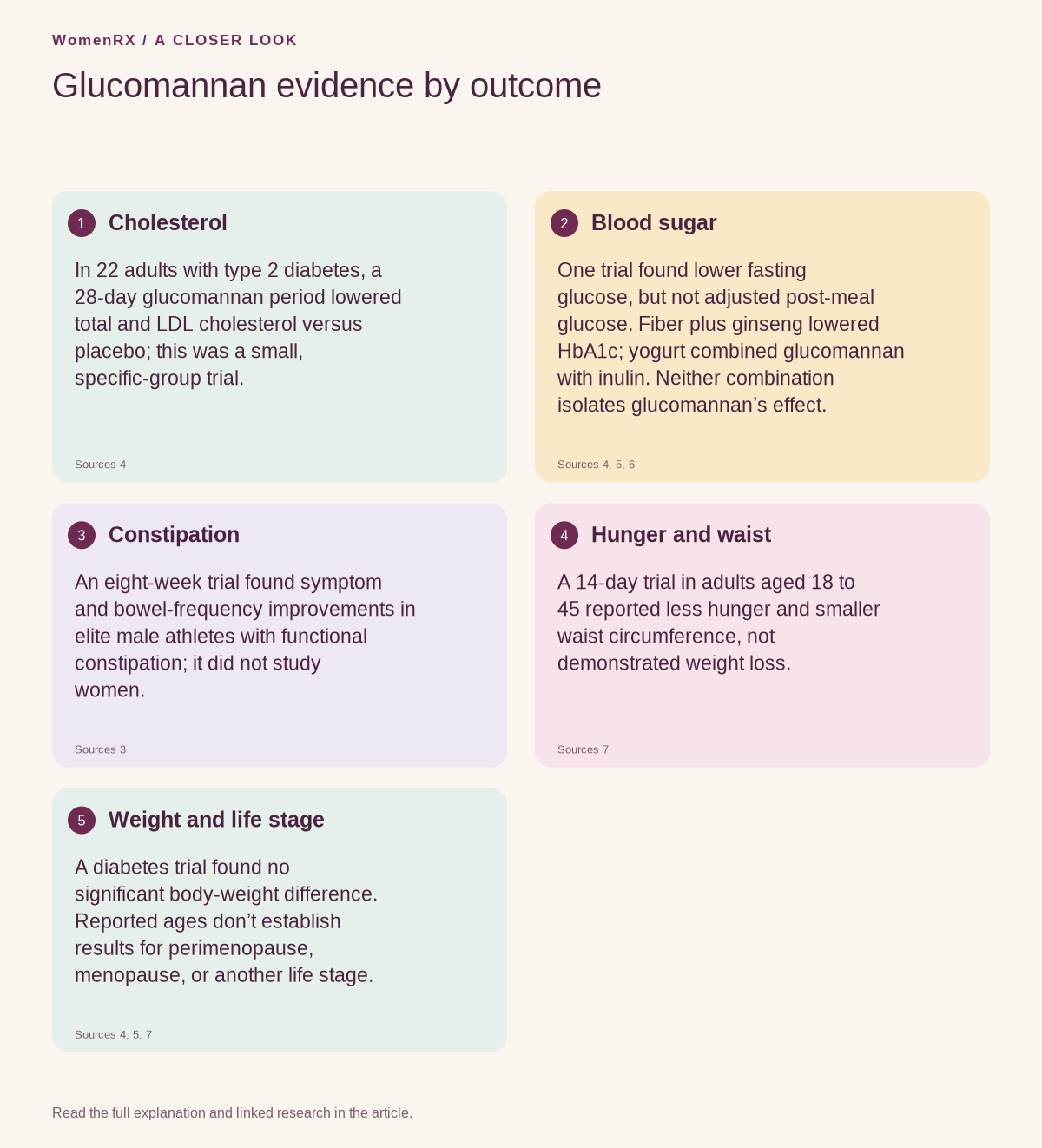
Cholesterol: In 22 adults with type 2 diabetes, a 28-day glucomannan period lowered total and LDL cholesterol versus placebo; this was a small, specific-group trial.4
Blood sugar: One trial found lower fasting glucose, but not adjusted post-meal glucose. Fiber plus ginseng lowered HbA1c; yogurt combined glucomannan with inulin. Neither combination isolates glucomannan’s effect.456
Constipation: An eight-week trial found symptom and bowel-frequency improvements in elite male athletes with functional constipation; it did not study women.3
Hunger and waist: A 14-day trial in adults aged 18 to 45 reported less hunger and smaller waist circumference, not demonstrated weight loss.7
Weight and life stage: A diabetes trial found no significant body-weight difference. Reported ages don’t establish results for perimenopause, menopause, or another life stage.457
Read the figure as text
These studies test different outcomes in different groups; evidence for one should not be read as evidence for all.- Cholesterol: In 22 adults with type 2 diabetes, a 28-day glucomannan period lowered total and LDL cholesterol versus placebo; this was a small, specific-group trial.4
- Blood sugar: One trial found lower fasting glucose, but not adjusted post-meal glucose. Fiber plus ginseng lowered HbA1c; yogurt combined glucomannan with inulin. Neither combination isolates glucomannan’s effect.456
- Constipation: An eight-week trial found symptom and bowel-frequency improvements in elite male athletes with functional constipation; it did not study women.3
- Hunger and waist: A 14-day trial in adults aged 18 to 45 reported less hunger and smaller waist circumference, not demonstrated weight loss.7
- Weight and life stage: A diabetes trial found no significant body-weight difference. Reported ages don’t establish results for perimenopause, menopause, or another life stage.457
More questions, answered
Does evidence for cholesterol also mean glucomannan helps blood sugar?
No. Cholesterol and blood sugar are separate outcomes, and each needs its own evidence. One small trial in people with type 2 diabetes measured both, but a result for one measure doesn’t establish a benefit for the other or for other populations. 4
Sources you can check
- Cholesterol Levels: What You Need to Know: MedlinePlusAccessed 2026-09-25Return to first citation
- Cholesterol Medicines: MedlinePlusAccessed 2026-09-25Return to first citation
- Effects of konjac glucomannan on gastrointestinal symptoms and gut microbiota in athletes with functional constipation: a double-blind randomized controlled trial.Zhu Y, Chen X, Song G. · European journal of nutrition · 2025Return to first citation
- Konjac supplement alleviated hypercholesterolemia and hyperglycemia in type 2 diabetic subjects--a randomized double-blind trial.Chen HL, Sheu WH, Tai TS, Liaw YP, Chen YC. · Journal of the American College of Nutrition · 2003Return to first citation
- Co-administration of a konjac-based fibre blend and American ginseng (Panax quinquefolius L.) on glycaemic control and serum lipids in type 2 diabetes: a randomized controlled, cross-over clinical trial.Jenkins AL, Morgan LM, Bishop J, Jovanovski E, Jenkins DJA, Vuksan V. · European journal of nutrition · 2018Return to first citation
- Effects of Yogurt Enriched with Konjac Glucomannan and Inulin on Insulin Sensitivity, Glycemic Control, Lipid Profiles, Anthropometric Measures and Oxidative Stress in Type 2 Diabetes Mellitus: A Randomized Controlled Trial.Dehzad MJ, Raja A, Moghdani Z, Sohrabi Z, Fararooei M, Famouri M, Askarpour M, Babajafari S. · Preventive nutrition and food science · 2025Return to first citation
- Gummies candy enriched with Konjac glucomannan reduces hunger intensity and waist circumference of overweight individuals.Fernandes ACS, Muxfeldt L, Motta NG, Skonieski C, Fagundes KR, Sandri G, de Chaves DB, Suthovski G, Gallina AL, Araujo SM, Benvegnú DM. · International journal of biological macromolecules · 2023Return to first citation