Alpha-Lipoic Acid: Side Effects and Medication Checks
Digestive symptoms have been reported, and ALA’s glucose-lowering signal makes a medication review especially useful if you treat diabetes.
Alpha-lipoic acid (ALA) is generally described as well tolerated, though digestive symptoms, mild nausea, and itching have been reported. ALA also has a blood-glucose-lowering signal. If you use medicine to lower blood sugar, ask a pharmacist or prescriber to check your combination before taking it. Pregnancy and breastfeeding call for their own discussion. 1 3 4 5

What side effects have been reported?
In studies of ALA for diabetic neuropathy, gastrointestinal disturbances were among the most commonly reported adverse events, and researchers found no difference in tolerability between ALA and control groups. Mild nausea or itching have also been described as possible effects. These findings are reassuring about tolerability in the studied settings, but they don’t mean every person will respond the same way. 3 5
If you notice a new symptom after starting ALA, ask a pharmacist or prescriber whether it could be related and what to do.
The key medication question is blood sugar
ALA has shown a blood-glucose-lowering effect in research reviewed for people with type 2 diabetes. That makes it sensible to check before combining ALA with insulin or another glucose-lowering treatment. This is a reason for an individualized review, not proof of an interaction with a particular medicine: the research doesn’t establish how much ALA might add to an individual’s risk of low blood sugar. 1
One older review of diabetic-neuropathy trials reported that ALA did not affect glycemic control in those studies. That finding describes the trial participants; it doesn’t settle how every person taking glucose-lowering medicine will respond. 2
Before taking ALA, share the product label and your full medication and supplement list with your pharmacist or prescriber. Ask whether ALA changes anything about your current blood-sugar plan. Don’t change prescribed diabetes medicine on your own.
Pregnancy and breastfeeding call for separate advice
A retrospective observational study followed 610 pregnant women who took oral ALA daily for at least seven weeks. It reported no adverse effects in mothers or newborns. Because the study was observational, it can’t establish safety for every pregnancy or replace an individualized decision with your pregnancy-care team. 4
That pregnancy finding shouldn’t be assumed to apply to breastfeeding. Research in pregnant women doesn’t tell us whether ALA is suitable while nursing. If you’re pregnant, trying to conceive, or breastfeeding, raise ALA specifically with the clinician involved in your care before using it. 4 6
A practical check before you start
Check the label for ALA, also called thioctic acid, and bring it to a medication review. Pay particular attention to glucose-lowering treatment, pregnancy or breastfeeding, and any previous reaction to ALA or a product ingredient. A clinical trial excluded people with known hypersensitivity to ALA or its components, which makes a past reaction worth flagging before use. 1 4 6
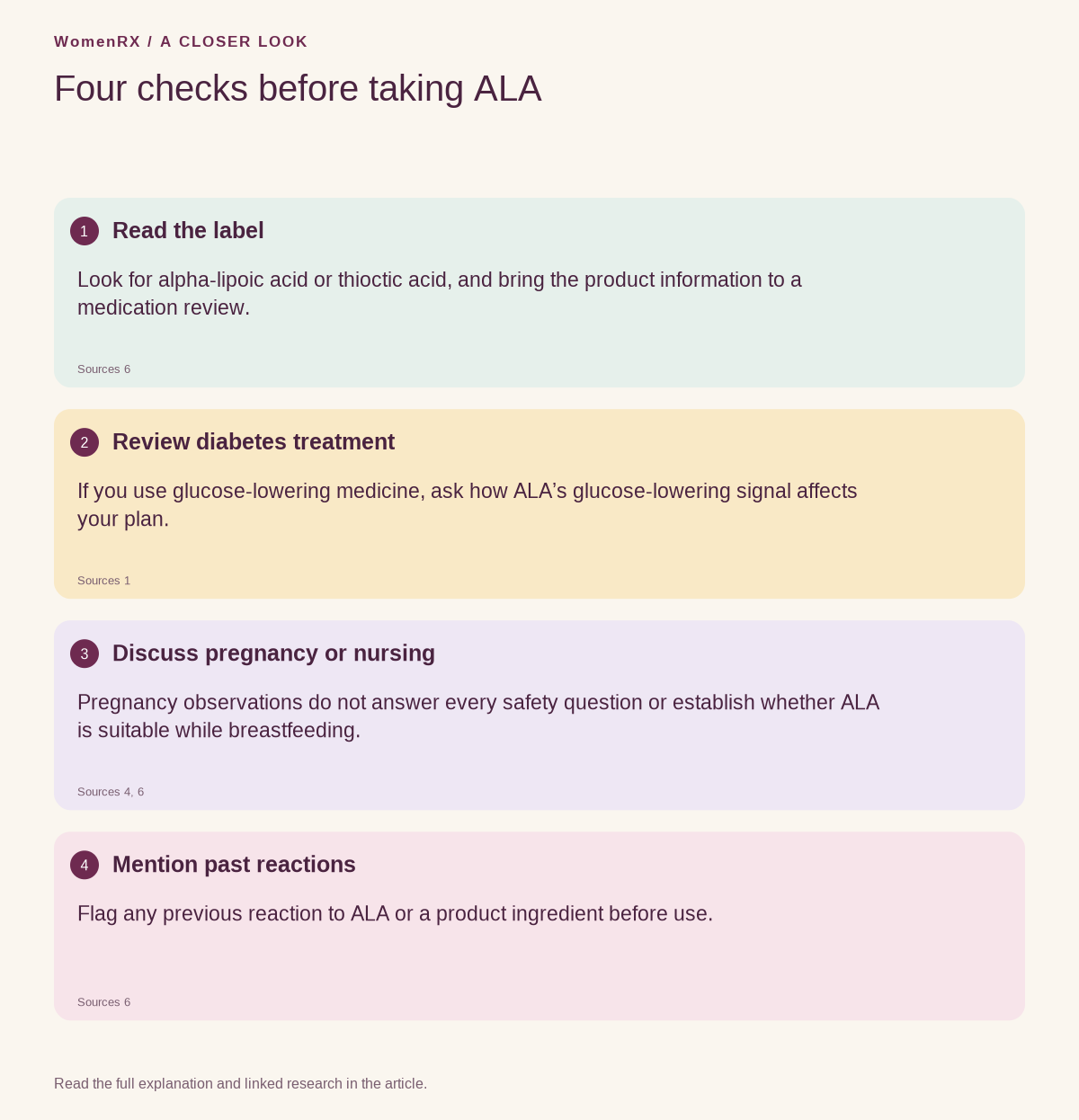
Four checks before taking ALA
Read the label: Look for alpha-lipoic acid or thioctic acid, and bring the product information to a medication review.6
Review diabetes treatment: If you use glucose-lowering medicine, ask how ALA’s glucose-lowering signal affects your plan.1
Discuss pregnancy or nursing: Pregnancy observations do not answer every safety question or establish whether ALA is suitable while breastfeeding.46
Mention past reactions: Flag any previous reaction to ALA or a product ingredient before use.6
Read the figure as text
Use these checks to make a medication discussion specific to your product and health situation.- Read the label: Look for alpha-lipoic acid or thioctic acid, and bring the product information to a medication review.6
- Review diabetes treatment: If you use glucose-lowering medicine, ask how ALA’s glucose-lowering signal affects your plan.1
- Discuss pregnancy or nursing: Pregnancy observations do not answer every safety question or establish whether ALA is suitable while breastfeeding.46
- Mention past reactions: Flag any previous reaction to ALA or a product ingredient before use.6
Sources you can check
- Natural products for the management of type 2 diabetes mellitus and comorbid conditions.Smith JD, Clinard VB. · Journal of the American Pharmacists Association : JAPhA · 2014Return to first citation
- Efficacy and safety of alpha-lipoic acid supplementation in the treatment of symptomatic diabetic neuropathy.Foster TS. · The Diabetes educator · 2007Return to first citation
- Effect of alpha-lipoic acid supplementation on polycystic ovary syndrome clinical outcome in infertile females treated with letrozole: a randomized controlled trial.Sallam MA, Hamza H, Shaheen SM, Ahmed MA. · Saudi pharmaceutical journal : SPJ : the official publication of the Saudi Pharmaceutical Society · 2026Return to first citation
- Safety of oral alpha-lipoic acid treatment in pregnant women: a retrospective observational study.Parente E, Colannino G, Picconi O, Monastra G. · European review for medical and pharmacological sciences · 2017Return to first citation
- Ranking Alpha Lipoic Acid and Gamma Linolenic Acid in Terms of Efficacy and Safety in the Management of Adults With Diabetic Peripheral Neuropathy: A Systematic Review and Network Meta-analysis.Prado MB, Adiao KJB. · Canadian journal of diabetes · 2024Return to first citation
- Efficacy and Safety of Pregabalin and Alpha-Lipoic Acid Combination in Patients With Painful Diabetic Peripheral Neuropathy: A Randomized, Open-Label, Non-Inferiority, Phase IV Clinical Trial and Subgroup Analysis (OPTIMUM Study).Oh TJ, Kim SS, Lee SH, Kwon HS, Kim ES, Rhee EJ, Yoo HJ, Jang HN, Lee WJ, Kim ES, Kim SY, Koh G, Hong EG, Park TS, Won JC. · Diabetes, obesity & metabolism · 2026Return to first citation