Taurine Supplements: What Benefits Have Been Measured, and When?
Taurine studies measure outcomes over very different time frames, so a trial’s length isn’t a reliable estimate of when you’ll feel a benefit.
There isn’t one established “time to work” for taurine. Human trials have measured outcomes after periods ranging from 14 days to 16 weeks, and the results depend on what was studied: cramps in people with chronic liver disease, recovery after transplantation, or blood markers in older women. These time points show when researchers assessed results, not when an effect first began. 1235
The study length is not an onset time
A supplement trial can tell you whether researchers found a difference after a set period. It usually can’t pinpoint the first day a person might notice a change. Taurine studies also measure very different things, from symptom reports to blood tests and hospital outcomes. A change in a lab marker isn’t automatically a benefit you can feel.
So, rather than asking how long taurine takes to work in general, it’s more useful to ask: What outcome was measured, in whom, at what dose, and after how long?
What the different time frames measured
After 14 days: outcomes during traumatic brain injury care. In a small randomized trial, 32 patients with traumatic brain injury received 30 mg/kg/day of taurine added to standard enteral nutrition for 14 days; the control group received standard enteral nutrition alone. Taurine was associated with lower IL-6, higher Glasgow Coma Scale scores, and less weight loss. The change in APACHE II score was marginal (p = 0.05). The groups did not differ significantly in IL-10, hs-CRP, TNF-α, SOFA or NUTRIC scores, intensive-care stay, time on a ventilator, or 30-day mortality. These findings concern seriously ill hospital patients, not everyday energy or exercise performance. 1
After four-week treatment periods: muscle cramps with chronic liver disease. In a crossover trial, people with chronic liver disease and frequent cramps took taurine or placebo for four weeks before switching to the other treatment. Among the 30 people who completed the study, those receiving 2 g/day of taurine had, compared with placebo, seven fewer cramps per fortnight, 89 fewer minutes of cramping per fortnight, and cramp severity that was 1.4 points lower on a Likert scale. The study enrolled 49 people and reported that 70% of participants were male, without specifying whether that percentage describes all enrollees or only the 30 completers. The four-week period is when outcomes were compared; it doesn’t establish the day the cramps first changed. 3
After 30 days: recovery following liver transplantation. A randomized trial analyzed 169 adults who received 2 g/day of taurine or placebo from transplant day through day 30. The taurine group had greater reductions in AST, total bilirubin, and INR, and the study also reported lower mortality, shorter intensive transplantation unit and hospital stays, and less time on mechanical ventilation than placebo. This was closely monitored care after major surgery, so it doesn’t establish a general benefit or onset time for someone taking taurine on their own. 2
After 12 or 16 weeks: exercise-related measures and blood markers. A 12-week trial studied 44 men with obesity in four groups: control, taurine alone, exercise alone, and exercise plus taurine. The taurine groups received 3 g/day. The combined exercise-and-taurine group had the greatest reductions in asprosin, body mass, BMI, and body-fat percentage, and the greatest increase in spexin compared with the other groups. Each group had only 11 participants, so these findings are preliminary. They don’t establish that taurine alone produces the same body-composition changes, or that it gives an immediate workout boost. 4
A separate 16-week trial in 24 women ages 55 to 70 compared 1.5 g of taurine with placebo and measured oxidative-stress markers before and after supplementation. Taurine levels and the antioxidant enzyme SOD increased in the taurine group, and SOD levels were higher than in the placebo group after the intervention. Glutathione reductase decreased regardless of group, while malondialdehyde increased only in the placebo group. These are blood-test findings; they don’t show that participants felt younger, had more energy, or experienced a broader anti-aging benefit. 5
What the women’s research does and doesn’t show
The women-only trial is a useful distinction: women were studied directly, but the outcomes were biochemical markers measured before and after 16 weeks. It does not answer whether taurine improves a symptom or how soon a woman might notice a difference. 5
The exercise trial studied men only. The cramp trial reported 70% male participants, without saying whether that percentage refers to all enrollees or just those who completed the study. These findings shouldn’t be presented as if they were established specifically in women. 34
Pregnancy and breastfeeding are separate questions. The trials described here don’t establish taurine supplement safety during pregnancy or while breastfeeding, so their results shouldn’t be used to answer those safety questions.
A practical way to read a taurine claim
When a label or article promises a quick effect, check what outcome the research actually measured. Was it a symptom you care about, or a blood marker? Were participants healthy, or receiving treatment for a serious condition? Was the outcome measured after a workout, or only after weeks of repeated use?
In the human trials described here, repeated-use studies assessed results after days or weeks. The exercise trial measured outcomes after 12 weeks, not after a single dose or workout. Those study schedules don’t add up to one proven onset time, and they don’t show that every proposed use of taurine works. 12345
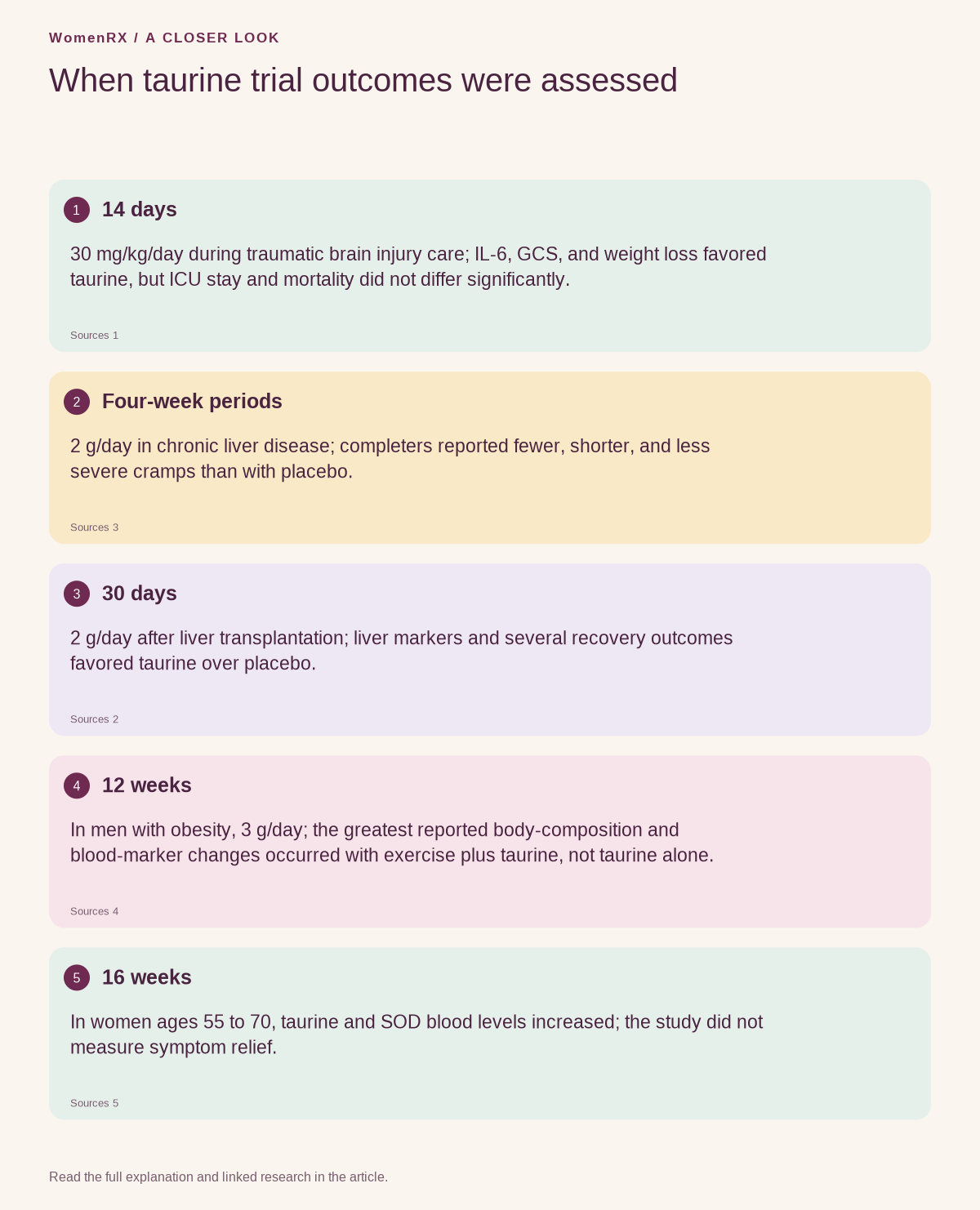
When taurine trial outcomes were assessed
14 days: 30 mg/kg/day during traumatic brain injury care; IL-6, GCS, and weight loss favored taurine, but ICU stay and mortality did not differ significantly.1
Four-week periods: 2 g/day in chronic liver disease; completers reported fewer, shorter, and less severe cramps than with placebo.3
30 days: 2 g/day after liver transplantation; liver markers and several recovery outcomes favored taurine over placebo.2
12 weeks: In men with obesity, 3 g/day; the greatest reported body-composition and blood-marker changes occurred with exercise plus taurine, not taurine alone.4
16 weeks: In women ages 55 to 70, taurine and SOD blood levels increased; the study did not measure symptom relief.5
Read the figure as text
These time points show the doses and intervention periods used in different studies, along with the specific findings reported. They are not a guaranteed wait before a person feels an effect.- 14 days: 30 mg/kg/day during traumatic brain injury care; IL-6, GCS, and weight loss favored taurine, but ICU stay and mortality did not differ significantly.1
- Four-week periods: 2 g/day in chronic liver disease; completers reported fewer, shorter, and less severe cramps than with placebo.3
- 30 days: 2 g/day after liver transplantation; liver markers and several recovery outcomes favored taurine over placebo.2
- 12 weeks: In men with obesity, 3 g/day; the greatest reported body-composition and blood-marker changes occurred with exercise plus taurine, not taurine alone.4
- 16 weeks: In women ages 55 to 70, taurine and SOD blood levels increased; the study did not measure symptom relief.5
More questions, answered
Does a 16-week study mean you need to take taurine for 16 weeks?
No. It means researchers assessed the women’s blood markers before and after a 16-week intervention. It doesn’t establish a recommended duration for taking taurine or show when a person might notice a change. 5
Do taurine exercise studies show an immediate workout effect?
The exercise trial tested a 12-week program in men with obesity, with taurine groups receiving 3 g/day. The greatest reported body-composition and blood-marker changes were in the group combining taurine with exercise; the trial doesn’t establish an effect from a single dose or workout, or the same body-composition changes from taurine alone. 4
Sources you can check
- The effects of Taurine supplementation on inflammatory markers and clinical outcomes in patients with traumatic brain injury: a double-blind randomized controlled trial.Vahdat M, Hosseini SA, Soltani F, Cheraghian B, Namjoonia M. · Nutrition journal · 2021Return to first citation
- Could taurine supplementation improve graft functions after liver transplantation? A randomized clinical trial among liver transplant recipients.Mottaghi S, Vazin A, Nikoupour H, Firoozifar SM, Haem E, Heidari R, Shafiekhani M. · Clinical nutrition ESPEN · 2026Return to first citation
- Randomised clinical trial: oral taurine supplementation versus placebo reduces muscle cramps in patients with chronic liver disease.Vidot H, Cvejic E, Carey S, Strasser SI, McCaughan GW, Allman-Farinelli M, Shackel NA. · Alimentary pharmacology & therapeutics · 2018Return to first citation
- Combined Aerobic-Resistance Training and Taurine Supplementation Reduce Asprosin and Elevate Spexin in Men with Obesity: A 12-Week Supplement-Blinded, Randomized Controlled Trial.Saedmocheshi S, Dhahbi W, Saeidi A, Rahmani A. · Nutrients · 2026Return to first citation
- Taurine as a possible antiaging therapy: A controlled clinical trial on taurine antioxidant activity in women ages 55 to 70.Abud GF, De Carvalho FG, Batitucci G, Travieso SG, Bueno Junior CR, Barbosa Junior F, Marchini JS, de Freitas EC. · Nutrition (Burbank, Los Angeles County, Calif.) · 2022Return to first citation