Cinnamon Supplements: Blood Sugar Evidence and Safety
Cinnamon may affect fasting blood sugar in some short trials, but the species and form matter when weighing that possibility against coumarin exposure.
Cinnamon used to flavor food isn’t the same choice as taking a powder or extract supplement regularly. Short adult trials suggest some cinnamon supplements may lower fasting blood sugar, but results don’t establish a reliable benefit for every product. Cassia generally contains more coumarin than Ceylon cinnamon, raising a concern with prolonged use. Adult trials don’t establish supplement safety during pregnancy or breastfeeding. 1 2 3
Start with the species and form
A sprinkle of cinnamon in oatmeal and a daily cinnamon capsule may share a name, but the supplement evidence doesn’t tell you what a culinary amount will do. Trials have used measured amounts of cinnamon powder or specific extracts, often for weeks at a time. Those findings can’t simply be transferred to cinnamon used as a flavoring. 1 2 5
The species matters, too. Cassia cinnamon and Ceylon cinnamon, also called Cinnamomum verum or Cinnamomum zeylanicum, differ in their coumarin content. Cassia generally contains more coumarin, a naturally occurring compound associated with potential liver toxicity. That makes prolonged use of cassia supplements a different safety question from using cinnamon as a spice. It does not mean lower-coumarin Ceylon supplements have been proved safe for long-term use. 1 2
What blood sugar studies actually show
Fasting blood sugar is the clearest reason cinnamon attracts research interest, but the findings aren’t uniform. A 2015 review described the diabetes evidence as inconclusive; it noted that older trials largely studied cassia or related cinnamon species, rather than Ceylon. A later meta-analysis pooled 16 randomized trials involving 1,020 people with type 2 diabetes and found improvements in glucose and lipid measures compared with placebo. Those trials lasted from 40 days to four months, which limits what they can tell us about sustained benefit or safety. 1 3
A newer trial helps answer a narrower question: what happened with one standardized Ceylon extract? In a 2025 randomized, placebo-controlled study, 150 adults with elevated LDL cholesterol enrolled and 127 were assessed at 12 weeks. The extract group had a greater reduction in fasting blood sugar than the placebo group, while the difference in LDL cholesterol was not statistically significant. The fasting-blood-sugar finding was particularly pronounced among participants with type 2 diabetes. It doesn’t establish that another Ceylon product, or cinnamon sprinkled on food, will have the same effect. 2
There’s also a difference between a change in a blood test and a dependable treatment. An overview of supplement research found signals of lower fasting blood sugar or HbA1c with cinnamon, but described substantial variation across studies and said the clinical effects were often not remarkable. Cinnamon hasn’t been established as a replacement for diabetes treatment. 6 1
Does the evidence tell women anything different?
Women made up 66% of participants in the 2025 Ceylon-extract trial. Its overall result, by itself, doesn’t show whether the effect differs between women and men. 2
PCOS is a more specifically women-focused question. A review found nine eligible studies and described possible improvements in some metabolic measures, but it included animal as well as clinical research and called for more clinical trials. Those findings don’t establish cinnamon as a treatment for PCOS or show that it improves fertility. 4
Pregnancy and breastfeeding call for a separate distinction between seasoning food and taking a supplement. The adult diabetes and cholesterol trials do not establish the safety of regular cinnamon supplementation during pregnancy or breastfeeding. Nor can results from those trials be used to set a safe supplement amount for either situation. That gap says little about ordinary culinary use; it means the two forms shouldn’t be treated as interchangeable. 1 2 3
A useful comparison before buying a supplement
If a cinnamon supplement interests you, look for the named species and whether it contains bark powder or an extract. That won’t tell you whether it works, but it lets you compare the product with what was actually studied. Much of the older glucose research involved cassia, with its higher coumarin concern; the newer Ceylon result comes from one standardized extract studied for 12 weeks. Choosing Ceylon may address part of the coumarin concern without settling the questions of long-term safety or benefit. 1 2
If your goal is simply to enjoy the flavor, you don’t need to treat cinnamon as a blood sugar strategy. If your goal is to change a glucose result, the key question is more specific: is there evidence for this form and species, in people like you, over a timeframe that matters? At present, that answer is much clearer for short-term fasting-blood-sugar measurements than for lasting health outcomes. 1 2 3
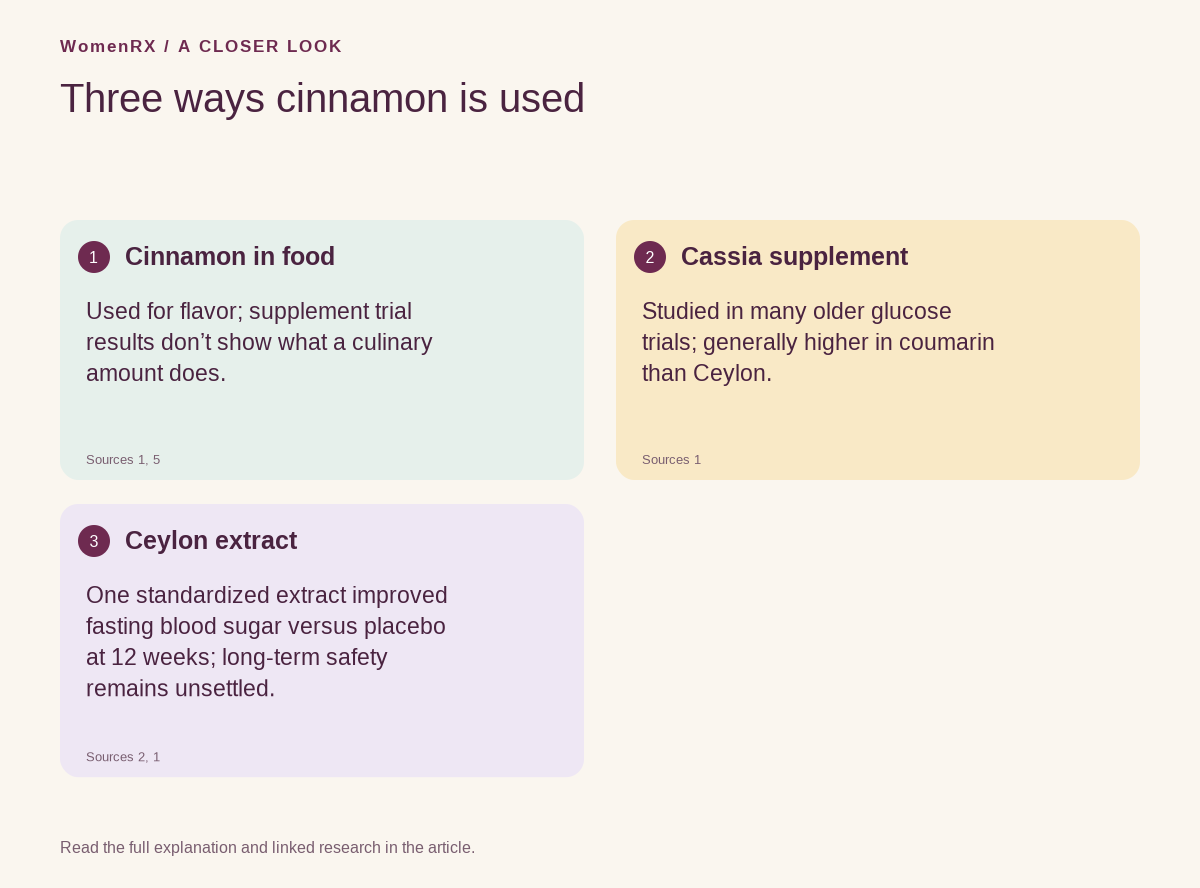
Three ways cinnamon is used
Cinnamon in food: Used for flavor; supplement trial results don’t show what a culinary amount does.15
Cassia supplement: Studied in many older glucose trials; generally higher in coumarin than Ceylon.1
Ceylon extract: One standardized extract improved fasting blood sugar versus placebo at 12 weeks; long-term safety remains unsettled.21
Read the figure as text
Form and species determine which trial findings and coumarin concerns are relevant.- Cinnamon in food: Used for flavor; supplement trial results don’t show what a culinary amount does.15
- Cassia supplement: Studied in many older glucose trials; generally higher in coumarin than Ceylon.1
- Ceylon extract: One standardized extract improved fasting blood sugar versus placebo at 12 weeks; long-term safety remains unsettled.21
More questions, answered
Is Ceylon cinnamon a proven safer supplement than cassia?
Ceylon cinnamon generally contains less coumarin, so it presents less of that particular exposure concern. But lower coumarin content alone doesn’t establish the long-term safety of a Ceylon supplement. 1 2
Sources you can check
- The glycaemic outcomes of Cinnamon, a review of the experimental evidence and clinical trials.Medagama AB. · Nutrition journal · 2015Return to first citation
- Effects of Cinnamomum zeylanicum (Ceylon cinnamon) extract on lipid profile, glucose levels and its safety in adults: A randomized, double-blind, controlled trial.Muthukuda D, de Silva CK, Ajanthan S, Wijesinghe N, Dahanayaka A, Pathmeswaran A. · PloS one · 2025Return to first citation
- Efficacy of cinnamon supplementation on glycolipid metabolism in T2DM diabetes: A meta-analysis and systematic review.Zhou Q, Lei X, Fu S, Li Z, Chen Y, Long C, Li S, Chen Q. · Frontiers in physiology · 2022Return to first citation
- Mechanistic and therapeutic insight into the effects of cinnamon in polycystic ovary syndrome: a systematic review.Maleki V, Faghfouri AH, Tabrizi FPF, Moludi J, Saleh-Ghadimi S, Jafari-Vayghan H, Qaisar SA. · Journal of ovarian research · 2021Return to first citation
- To what extent does cinnamon administration improve the glycemic and lipid profiles?Santos HO, da Silva GAR. · Clinical nutrition ESPEN · 2018Return to first citation
- The effects of dietary supplements and natural products targeting glucose levels: an overview.Hekmat-Ardakani A, Morshed-Behbahani B, Rahimi-Ardabili H, Ayati MH, Namazi N. · Critical reviews in food science and nutrition · 2023Return to first citation