How to Compare Cinnamon Supplements and Their Safety
A cinnamon label can tell you whether a product resembles what researchers tested and whether its species raises a coumarin question.
Start with the botanical name, then compare powder versus extract, the amount per serving, and any other active ingredients. Cassia cinnamon appears in many blood-sugar trials, but results are mixed and don’t establish a best supplement. Cassia’s higher coumarin content also matters when considering regular use; Ceylon’s lower coumarin content is not proof of a blood-sugar benefit. 1 7
Two bottles can both say “cinnamon” while containing different species or preparations. If you’re comparing them for a blood-sugar claim, those differences are more useful than a promise on the front label. Here’s how to separate what a product contains from what the research has actually tested.
First, find the botanical name
Cassia cinnamon is Cinnamomum cassia. Ceylon cinnamon is Cinnamomum verum, also called Cinnamomum zeylanicum. They’re different species, not two names for the same ingredient. 1
The distinction matters for both evidence and safety. Cassia was used in the human glucose trials examined in a 2015 review, and it can contain substantially more coumarin than Ceylon cinnamon. Ceylon had not been tested in the glucose trials that review examined. Its lower coumarin content therefore answers one question about the ingredient, not whether a Ceylon supplement will improve blood sugar. 1
If a label says only “cinnamon,” you can’t identify the species from that wording. That makes it harder to judge both the product’s similarity to a studied preparation and its likely coumarin exposure. A species name helps, but it doesn’t tell you how much coumarin is in that particular bottle. 1 2
Next, compare what’s in the serving
Look for bark powder, extract, or a combination, then check the amount listed per serving. Human studies have not tested one standard cinnamon preparation. The 2015 review described cassia powder and aqueous-extract trials using amounts from 500 milligrams to 6 grams daily for 40 days to four months. Those are study conditions, not a suggested amount to take. 1
For example, a 12-week randomized trial in adults with prediabetes used capsules containing cinnamon extract plus Cinnamomum burmannii powder. The mean fasting-glucose result differed by 5 mg/dL between the cinnamon and placebo groups at 12 weeks: fasting glucose rose in the placebo group but remained stable in the cinnamon group. That finding doesn’t establish the same effect for cassia powder, Ceylon cinnamon, or a different extract. The trial also did not determine whether cinnamon prevents progression to type 2 diabetes. 6
Read past the word “cinnamon” for added active ingredients, too. In a trial of people with type 2 diabetes, researchers tested berberine plus cinnamon against placebo. Its findings cannot isolate an effect of cinnamon alone, so they aren’t evidence that a cinnamon-only bottle works the same way. 4
Decide what the blood-sugar claim means
A product may refer vaguely to “blood-sugar support,” but studies have measured different outcomes, including fasting glucose, glucose after a challenge, and HbA1c. An encouraging result on one measure doesn’t settle the others.
The broader findings are mixed. A 2024 systematic review of 45 studies concluded that cinnamon likely has a modest positive effect on blood glucose, while noting that differing glucose measures prevented the authors from combining the studies into one result. A separate review described earlier diabetes trials in which fasting-glucose findings were inconclusive and HbA1c did not significantly improve in the analysis it discussed. Another meta-analysis reported favorable glucose findings but noted short studies, small samples, and variation across trials. 7 1 5
That’s why the practical question isn’t “Which brand makes the strongest claim?” It’s “Does this product identify its species and preparation, and does the evidence address the outcome I care about?” Even a close match to a trial product would not make cinnamon a replacement for diabetes treatment.
Keep label clarity and product quality separate
A detailed label makes comparison possible; it doesn’t independently verify what’s inside. One DNA-barcoding study examined 54 US herbal supplements associated with purported Ayurvedic treatment of respiratory symptoms during COVID-19. The products spanned several herb categories, including cinnamon. The expected species was detected in 38.9% overall, not in a reported cinnamon-only group. Because of how those products were selected, that figure cannot estimate how often cinnamon supplements marketed for blood sugar are mislabeled. The researchers also noted limitations of DNA barcoding for identifying these products. 3
Independent quality verification may provide information about checks on a product or its ingredients, but it does not establish that a supplement is safe or effective. Results from one tested formulation may not carry over to another. 2
What about products marketed to women?
The glucose evidence discussed here does not establish a special benefit for women. The prediabetes trial enrolled adults and reported an overall result, not a women-specific effect in the study details presented. A bottle labeled “for women” is not, by itself, evidence that its formula was tested in women. 6
If you’re breastfeeding, there’s a further distinction between cinnamon used as a food flavoring and regular supplement use: LactMed reports no data on cinnamon’s safety in nursing mothers or infants and no studies showing that it increases milk supply. 2
For a useful side-by-side comparison, write down each bottle’s botanical name, powder or extract form, amount per serving, and other active ingredients. An unspecified species or proprietary blend leaves you with less to compare. And if the reason you’re shopping is a blood-sugar concern, treat the claim as a claim, not as a result you can count on for yourself.
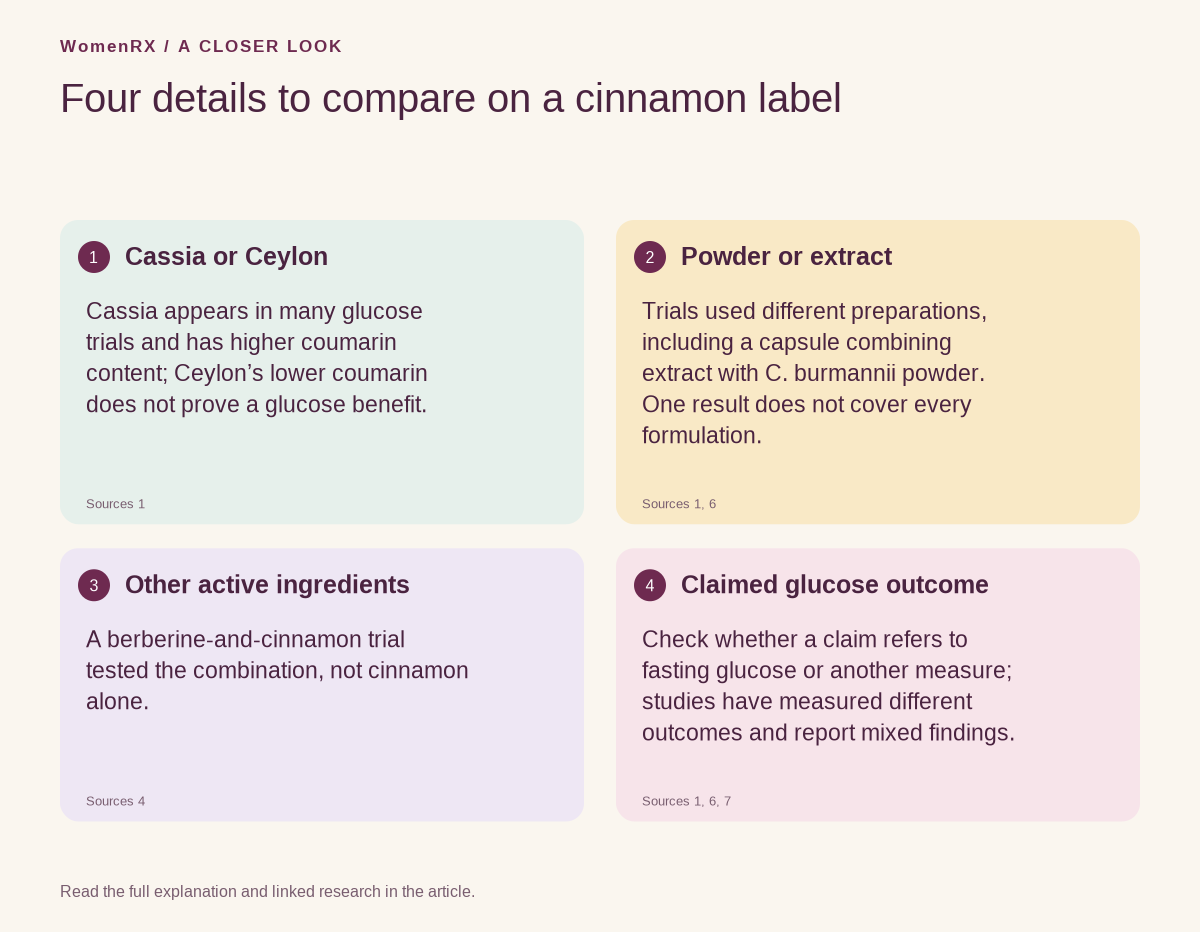
Four details to compare on a cinnamon label
Cassia or Ceylon: Cassia appears in many glucose trials and has higher coumarin content; Ceylon’s lower coumarin does not prove a glucose benefit.1
Powder or extract: Trials used different preparations, including a capsule combining extract with C. burmannii powder. One result does not cover every formulation.16
Other active ingredients: A berberine-and-cinnamon trial tested the combination, not cinnamon alone.4
Claimed glucose outcome: Check whether a claim refers to fasting glucose or another measure; studies have measured different outcomes and report mixed findings.167
Read the figure as text
Each detail answers a different question about how closely a product matches the research and what remains uncertain.- Cassia or Ceylon: Cassia appears in many glucose trials and has higher coumarin content; Ceylon’s lower coumarin does not prove a glucose benefit.1
- Powder or extract: Trials used different preparations, including a capsule combining extract with C. burmannii powder. One result does not cover every formulation.16
- Other active ingredients: A berberine-and-cinnamon trial tested the combination, not cinnamon alone.4
- Claimed glucose outcome: Check whether a claim refers to fasting glucose or another measure; studies have measured different outcomes and report mixed findings.167
More questions, answered
Does Ceylon cinnamon have better blood-sugar evidence than cassia?
Not on the basis of its lower coumarin content. Cassia was used in the glucose trials assessed by a 2015 review; Ceylon had not been tested in those trials. Lower coumarin and demonstrated glucose benefit are separate questions. 1
Does a quality seal prove a cinnamon supplement works?
No. Independent verification can address aspects of product or ingredient quality, but it does not certify clinical effectiveness or establish that a particular supplement is safe for you. 2
Sources you can check
- The glycaemic outcomes of Cinnamon, a review of the experimental evidence and clinical trials.Medagama AB. · Nutrition journal · 2015Return to first citation
- Cinnamon2006Return to first citation
- DNA barcoding of herbal supplements on the US commercial market associated with the purported treatment of COVID-19.Harris CM, Kim DY, Jordan CR, Miranda MI, Hellberg RS. · Phytochemical analysis : PCA · 2024Return to first citation
- The efficacy and safety of berberine in combination with cinnamon supplementation in patients with type 2 diabetes: a randomized clinical trial.Mansour A, Sajjadi-Jazi SM, Gerami H, Khorasanian AS, Moalemzadeh B, Karimi S, Afrakoti NM, Mofid V, Mohajeri-Tehrani MR, Hekmatdoost A. · European journal of nutrition · 2025Return to first citation
- Efficacy of cinnamon supplementation on glycolipid metabolism in T2DM diabetes: A meta-analysis and systematic review.Zhou Q, Lei X, Fu S, Li Z, Chen Y, Long C, Li S, Chen Q. · Frontiers in physiology · 2022Return to first citation
- Influence of Cinnamon on Glycemic Control in Individuals With Prediabetes: A Randomized Controlled Trial.Romeo GR, Lee J, Mulla CM, Noh Y, Holden C, Lee BC. · Journal of the Endocrine Society · 2020Return to first citation
- A Systematic Review Evaluating Cinnamon's Effects on Glucose Utilizing a Ranking System to Assess Bias and Study Quality.Bakhach H, Nuffer M, Tall Bull S, Nuffer W. · Journal of medicinal food · 2024Return to first citation