Does Cinnamon Type Matter for Supplement Safety?
Yes: cassia generally contains more coumarin than Ceylon, so cinnamon type and how much you use can change the safety question.
Yes. Cassia cinnamon has higher coumarin content than Ceylon cinnamon, and repeated or concentrated use can add up to more exposure than occasional seasoning. But a product’s name may not tell you exactly what’s in it, and a short adult study of a specific Ceylon extract can’t establish long-term, pregnancy, or breastfeeding safety. 12
The type matters, but so does the amount
Cassia and Ceylon cinnamon aren’t interchangeable for every safety question. Cassia is described as having higher coumarin content, while Ceylon cinnamon has lower amounts. Coumarin is a naturally occurring compound that has raised concern about liver toxicity at high exposure. 12
That doesn’t mean a sprinkle of cinnamon and a capsule create the same exposure. The amount used, how often you use it, and whether it’s a concentrated product all matter. A risk assessment found that some patterns of regular cinnamon-tea drinking or supplement use could exceed its daily coumarin benchmark. It also estimated high exposure from some cinnamon-containing foods, so the distinction isn’t simply “food is safe, supplements are risky.” The assessment identifies potential concern; it does not show that every person using cinnamon develops liver injury. 2
What the label can, and can’t, tell you
Look for the cinnamon species, not only the word “cinnamon.” Research on a clearly identified Ceylon extract may not apply to a cassia product, a different extract, or a product that doesn’t identify its species. A clinical trial paper also notes that cinnamon studies may use unclear species names and that differences in species and composition limit how well results carry over from one product to another. 1
That matters for safety as well as for claimed benefits: “Ceylon” on a label doesn’t tell you the product’s exact coumarin content, and a study of one standardized extract doesn’t establish the composition or safety of every product sold under that name. A review of supplements for diabetes also describes variation in commercially available product quality and purity. 14
For example: if you use cinnamon in cooking now and then, that’s a different pattern from taking a concentrated capsule every day or drinking cinnamon tea regularly. But the type and the total amount still matter, especially with repeated use. Don’t assume that a capsule is low in coumarin just because the label says “cinnamon.”
What’s known about supplements, and what isn’t
In a 12-week randomized trial, 150 adults were assigned to a standardized Ceylon cinnamon extract or placebo; 66% of participants were women. The study reported a favorable safety profile, but it tested one identified extract over a limited period. It can’t establish the long-term safety of other products or answer whether cinnamon supplements are safe during pregnancy or breastfeeding. 1
If you’re pregnant, trying to become pregnant, or breastfeeding, don’t treat evidence from a short adult trial as evidence that a concentrated cinnamon product is safe for you. Ordinary use as a seasoning is a separate question from taking a supplement, but the trial doesn’t answer supplement safety during these stages. 1
If you take medicine
One trial of a particular Ceylon extract found a greater reduction in fasting blood sugar than placebo. It did not test whether cinnamon interacts with medicines, and its finding does not show that every cinnamon product has the same effect. If you take medicine to manage blood sugar, discuss the particular product with your pharmacist or prescriber rather than assuming the trial answers how it would work alongside your treatment. 1
The practical takeaway: before adding a concentrated product, share its label and species with the person who manages your medicines. Don’t use cinnamon supplements as a replacement for prescribed treatment; evidence about glucose effects varies across cinnamon products and studies. 13
A quick way to compare your options
For occasional seasoning, you generally have more control over how much you use. For a supplement or regular cinnamon tea, check whether the species is identified, remember that cassia tends to be higher in coumarin, and factor in repeated use. If the species or product composition is unclear, you can’t reliably use a study of a specific Ceylon extract to judge that product’s safety. 12
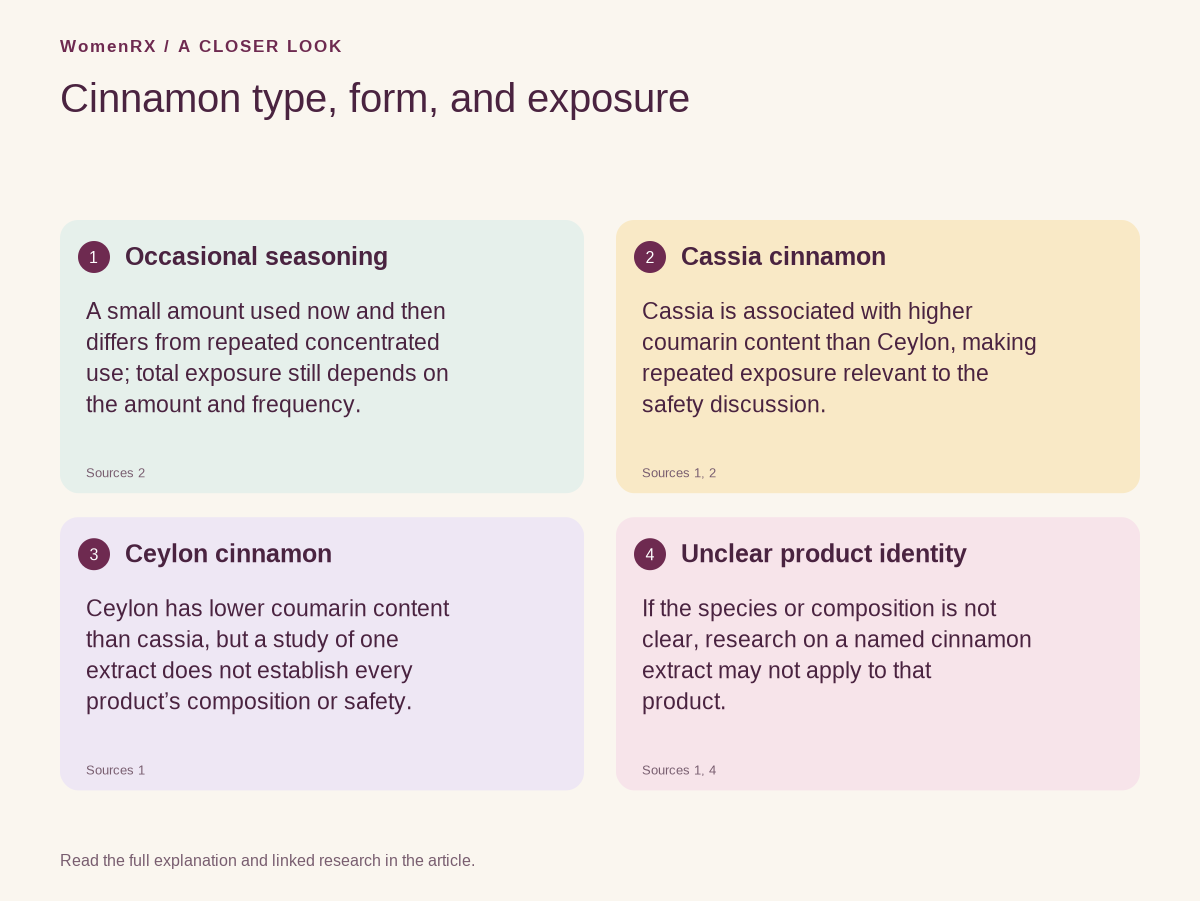
Cinnamon type, form, and exposure
Occasional seasoning: A small amount used now and then differs from repeated concentrated use; total exposure still depends on the amount and frequency.2
Cassia cinnamon: Cassia is associated with higher coumarin content than Ceylon, making repeated exposure relevant to the safety discussion.12
Ceylon cinnamon: Ceylon has lower coumarin content than cassia, but a study of one extract does not establish every product’s composition or safety.1
Unclear product identity: If the species or composition is not clear, research on a named cinnamon extract may not apply to that product.14
Read the figure as text
Compare the type and pattern of use before applying research on one cinnamon product to another.- Occasional seasoning: A small amount used now and then differs from repeated concentrated use; total exposure still depends on the amount and frequency.2
- Cassia cinnamon: Cassia is associated with higher coumarin content than Ceylon, making repeated exposure relevant to the safety discussion.12
- Ceylon cinnamon: Ceylon has lower coumarin content than cassia, but a study of one extract does not establish every product’s composition or safety.1
- Unclear product identity: If the species or composition is not clear, research on a named cinnamon extract may not apply to that product.14
More questions, answered
Is Ceylon cinnamon automatically safe as a supplement?
No. It tends to have lower coumarin content than cassia, but that doesn’t establish the exact content or long-term safety of every Ceylon product. A 12-week trial studied one standardized extract, not all supplements. 1
Sources you can check
- Effects of Cinnamomum zeylanicum (Ceylon cinnamon) extract on lipid profile, glucose levels and its safety in adults: A randomized, double-blind, controlled trial.Muthukuda D, de Silva CK, Ajanthan S, Wijesinghe N, Dahanayaka A, Pathmeswaran A. · PloS one · 2025Return to first citation
- Risk assessment of coumarin using the bench mark dose (BMD) approach: children in Norway which regularly eat oatmeal porridge with cinnamon may exceed the TDI for coumarin with several folds.Fotland TØ, Paulsen JE, Sanner T, Alexander J, Husøy T. · Food and chemical toxicology : an international journal published for the British Industrial Biological Research Association · 2012Return to first citation
- Sweetly Improving Sugars? Reviewing Cinnamon's Effects on Blood Glucose.Nuffer W, Tall Bull S, Bakhach H, Nuffer M. · Journal of medicinal food · 2023Return to first citation
- Supplements for Diabetes Mellitus: A Review of the Literature.Yilmaz Z, Piracha F, Anderson L, Mazzola N. · Journal of pharmacy practice · 2017Return to first citation