Cinnamon Supplements Long Term: What to Check Before Continuing
A cinnamon label’s species and preparation matter, but short studies can’t establish that a supplement is safe to take long term.
Before continuing a cinnamon supplement, check its botanical species, whether it’s powder or an extract, the amount per serving, and how long you’ve taken it. Cassia is described as higher in coumarin than Ceylon cinnamon, a relevant distinction for liver-safety questions. But studies are short, and they don’t establish a universally safe long-term dose or answer safety in pregnancy or breastfeeding. 1 2
The word “cinnamon” leaves out useful details
Cinnamon supplements aren’t all the same. Cinnamomum cassia is described as having more coumarin than Ceylon cinnamon, which may appear on a label as Cinnamomum verum. One clinical trial studied C. zeylanicum, another name used for Ceylon cinnamon. Species matters because research on one preparation can’t automatically tell you about another. 1 3
Check whether the label identifies the species, says whether the product is powder or an extract, and lists any standardization. These details can help you see whether a product resembles one used in a study. They don’t prove that it has the same composition or safety profile. Cinnamon studies have used different species and preparations, and reviews describe variation in formulation and study duration. 1 2 5
Food use and concentrated supplements aren’t interchangeable
Cinnamon used as a seasoning and a capsule or extract are different forms of use. The clinical studies discussed here tested measured amounts of powders or extracts; they didn’t directly compare those products with ordinary culinary use. So a study of a supplement can’t establish the safety of every capsule, and supplement findings shouldn’t be treated as a measure of the risk from using cinnamon in food. 1 2
For a practical label review, write down the species, form, amount per serving, number of servings you take, and how long you’ve used it. If the species or preparation isn’t stated, that’s a real limit: you can’t confidently match the product to a specific study.
What the liver research can and can’t tell you
Coumarins are plant compounds described as having potential toxic effects on the liver. Cassia is described as higher in coumarin than Ceylon cinnamon, so species is relevant when considering a supplement. The available findings don’t quantify the chance of liver injury from a cinnamon product, identify a safe amount or duration, or show that choosing Ceylon makes long-term use safe. 1
A randomized trial studied one standardized Ceylon cinnamon extract for 12 weeks in 150 adults with elevated LDL cholesterol; 127 were assessed at 12 weeks. The researchers reported a favorable safety profile for that trial. But participants who were pregnant or lactating, as well as people with certain liver conditions or abnormal liver tests, were excluded. The result therefore doesn’t answer safety for those groups or establish safety after longer use. 1
A systematic review of trials in people with type 2 diabetes reported follow-up periods ranging from 40 days to four months. That provides some short-term context, not a long-term safety record. Differences in product and study design also make it difficult to apply one study’s results to a different supplement. 2
A useful check before you continue
Use the bottle to answer four questions:
- Which species? Does the label name C. cassia, C. verum, or another species?
- Which preparation? Is it powder or an extract? Is any standardization stated?
- What are you taking? Note the amount per serving and how many servings you use, without assuming a study amount is a personal target.
- For how long? Record when you started and whether the product or amount has changed.
If you’re considering continued use, share those details with a pharmacist or clinician who can review your overall health and medicines. This is a product-specific review, not a claim that a particular cinnamon supplement is known to interact with a particular medicine. Studies have explored possible effects on blood glucose, but findings vary by product and study; the cited research doesn’t verify a specific medication interaction. 1 4
Pregnancy and breastfeeding are separate questions
The 12-week adult trial excluded pregnant and lactating participants. Its safety findings therefore can’t answer whether a cinnamon supplement is safe during pregnancy or breastfeeding. Short-term results in other adults shouldn’t be used to fill that gap. 1
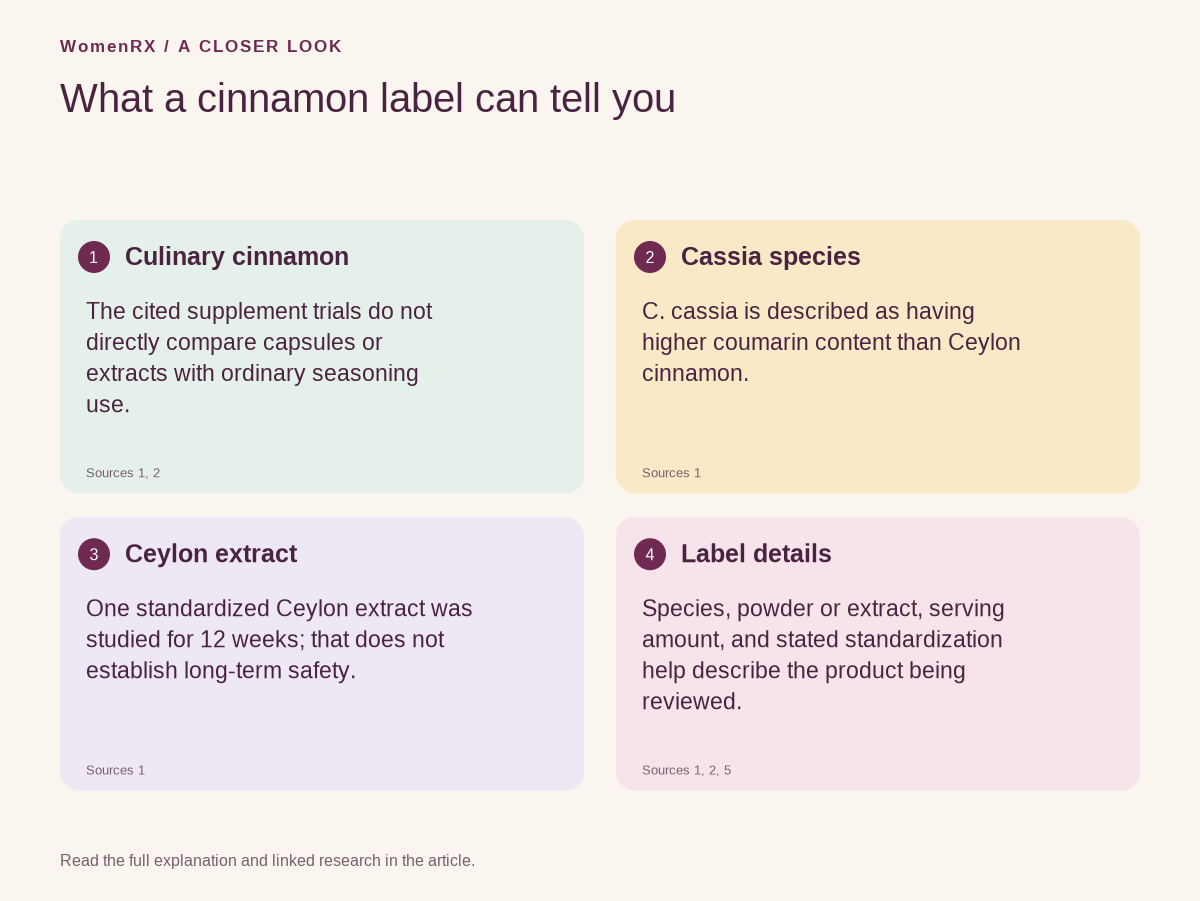
What a cinnamon label can tell you
Culinary cinnamon: The cited supplement trials do not directly compare capsules or extracts with ordinary seasoning use.12
Cassia species: C. cassia is described as having higher coumarin content than Ceylon cinnamon.1
Ceylon extract: One standardized Ceylon extract was studied for 12 weeks; that does not establish long-term safety.1
Label details: Species, powder or extract, serving amount, and stated standardization help describe the product being reviewed.125
Read the figure as text
Food use and supplement trials are not directly interchangeable. The product’s species and preparation help show how closely it resembles what researchers studied.- Culinary cinnamon: The cited supplement trials do not directly compare capsules or extracts with ordinary seasoning use.12
- Cassia species: C. cassia is described as having higher coumarin content than Ceylon cinnamon.1
- Ceylon extract: One standardized Ceylon extract was studied for 12 weeks; that does not establish long-term safety.1
- Label details: Species, powder or extract, serving amount, and stated standardization help describe the product being reviewed.125
More questions, answered
Does Ceylon cinnamon have proven long-term safety?
No. It’s described as lower in coumarin than cassia, but the trial of one standardized Ceylon extract lasted 12 weeks. That doesn’t establish long-term safety for that extract or for other products. 1
Do the cited studies answer whether cinnamon supplements are safe while breastfeeding?
The 12-week adult trial excluded lactating participants, so it doesn’t answer that question. 1
Sources you can check
- Effects of Cinnamomum zeylanicum (Ceylon cinnamon) extract on lipid profile, glucose levels and its safety in adults: A randomized, double-blind, controlled trial.Muthukuda D, de Silva CK, Ajanthan S, Wijesinghe N, Dahanayaka A, Pathmeswaran A. · PloS one · 2025Return to first citation
- Efficacy of cinnamon supplementation on glycolipid metabolism in T2DM diabetes: A meta-analysis and systematic review.Zhou Q, Lei X, Fu S, Li Z, Chen Y, Long C, Li S, Chen Q. · Frontiers in physiology · 2022Return to first citation
- Dietary supplements for dysmenorrhoea.Pattanittum P, Kunyanone N, Brown J, Sangkomkamhang US, Barnes J, Seyfoddin V, Marjoribanks J. · The Cochrane database of systematic reviews · 2016Return to first citation
- Sweetly Improving Sugars? Reviewing Cinnamon's Effects on Blood Glucose.Nuffer W, Tall Bull S, Bakhach H, Nuffer M. · Journal of medicinal food · 2023Return to first citation
- Supplements for Diabetes Mellitus: A Review of the Literature.Yilmaz Z, Piracha F, Anderson L, Mazzola N. · Journal of pharmacy practice · 2017Return to first citation