Prebiotics: Does Timing Matter, and How Should You Start?
Start a prebiotic gradually and pay attention to how you feel; a study of divided inulin doses can’t tell you whether taking it with meals is better.
There’s no best mealtime or time of day established by the timing study discussed here: it tested a large inulin dose taken all at once or divided over several hours, not with versus without food. Adding fiber too quickly can cause gas or bloating. If that happens after an increase, pause the increase or return to an amount you tolerated. Seek advice if bloating persists. 1 2 4
What the timing study can tell you
The inulin trial described below did not compare taking a prebiotic with food versus on an empty stomach, or test a best time of day. It cannot tell you whether either choice improves benefits or comfort. If the product label gives directions, follow them; otherwise, choose a time you can remember. That’s a choice for convenience, not a research-backed schedule.
Timing is also not the same as tolerance. A small randomized crossover trial in 17 healthy adults tested 20 grams of inulin taken all at once or split into small amounts over six hours. Splitting it reduced breath hydrogen in the first six hours, but hydrogen rose later, and the split schedule did not reduce it over the full 24 hours. Breath hydrogen was a marker of fermentation, not a measure showing that people felt less bloated. The trial does not establish an ideal schedule for everyday use. 4
The kind of fiber matters
“Prebiotic” isn’t one single ingredient. For example, fructooligosaccharides (FOS) and inulin are fermentable fibers, but results with one type shouldn’t automatically be applied to another. 4 5 A review of studies in people with inflammatory bowel disease found that flatulence and bloating were more common with oligofructose-enriched inulin; other prebiotics in the review did not show the same pattern. The review rated the overall certainty of evidence as very low, and its findings apply to people with IBD, not everyone taking a supplement. 3
FOS research also illustrates why a hoped-for gut effect and day-to-day comfort are separate questions. A meta-analysis of eight studies, including studies of adults and infants, found increased counts of Bifidobacterium during FOS use, but did not find a difference from comparison groups in reported gastrointestinal symptoms overall. Its reported analyses do not establish whether women experience different digestive effects from men. That does not mean every person will tolerate FOS, or that other prebiotic fibers will feel the same. 5
A gradual trial, without a rigid schedule
If you decide to try a prebiotic supplement, keep the experiment simple:
- Choose one product. Check what kind of fiber it contains and use the label directions. Don’t start several new fibers or gut supplements at once; it becomes harder to tell what is affecting you.
- Increase gradually. Add fiber slowly rather than making a sudden jump. Increasing dietary fiber too quickly can cause gas, bloating, and cramps. If the product directions allow flexibility, you can build up gradually rather than jumping straight to the full amount. 1
- Keep a brief log. Note the product, amount, time taken, meals, and any gas, bloating, cramps, or changes in bowel habits. This is a practical way to spot patterns, not a validated test of whether a supplement is right for you.
- Adjust if discomfort starts. If gas or bloating follows an increase, pause the increase or return to an amount you tolerated. Note what changed before trying a different time or another product. This follows the general advice to add fiber slowly, rather than assuming a new schedule will fix the discomfort. 1
- Get help if it persists. If bloating keeps happening or doesn’t go away, seek medical advice. 2
Getting fiber from foods is another option. Whole grains, fruits, and vegetables provide dietary fiber, and adding fiber-rich foods gradually can help avoid a sudden increase. 1
When symptoms deserve more attention
Gas can happen as gut bacteria ferment certain fibers, but persistent or frequent bloating shouldn’t automatically be blamed on a supplement. If bloating keeps happening or doesn’t go away, or if it comes with unintended weight loss or blood in your stool, seek medical advice. 2
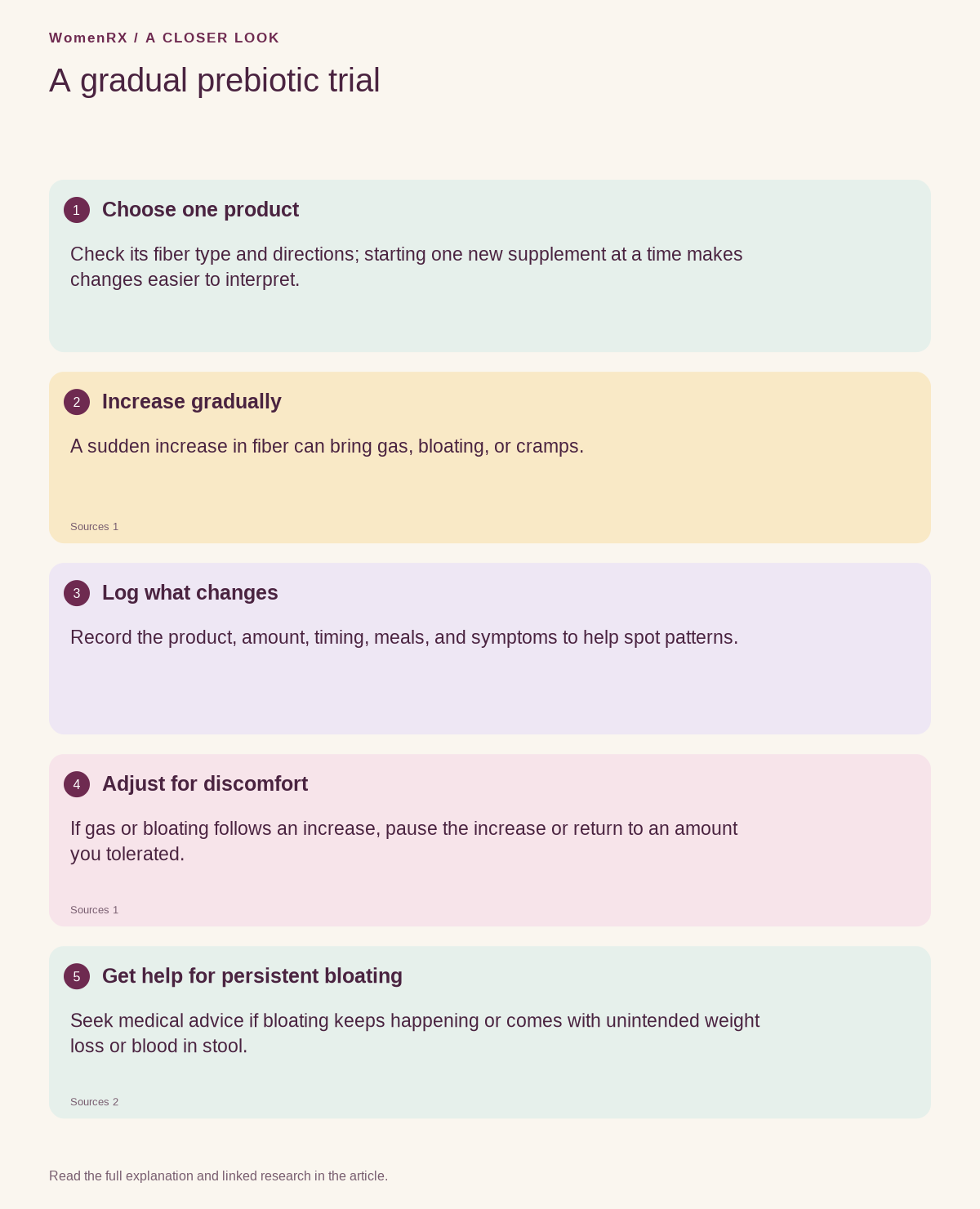
A gradual prebiotic trial
Choose one product: Check its fiber type and directions; starting one new supplement at a time makes changes easier to interpret.
Increase gradually: A sudden increase in fiber can bring gas, bloating, or cramps.1
Log what changes: Record the product, amount, timing, meals, and symptoms to help spot patterns.
Adjust for discomfort: If gas or bloating follows an increase, pause the increase or return to an amount you tolerated.1
Get help for persistent bloating: Seek medical advice if bloating keeps happening or comes with unintended weight loss or blood in stool.2
Read the figure as text
A way to try one fiber, respond to discomfort, and notice whether it suits you. This is a practical guide, not a validated tolerance test.- Choose one product: Check its fiber type and directions; starting one new supplement at a time makes changes easier to interpret.
- Increase gradually: A sudden increase in fiber can bring gas, bloating, or cramps.1
- Log what changes: Record the product, amount, timing, meals, and symptoms to help spot patterns.
- Adjust for discomfort: If gas or bloating follows an increase, pause the increase or return to an amount you tolerated.1
- Get help for persistent bloating: Seek medical advice if bloating keeps happening or comes with unintended weight loss or blood in stool.2
More questions, answered
Should I take a prebiotic with food?
Follow the product’s directions. If they don’t specify, choose a time that fits your day. The divided-dose inulin trial did not compare taking it with meals versus without food, so it cannot answer whether either choice improves comfort. 4
Does splitting a prebiotic dose prevent bloating?
The small trial in healthy adults does not establish that it does. Splitting a large inulin dose shifted the timing of breath hydrogen but did not lower it over the full 24 hours. That finding does not show that splitting the dose prevents bloating. 4
Sources you can check
- Dietary Fiber: MedlinePlusAccessed 2026-09-25Return to first citation
- Bloating - NHSAccessed 2026-09-25Return to first citation
- Prebiotics for Induction and Maintenance of Remission in Inflammatory Bowel Disease: Systematic Review and Meta-Analysis.Limketkai BN, Godoy-Brewer G, Shah ND, Maas L, White J, Parian AM, Mullin GE. · Inflammatory bowel diseases · 2025Return to first citation
- Mode of Action of Psyllium in Reducing Gas Production from Inulin and its Interaction with Colonic Microbiota: A 24-hour, Randomized, Placebo-Controlled Trial in Healthy Human Volunteers.Alhasani AT, Modasia AA, Anodiyil M, Corsetti M, Aliyu AI, Crooks C, Marciani L, Reid J, Yakubov GE, Taylor M, Avery A, Harris H, Warren FJ, Spiller RC. · The Journal of nutrition · 2025Return to first citation
- Effect of Fructooligosaccharides Supplementation on the Gut Microbiota in Human: A Systematic Review and Meta-Analysis.Dou Y, Yu X, Luo Y, Chen B, Ma D, Zhu J. · Nutrients · 2022Return to first citation