Probiotics or Prebiotics: Match the Choice to Your Goal
Probiotics and prebiotics do different things, and neither is a universal gut-health fix.
A probiotic is a live microorganism; a prebiotic is a non-digestible ingredient that selectively supports particular gut microbes. Dietary fiber from foods can help prevent constipation, but that doesn’t establish a prebiotic supplement as treatment for constipation. For antibiotic-associated diarrhea, research supports some specific probiotics in some groups. Choose by your goal and the exact ingredient or strain, rather than assuming you need both. 1 2 3
The difference is what you’re choosing
A probiotic is a live microorganism intended to provide a health benefit. A prebiotic is a non-digestible food ingredient that selectively supports the growth or activity of particular gut microbes in a way associated with a benefit to the host. Inulin, fructooligosaccharides, and resistant starch are examples studied as prebiotics. They aren’t interchangeable, and choosing both doesn’t need to be the default just because both relate to gut microbes. 1 3
There’s another useful distinction: dietary fiber is a broad category, while “prebiotic” describes an effect on particular microbes. Fiber-rich foods can support digestion without every fiber being established as a prebiotic. And research on a particular probiotic strain or prebiotic ingredient doesn’t necessarily apply to every product in that category. 1 2 3
Match the option to the outcome
If constipation is the concern: Dietary fiber from foods such as whole grains, fruits, and vegetables can help prevent constipation. That supports focusing on fiber in your diet, not assuming an inulin or other prebiotic supplement has been proven to treat constipation. Increase fiber gradually; a quick jump can cause gas, bloating, or cramps. 2
If you’re taking antibiotics and want to reduce diarrhea risk: Some studies find benefit from particular probiotics, including Lactobacillus rhamnosus GG and Saccharomyces boulardii. Results depend on the strain and the people studied. For example, one analysis of adults taking antibiotics found S. boulardii was associated with a lower risk of antibiotic-associated diarrhea than placebo or no treatment: 8.2% versus 17.4%. The NIH Office of Dietary Supplements summary gives an adult estimate, not a women-specific estimate, so that figure shouldn’t be read as a result specifically for women. 1
If the goal is general “gut health,” bloating, or another symptom: A broad goal doesn’t identify which product, if any, has evidence for the outcome you want. Probiotic effects vary by strain, and many commercial products haven’t been examined in research studies. A high CFU number by itself doesn’t mean a probiotic works better. For symptoms such as bloating, this evidence doesn’t establish that a probiotic or prebiotic is the right answer. 1
A practical way to choose
Start with the result you want, not the label. If you’re considering a probiotic, look for a product that names the strain and check whether research supports that specific option for your goal. Product evidence can’t be assumed to transfer from one strain or blend to another. The number of live organisms on a label also matters: NIH’s Office of Dietary Supplements advises looking for CFU listed through the end of shelf life, since live organisms can die over time. More CFUs aren’t necessarily more effective. 1
If you’re considering a prebiotic, check what ingredient the product contains, then keep the claim in proportion: evidence that an ingredient selectively supports particular gut microbes is not by itself proof that a supplement improves a particular symptom. If your goal is everyday fiber intake, foods are a supported place to begin. Add fiber gradually to limit gas and bloating. 2 3
For some goals, neither supplement may be the best-supported choice. If you can’t name a specific outcome you’re trying to change, there’s no clear basis here to choose a probiotic or a prebiotic. Don’t treat taking both as a default; start by matching a specific ingredient or strain to the goal you have in mind.
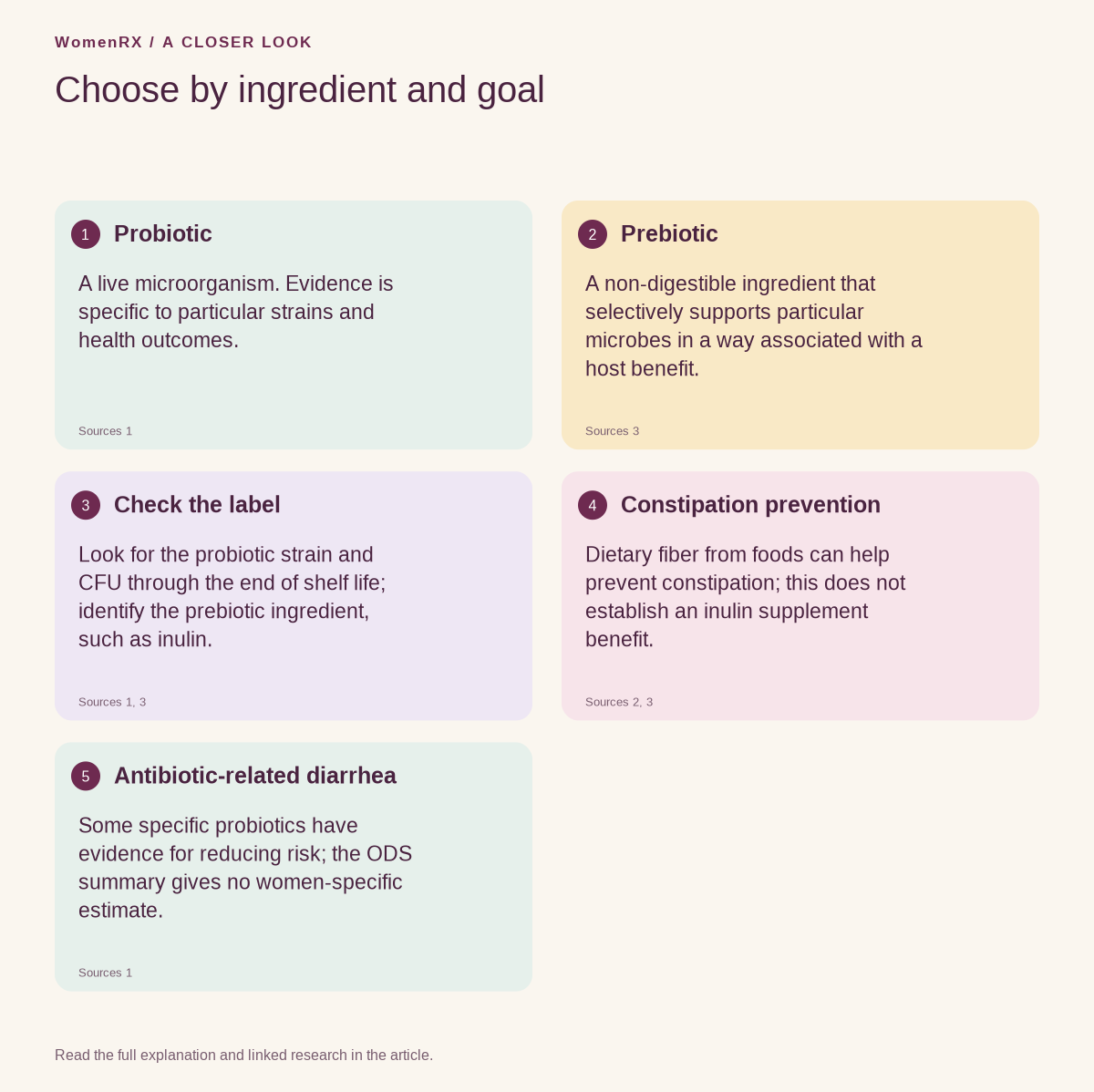
Choose by ingredient and goal
Probiotic: A live microorganism. Evidence is specific to particular strains and health outcomes.1
Prebiotic: A non-digestible ingredient that selectively supports particular microbes in a way associated with a host benefit.3
Check the label: Look for the probiotic strain and CFU through the end of shelf life; identify the prebiotic ingredient, such as inulin.13
Constipation prevention: Dietary fiber from foods can help prevent constipation; this does not establish an inulin supplement benefit.23
Antibiotic-related diarrhea: Some specific probiotics have evidence for reducing risk; the ODS summary gives no women-specific estimate.1
Read the figure as text
The product category alone doesn’t predict a benefit. Match the ingredient to a specific outcome and check what the label actually tells you.- Probiotic: A live microorganism. Evidence is specific to particular strains and health outcomes.1
- Prebiotic: A non-digestible ingredient that selectively supports particular microbes in a way associated with a host benefit.3
- Check the label: Look for the probiotic strain and CFU through the end of shelf life; identify the prebiotic ingredient, such as inulin.13
- Constipation prevention: Dietary fiber from foods can help prevent constipation; this does not establish an inulin supplement benefit.23
- Antibiotic-related diarrhea: Some specific probiotics have evidence for reducing risk; the ODS summary gives no women-specific estimate.1
More questions, answered
Are probiotics and prebiotics the same as fiber?
No. Fiber is a broad category of plant carbohydrate. Some fibers, such as inulin, can act as prebiotics by selectively supporting particular gut microbes in a way associated with a host benefit, but not every fiber is a prebiotic. Probiotics are live microorganisms, not fiber. 1 2 3
Does a higher CFU count mean a probiotic is better?
Not necessarily. The number of viable organisms is useful label information, but NIH’s Office of Dietary Supplements notes that a higher CFU count doesn’t by itself mean greater effectiveness. The strain and the health goal matter too. 1
Sources you can check
- Probiotics - Health Professional Fact SheetAccessed 2026-09-25Return to first citation
- Dietary Fiber: MedlinePlusAccessed 2026-09-25Return to first citation
- Gut microbiota in acute lung injury/acute respiratory distress syndrome: mechanistic insights and therapeutic opportunities via the gut-lung axis.Zeng L, Xue B, Ren X, Gong S, Yan J. · Frontiers in cellular and infection microbiology · 2026Return to first citation