Saffron Supplements: Side Effects and Safety Checks
Saffron supplements are usually tolerated in studies, but stomach symptoms, unclear extract strength, medicines, and pregnancy or breastfeeding are good reasons to check before using one.
Human studies most often report mild digestive problems with saffron, though nausea, dry mouth, reduced appetite, and headache have also been reported. 3 4 Supplement extracts and powders are not automatically comparable to saffron used as a spice. Check the exact preparation and amount, and ask a pharmacist about medicines, especially blood thinners, because interaction evidence is limited. 3 Get individualized advice before using supplements during pregnancy or breastfeeding. Pregnancy evidence is limited, and the breastfeeding concern includes findings from mice that cannot establish effects in human infants. 1 2
What side effects have been reported?
In a systematic review of human saffron studies, digestive problems were the most frequently reported side effects and were usually mild and self-limiting. Another review of clinical-trial meta-analyses listed nausea, dry mouth, poor appetite, and headache among commonly reported effects. These reports describe what happened during studies; they don’t predict exactly how you’ll respond. 3 4
One systematic review included 102 clinical trials and a single case report, and estimated the incidence of adverse events at around 17.5%. That figure comes from studies with varied preparations and conditions, so it isn’t a personal risk estimate or a women-specific rate. The review also cautioned that higher medicinal use or prolonged use may be associated with more significant adverse events. 3
Read the product details, not just the milligrams
Saffron used as a spice and a concentrated supplement are different kinds of exposure. Human safety studies have used preparations including stigma powder and extracts; their findings don’t provide a dependable conversion between a supplement’s milligrams and the amount of saffron in food. 3
Before buying or using a product, check whether the label identifies the plant part, whether it’s a powder or extract, and how much of that preparation it contains. If the amount or preparation is unclear, or the label uses a blend without saying how much saffron it contains, ask a pharmacist whether the product can be assessed. A milligram amount alone may not make two different preparations comparable.
Ask about medicines and your health context
The human safety review identifies drug interactions, particularly possible interactions involving anticoagulants (blood thinners), as an area where reliable data are lacking. That is a reason to have a pharmacist review your medication list, not proof that saffron is known to interact with every blood thinner. Mention other supplements too, since the product and combination matter. 3
A check is especially useful if you take an anticoagulant, use several medicines or supplements, or are considering regular or prolonged use. Bring the product label or a clear photo of it so the pharmacist can see the preparation and amount.
Pregnancy and breastfeeding call for individual advice
Don’t assume that a supplement is safe in pregnancy because saffron is used in food. A review of pregnancy evidence describes possible labor-related effects and reports concerns about uterine stimulation and miscarriage risk with higher exposure, while concluding that the evidence is too limited for clinical recommendations. Talk with your obstetric care team before using a saffron supplement, rather than trying to choose a dose yourself. 1
For breastfeeding, a study in nursing mice found kidney changes in the offspring after the mothers received saffron. Animal findings cannot establish either safety or harm for a human infant, so ask your clinician or pharmacist before taking a concentrated product while breastfeeding. 2
A practical decision path
If the product’s contents are unclear, start with its label and ask a pharmacist whether there’s enough information to assess it. If you take medicines, especially a blood thinner, or are pregnant or breastfeeding, have the specific product reviewed before using it. If nausea or stomach upset appears after starting a supplement, ask a pharmacist whether continuing makes sense; the timing alone doesn’t prove saffron caused it. 1 2 3 4
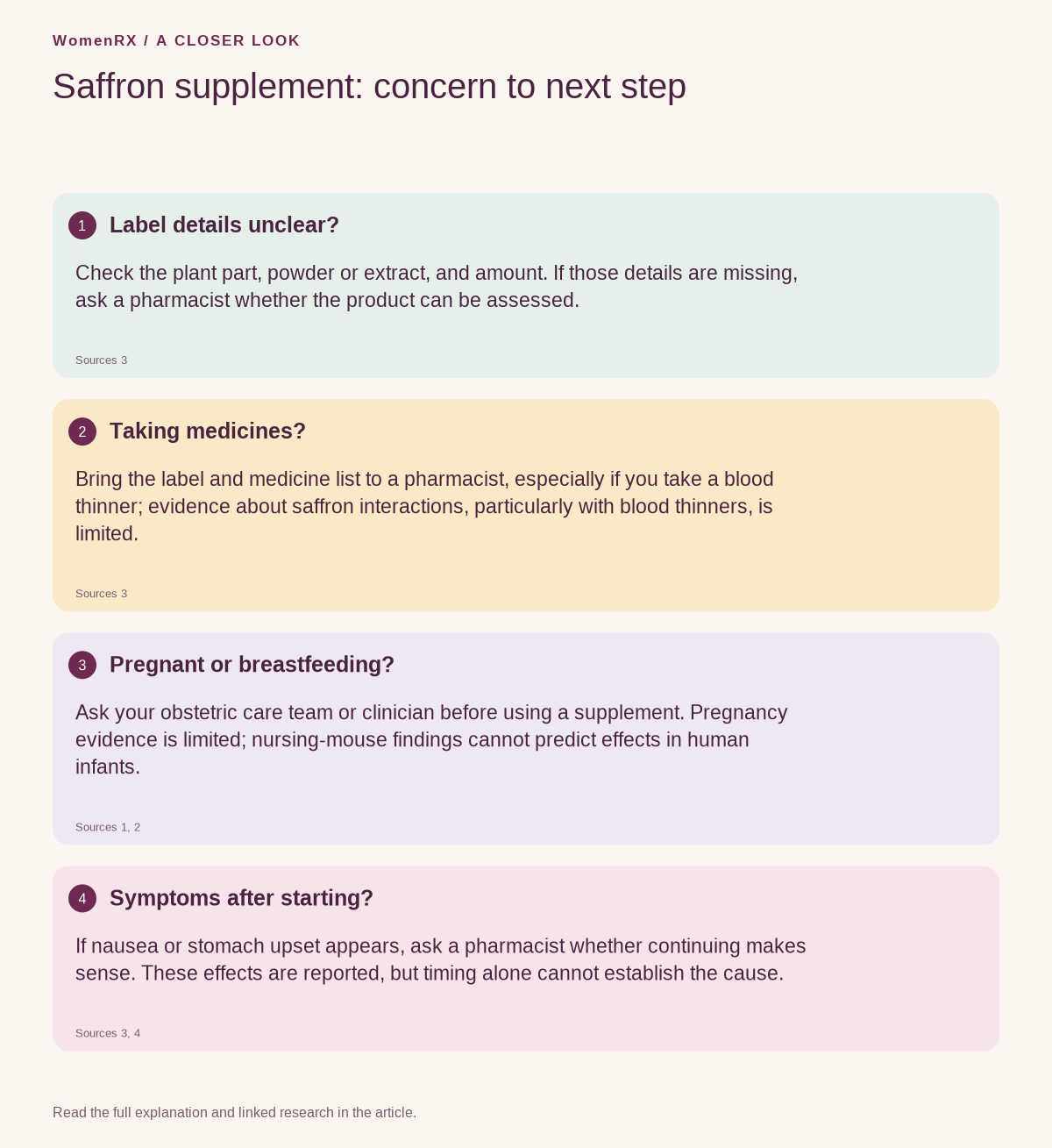
Saffron supplement: concern to next step
Label details unclear?: Check the plant part, powder or extract, and amount. If those details are missing, ask a pharmacist whether the product can be assessed.3
Taking medicines?: Bring the label and medicine list to a pharmacist, especially if you take a blood thinner; evidence about saffron interactions, particularly with blood thinners, is limited.3
Pregnant or breastfeeding?: Ask your obstetric care team or clinician before using a supplement. Pregnancy evidence is limited; nursing-mouse findings cannot predict effects in human infants.12
Symptoms after starting?: If nausea or stomach upset appears, ask a pharmacist whether continuing makes sense. These effects are reported, but timing alone cannot establish the cause.34
Read the figure as text
Find the concern that fits your situation, then use the corresponding check. These are conversation prompts, not a way to judge a product safe.- Label details unclear?: Check the plant part, powder or extract, and amount. If those details are missing, ask a pharmacist whether the product can be assessed.3
- Taking medicines?: Bring the label and medicine list to a pharmacist, especially if you take a blood thinner; evidence about saffron interactions, particularly with blood thinners, is limited.3
- Pregnant or breastfeeding?: Ask your obstetric care team or clinician before using a supplement. Pregnancy evidence is limited; nursing-mouse findings cannot predict effects in human infants.12
- Symptoms after starting?: If nausea or stomach upset appears, ask a pharmacist whether continuing makes sense. These effects are reported, but timing alone cannot establish the cause.34
More questions, answered
Does a “natural” label mean saffron is risk-free?
No. Human studies generally describe saffron as tolerated, but they also report side effects, and the safety review notes uncertainty around higher or prolonged medicinal use. 3
Is saffron known to interact with blood thinners?
The available review describes interaction evidence, especially for anticoagulants, as insufficient. That doesn’t establish a specific interaction, but it makes a pharmacist check sensible before combining them. 3
Sources you can check
- Saffron and Pregnancy: Cultural Practices, Beliefs, and Safety Evidence: An Integrative Review.Alshdefat A, Ayed A, Aqtam I, Ibitoye O, Vincent S, Furqani AA. · Journal of evidence-based integrative medicine · 2026Return to first citation
- Nephrotoxicity and hepatotoxicity evaluation of Crocus sativus stigmas in neonates of nursing mice.Bahmani M, Rafieian M, Baradaran A, Rafieian S, Rafieian-Kopaei M, Rafieian-Kopaei M. · Journal of nephropathology · 2014Return to first citation
- Adverse Events of Saffron (Crocus sativus L.): Systematic Review of Current Evidence.Hasheminasab FS, Hajimonfarednejad M, Najibi SM, Hashempur MH. · Health science reports · 2026Return to first citation
- Saffron (Crocus sativus L.) and health outcomes: a meta-research review of meta-analyses and an evidence mapping study.Lu C, Ke L, Li J, Zhao H, Lu T, Mentis AFA, Wang Y, Wang Z, Polissiou MG, Tang L, Tang H, Yang K. · Phytomedicine : international journal of phytotherapy and phytopharmacology · 2021Return to first citation